Illustrations and the Creative Process
September 22, 2015
I have, I think, over a thousand sketches, drawings and paintings of the various scenes and characters in my books. I love commissioning artwork–it’s a bit of an addiction, I think. When I was a kid I loved all the illustrations in my Chronicles of Narnia books. I’d stare at the pictures by British artist Pauline Baynes for hours. Baynes also illustrated JRR Tolkien’s Farmer Giles of Ham, which I also loved.

A manga painting of Sygillis of Metatron by Bea Kimera
I swore if I ever managed to collect the crazy ideas in my head into an actual book I’d have it plastered with illustrations.
Flash forward about thirty years. I made good on my promise. With an average of twenty-five maps and illustrations per book, I’ve got over 200 in print and counting.
A Picture is worth … a thousand less words.
The practice of adding illustrations to the interior of books seems to have vanished in modern times. When folks pick up my books to have a look at them, they almost always fan through the pages–what are they looking for?? Most books don’t have anything but printing in the interior and checking the pages for them usually comes up with nothing. But, imagine their surprise when they flip through my books and come to a page with a beautiful illustration. It’s a genuine moment.
Illustrations are also helpful when you’re dealing with a fantastic, completely made-up world like what I write. You have to describe everything, and that can derail the plot. Modern readers don’t like that, plot is very important Instead of spending a couple thousand words going over one of my whacky creations, why not toss in a cool picture and go a little lighter on the descriptions?

Princess Marilith of Xandarr, by Carol Phillips
A Creative Symbiosis
I usually give my artists a lot of freedom when they create an illustration. Some authors can be quite exacting in what they expect, me, I’m easy. I rather enjoy seeing how the artist interprets the subject. If I see something I really like, I’ll often add it into the writing, it’s only natural to do so.
Take this image of Princess Marilith of Xandarr by Carol Phillips. This is one of the first commissions I got from Carol, going all the way back to Book 1. As you can see, it’s a nude. I don’t recall asking Carol for a nude. Princess Marilith is an angry, spurned, blue-haired woman, heartbroken and vengeful. However, my early visualizations of her were fully clothed. Carol’s painting of her captured those various feelings–you can see how upset she is in her painted face. Her unexpectedly nude body is strong and beautiful. I was captivated by what I saw. Inspired, I went through and re-wrote the Princess, making her essentially nude in the story. She comes from Xandarr, a very hot and dry place, so it seemed to follow. Wearing only light veils or nothing at all, daring you to look her in the eye, has been her trademark ever since.

An early painting of Professor Hannah-Ben Shurlamp, by Eve Ventrue
Revving-Up my Creative Process
I usually come up with an idea or a character years before they actually appear on the page. Typically, as the image clarifies in my head, I get all excited and commission a drawing of it. Seeing the finished artwork gets me going every time and influences what happens in the books.
Take Hannah-Ben Shurlamp, EVoR. I was sitting at a Burger King several years back when I came up with a foil and opposite number for The Professor–Lt Kilos’ brainy husband. I imagined a tall, rather swarthy woman dressed all in white, her skin powdered to pearly perfection, her raven hair tucked up into a large white wig. I immediately sent a note to my friend, the amazing Eve Ventrue, gave her the details and waited a week or two to see the results.
Eve came up with Hannah-Ben sitting in an opulent padded study. As usual, I incorporated her study into the writing, the image of Professor Shurlamp sitting in her fine red room is her standard calling card.
That first painting of Hannah-Ben was stunning, she was beautiful, but I thought she was missing a little something. She was too demure, too unassuming. Professor Shurlamp is anything but unassuming–everything she does is big and bold and in-your-face.

Professor Hannah-Ben Shurlamp as a mile-high hologram on the planet Eng (Carol Phillips)
Not enough wig, not enough eyebrow and piercing stare. I wanted something beautiful, yet sort of horrible as well, rather like Gerald Scarfe’s work on Pink Floyd’s The Wall. Just like that. I wanted something cool, but a little creepy.
Enter Carol Phillips, the Queen of the League of Elder who has contributed probably 40% of my massive art inventory. Carol went to work and produced the second painting of Hannah-Ben.
Working with Carol for so long, she is often able to pop my head open, pull out the mess that’s inside and paint beautiful things with it. The painting Carol created of Professor Shurlamp was absolutely perfect. She was a mile high, she had the wig, the eyebrow, the “You are nothing to me” expression … everything was perfect. Even her snowy white gown was perfect–look at the frills, the buttons, the tight waistline and the bows. So many bows …
Seeing this thrilling painting gave me the added “oomph!” to finish The Shadow tech Goddess, a tome that had taken me four years to write.

Hannah-Ben Shurlamp, by Carol Phillips
And then came Stenibelle, another book where Hannah-Ben Shurlamp makes a notable appearance.
I wanted another image of Hannah-Ben for the book, I thought it would be a nice touch, and this time, Carol came up with a true masterpiece–the ultimate image of Professor Shurlamp holding her Glyph with scores of data orbiting her head. This image gave me chills when I first saw it (really–no kidding!!)
Seeing that giant wig, those curls, that glyph-wand in her hand helped me figure out the various twists and turns in the story that had been giving me a few minor fits.
So, when in doubt, get a piece of artwork and let it fire your imagination, you’ll be glad you did.
Copyright 2015, Ren Garcia, Carol Phillips and Eve Ventrue
The League and Fake Sciences
September 7, 2015
Over nine books, I’ve introduced a number of sciences delving into all sorts of odd things. Of course, I’m not a scientist, and therefore, all the sciences I introduce are pure fantasy. As they are fantasy, I don’t hesitate to make these made-up sciences as bizarre and off the chain as I can.
Here they are in no particular order:
GYNOLOGY:

Lady Vendra of Cone, who spent time in a convent on Carina 7, was a suspected Gynologist. (Eve Ventrue)
The science of maiming, enslaving and killing men is practiced on the dark, remote world of Carina 7. The ladies inhabiting Carina 7 are the descendants of the haremites of the Emperor King of Ming-Moorland. After centuries of being tormented by the Emperor, the ladies of Carina decided to turn the tables to some extent and created a whole science dedicated to enslaving, fighting and killing men. Any lone man who happened to make his way to the stony surface of Carina often found himself an unwilling victim and test subject as they refined their techniques.
Eventually, Gynology became a well-honed and proved science. A trained Gynologist, armed with a host of man-killing weapons, could effectively control men using various scents and an insidious device known as “The Barb”. A “Barbed” male would be enthralled to the Gynologist for the rest of his life, however long that lasted.
The Sisterhood of Light took a secretive interest in Gynology and managed to replicate some of its various tenets. What the Sisters do with this incorporated knowledge is currently unknown.
ANTHECARY:
Anthecary is a mind/body enhancement technique practiced on Onaris, particularly in the south Calverland region. Onaris’ majestic Lone Rider Mountain is the home of the Stoutback, a huge, six-legged lizard the locals have (somewhat) domesticated. Those herding the creature, known as Stoutback Shepherds, must do so in the near vertical pastures dotting the mountain’s face. Unable to afford technology to assist them in getting around in this grueling and dangerous environment, the shepherds developed a mind technique called Anthecary which would allow them to “stick” to the vertical surface of the mountain using their minds. Anthecary also “hardens” their bodies, allowing them to stand upright without having to brace themselves. When the League Stellar Marines adopted the giant S/K pistol as their standard-issue firearm, they adopted the use of Anthecary to combat the deadly recoil of the weapon. “Hardened” in an Anthecary state, the S/K can be safely and accurately fired.
CABALISM:
Xaphan Cabalism is a veritable mixed-bag of herbology, home-remedies, quack medicine, folklore, arcane investigation, machine science and religion all rolled into one. Cabalism was the Xaphans answer to the Hospitalers in the League, attempted to treat wounds and other medical maladies using pieced-together knowledge from various sources. Though rightly considered to be horrendous quacks and frauds, the Cabalists did managed to gather some practical knowledge, primarily through seducing and or abducting Hospitalers.
MENTRALYSIS:
In the burgeoning field of communicating with unconscious and comatose persons, Mentralysis is in the forefront. Using sophisticated computerized devices known as Mentralysis Decks, one may speak with a sleeping or comatose person as if they were awake. The Gold Coast of Hoban is the home and major research center of Mentralysis.
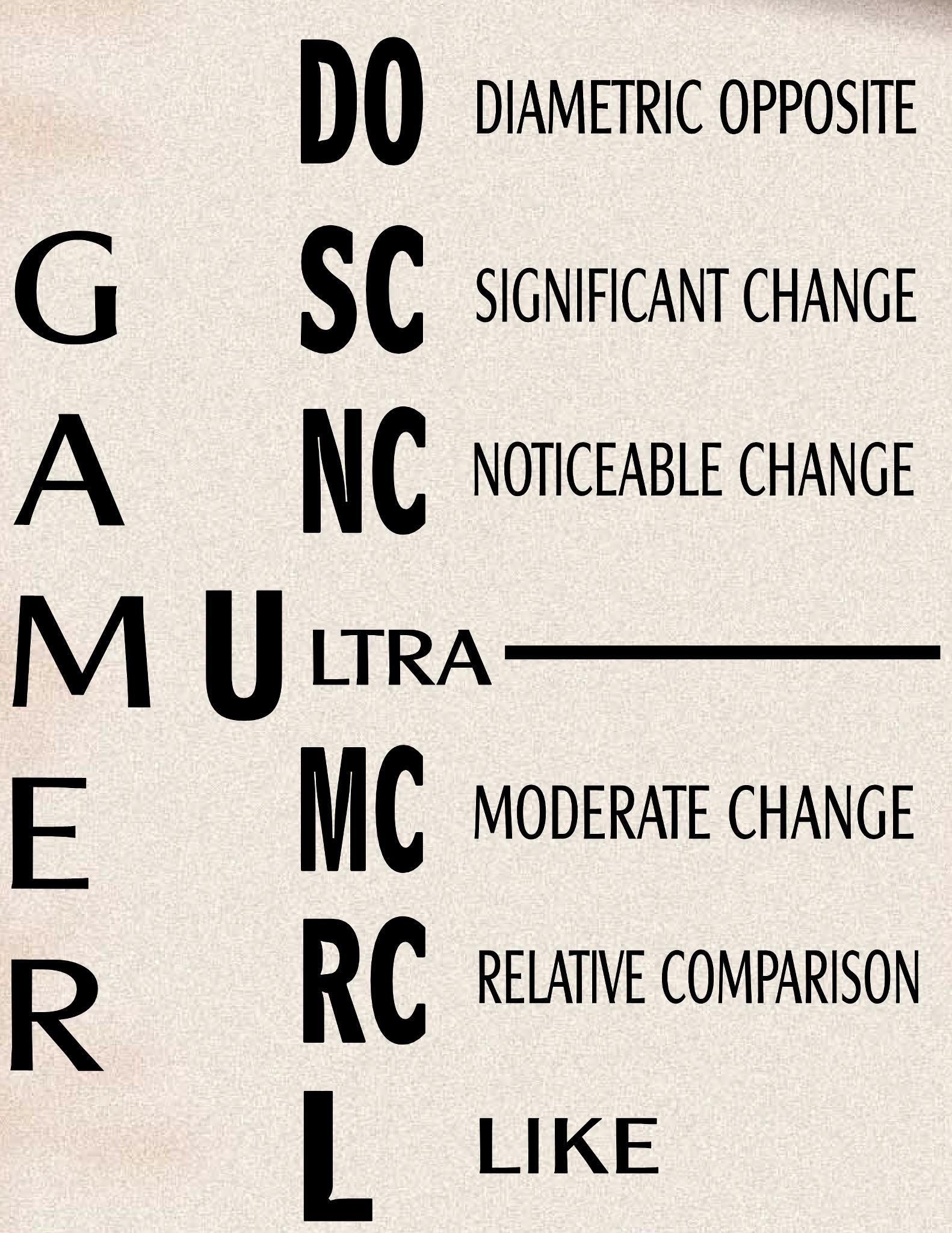
Mentralysis Archetype chart.
A major breakthrough with this science came when it was discovered that within all people is a Sleeping Self (SS) which takes control while asleep. The SS has a unique and independent personality, and may be very similar to the Waking Self (WS) or may be radically different. Mentralysists, through analysis, have determined there are seven types of Archetypical people, depending on how different the SS is from the WS.
Mentralysists have determined that various neurosis due to incompatibility between the WS and the SS can be treated, and oftentimes cured, using Mentralysis techniques.
CYBERLITICA:
Given the fact the League is full of people with an excess of spare time, a number of novel fads have come and gone through the years. One fad that took hold and has continued to grow is Cyberlitica, where one fabricates a completely different persona of either a fictitious person or, in some cases, of themselves. Using Cyberlitica, the fabricated “Changling” has a birth-date, public records of their passing, receipts, diplomas from various universities, have taken husbands or wives, and may have criminal records. The overriding goal of Cyberlitica is to create a completely convincing persona. If a Changling happens to make the posts, that is an added benefit. One man, a Lord Sharper of Stillville, divorced his wife after he learned most if not all of her glamorous wealth and exploits were fabricated via Cyberlitica. The Sisterhood of Light doggedly investigates Cyberlitica, and those who have been found to have created a Changling face heavy fines and or imprisonment.
BONDARISM:
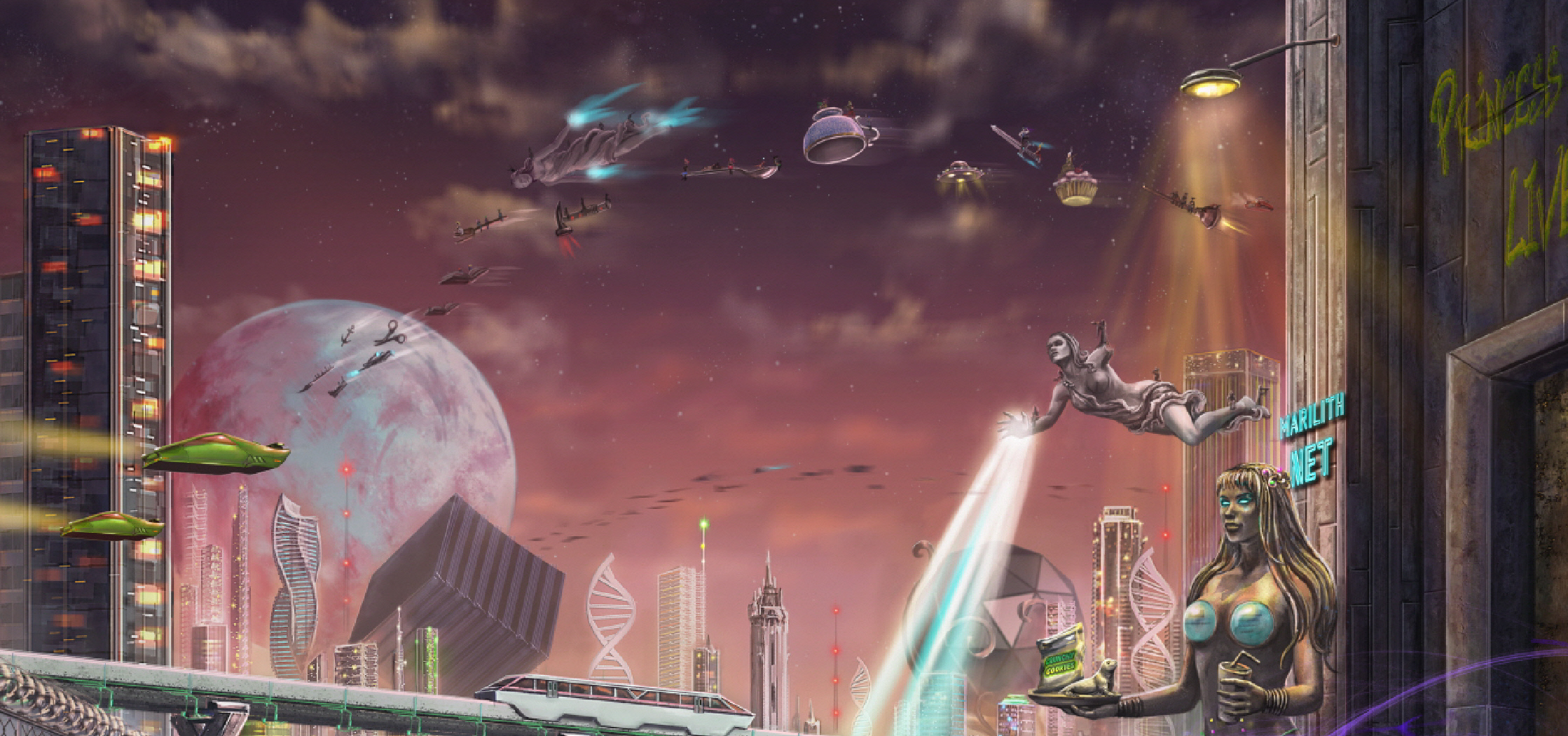
The city of Waam with an assortment of Bondar-inspired vehicles moving across the sky (Carol Phillips)
Never underestimate the Xaphans for coming up with crazy sciences. Bondarism, practiced in the city of Waam, is no exception. Bondarism is the notion that the human body can experience accelerated evolution if the body is rigorously stressed by placing it into unusual and uncomfortable situations. Buildings and various vehicles built with Bondarism in mind, have little to no ergonomic considerations, are suicidally unsafe and are impractical in the extreme. However, the people of Waam do appear to exhibit a number of advanced abilities, including the ability to fly and walk up walls. Perhaps there is something to Bondarism after all.
TA (Time Apparent)
TA is a form of Time Travel being studied by the Hospitalers. Time travel is a very difficult thing to achieve, though the mechanics of it are fairly well understood. Temporal Gravity (TG) is the most difficult aspect to overcome, as your TG ceaselessly attempts to pull you back into your proper place in time. Perception is also a very confounding thing to deal with, as time travelers will “forget” what they’ve come to do. (A legendary machine is said to have overcome all these problems, though its existence is in dispute)
An odd solution to the various issues with time travel is called Time Apparent by the Hospitalers. With TA, instead of sending your physical body ahead in time, only one’s consciousness goes. Once in the future, your consciousness will inhabit your body, in whatever condition your body happens to be in. You could appear as an animated corpse, a skeleton, a cloud of dust, or, in some cases, as a group of people if your material has been reincorporated into new life forms.
TA is only effective going forward from your apparent place in time. It has yet to be approved for general use by the Sisterhood of Light.
copyright 2015, Ren Garcia
The House of Bloodstein
July 22, 2015
Riding fast on the heels of Book 9, Stenibelle is Book 10: The House of Bloodstein. It is comprised of two volumes: the first being Perlamum, and the second Mentralysis.

Cover mockup for the House of Bloodstein, volume 1 (artwork and lettering by Carol Phillips)
ZOMBIES AND DRAGONS AND GODS, OH MY …
I wrote the Bloodstein books to be fun, to be exciting. I tormented my imagination until truly weird and amazing things popped out of my head. Using the previously introduced House of Blanchefort characters, we embark on a journey across the League and beyond.
In the past, I’ve tried to avoid monsters that have been covered by other authors–vampires, witches, werewolves, etc. I was also going to avoid zombies--too over-done, too formulaic. But then I had a bright idea–I figured out a way to use zombies that hasn’t been tried before, so you’ll find the zombies in The House of Bloodstein as breath of fresh air–dead air.
I also decided to tackle everybody’s favorite fantasy monster: dragons. Again–I never do the expected and well-trodden, if I’m going to have a dragon, it’s going to be a weird dragon. ‘Nuff said.
Here’s the current blurb for Volume 1:
THE HOUSE OF BLOODSTEIN: PERLAMUM
Mysterious and elusive, Lady Chrysania of Bloodstein calls from the ruins of her castle. She dwells in the dark, hiding her face, ravaged by an ancient curse. The only way to break the curse is to win a game called Perlamum. If she loses, she dies. She looks to her Vith kin in the west, begging for help acquiring the all-important pieces she needs to play the game.
Lord Kabyl of Blanchefort, his Ne-Countess Sammidoran, and his cousins answer her call. However, collecting the Perlamum pieces for Lady Bloodstein is a deadly game. They must face a host of perils:
-The terrible Black Hat in the city of Waam, who knows their every move.
-A hated rival on the planet Xandarr and the bewildering labyrinth of Gods Temple.
-The man from Shook who cannot be killed.
-A family of vile bravos from the south, and, worst of all, the Dead Men of Mare, nigh invincible creatures straight from an insane nightmare.
To even the odds, Kay and Sam turn to a forgotten graveyard deep in the Telmus Grove, and the great eminence resting there.
Can Lady Chrysania of Bloodstein be helped, or, for that matter …
… can she be trusted?
The House of Bloodstein. Perlamum will be out September 2015 from Loconeal Publishing.
copyright 2015 Ren Garcia and Carol Phillips
Stenibelle and “The Tests”
July 11, 2015
The release of LoE Book 9: Stenibelle is here!! I’m very proud of the book and of the character in it, the first LoE book to feature a female main character–most of the previous books have been ensembles with strong male and female characters.
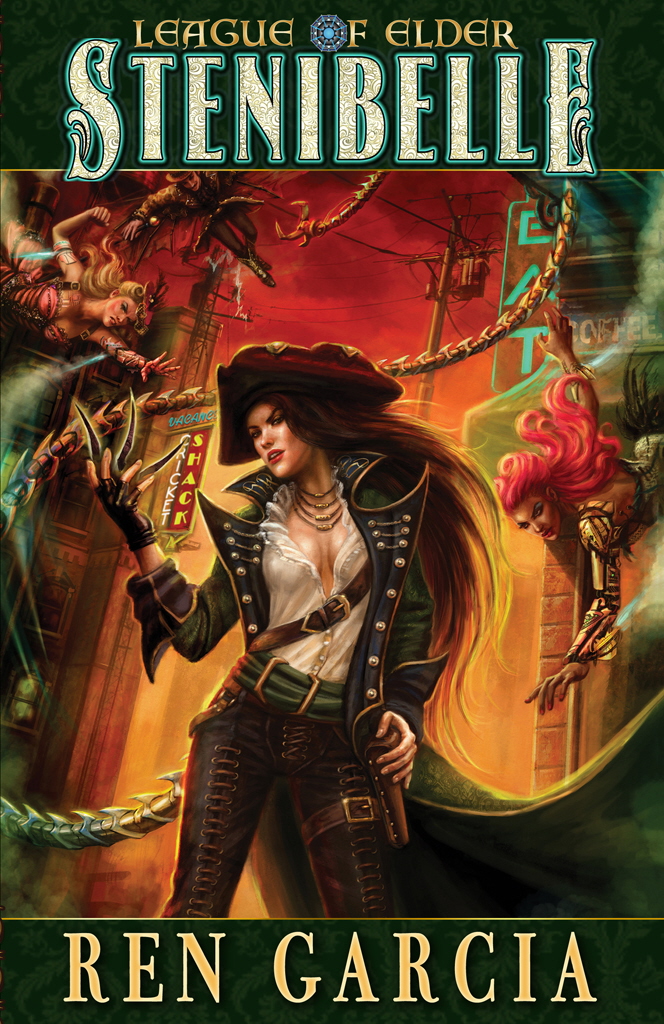
Stenibelle (Cover by Carol Phillips)
I’ve been asked if I think Stenibelle is a Feminist Book. I actually have no idea. The word “Feminist” has taken somewhat of a radical turn from the `60’s up till now. In the `60’s it meant a free, liberated woman, doing things previously considered to be “unlady-like” A `60’s feminist was probably a tomboy, or a hippie girl living in a VW van, smoking weed and wearing baggy clothes. She lived her life as she wanted, which might deviate from the established female model (chaste, married, motherhood, etc…).
Nowadays the word “Feminist” seems synonymous with “Feminazi“, a cold, opinionated, emotionally unavailable, agenda-ridden woman who hates all men. An invincible, man-killing war-machine bent on proving the superiority of the female gender. Obviously, such a character is a stereotype, and a polarizing one at that, setting both genders against each other.
STENIBELLE AND “THE TESTS”
I wrote Stenibelle to be a Female-Centric book, one that focused on the struggles of a female character without being political or polarizing. Stenibelle is not invincible, or perfect for that matter. She’s a flawed human being who starts out angry and unsure of herself, needing a healthy “kick-in-the-rear” to get pointed right. Stenibelle learns. She grows, she becomes more than what she was, as should be the case in any piece of fiction: the capacity to change.
So, what sort of a book is “Stenibelle”?
There are a number of tests out there, mostly aimed at judging women’s roles in films. We can apply these tests to Stenibelle, the book and see how she rates (Of course, this is me, the biased author judging the book. Read it for yourself and feel free to rebut if needed).
Bechdel Test
The Bechdel Test is a set of three simple and rather loose requirements designed to determine the role of women in a film.
- The movie has to have at least two women in it.
- The women must talk to each other.
- The women must talk about something besides men.
Given these rather vague requirements, Stenibelle easily passes the Bechdel Test. There are lots of females in the book, many more than just two. They have lengthy conversations with each other, and many of their conversations don’t involve men at all (of course, “talking about men” is a very nebulous factor. Are the women talking about a boyfriend? Are they talking about a man in the home or workplace? As there are only two genders, erasing 50% of them from a protracted conversation can be difficult if not impossible, forcing the conversation to be nothing more than “girl-talk” which opens a whole new can of worms. We’ll assume “talking about men” means discussing a boyfriend, husband or other love-related interest.)
The Russo Test
The Russo Test is a fairly new test designed to analyze the representation of LGBT characters in films. Inspired by the Bechdel test it’s named after film historian Vito Russo. It also has three loose criteria:
- The film contains a character that is identifiably lesbian, gay, bisexual, and/or transgender.
- The character must not be solely or predominantly defined by their sexual orientation or gender identity.
- The character must be tied into the plot in such a way that their removal would have a significant effect.
Without going into too much of the plot and the outcome of the story, Stenibelle passes the Russo Test, and it does so without being pushy, political or in any way agenda-driven.
The Mako Mori Test
Mako Mori was one of the lone female characters in the film Pacific Rim. Her depiction in the film has become the standard in giving a female a “fake, action-driven” role to play that fails the Bechdel Test. Again, the test has three basic criteria:
- At least one female character must be present
- The female gets her own narrative arc
- The female does not exist solely to supporting a man’s story.
Again, Stenibelle passes. Stenibelle is not there to simply support a secondary male character. This is her story. Without her, there would be nothing.
The “Sexy Lamp” Test
Comic book writer Kelly Sue De Connick created a somewhat tongue-in-cheek test judging the role of females in a story-arc. Essentially, if you can replace the female character with a lamp, blow-up doll, stirring stick or similar prop, would the story still fly??
Yes–you cannot replace Stenibelle with a cool lamp and have the story function. It would not–not at all. Moving on.
There is an additional test called the Finkbeiner Test dealing with the role of women in science. As Stenibelle is not a scientist (she’s actually more of a sorceress) this one really doesn’t apply.
So, that’s it. With Stenibelle, I wrote a human story dealing with a female in a tight spot. I tried to write it so that anybody, female or male, could get behind her and cheer. Pick it up–see if you agree.
Stenibelle will be available 7/24 from Loconeal Publishing.
copyright 2015, Ren Garcia
The House of Bloodstein
June 10, 2015
This fall, the League of Elder book 10, The House of Bloodstein (HOB) will be published. It’s the first of two HOB books, this one subtitled: Perlamum, and the second: Mentralysis. The second, already finished, will be out in 2016.

The House of Bloodstein cover. Painting by Carol Phillips
This little epic began life three years ago. Much as I dislike and complain about NaNoWriMo month as an unproductive and potentially destructive stunt, HOB was, at first, a NaNo project my friends talked into doing.
As with all my books, the finished product is nothing like what I started out with.
My initial thought was to explore the elusive and somewhat austere House of Bloodstein mentioned in previous books and learn a little more about them. The central plot point was a Perlamum tournament between Lady Chrysania of Bloodstein and a mysterious unknown opponent, possibly someone from Xaphan space.
PERLAMUM
In case you’re wondering, Perlamum is a board game rather like chess that is often played between two ladies with a high-stakes wager of some sort placed on the outcome. In a radical departure from chess, the contestants give their game pieces to a person known as the Gamesmaster, who then hides the pieces and sets the date the game is to be played. The pieces can be hidden literally anywhere. The contestants then must recover their pieces using clues left by the Gamesmaster. On the date of the game, the contestants play with what they have collected.
So, with that in mind, the original plot of the book was the courageous House of Blanchefort featuring Lord Kabyl, Lady Sammidoran, and their cousins Sarah and Phillip questing to recover the Perlamum pieces for Lady Chrysania. She then, like a scrappy little trooper, would play her game against incredible odds and come out on top in an inspirational display of the underdog winning out.
Blah!! It read like a bad ABC After School Special, and I wasn’t going to have it like that. I went to work on the story, pouring all the odd bits of my imagination into it, completely revamping the plot and the characters eventually coming up with enough material for two complete books.
No more After School Special.
As you can see from the cover, I think I out-did myself with original story-telling on this one. We’ll meet the Bloodsteins and trouble over their many secrets. We’ll head back to the city of Waam, first seen in Book 4 and stand in the presence of Wilhella Cormand-Grande, the Mad Black Hat of Waam. We’ll trade fists with the House of Wunderluck, bullies from the south, and face the horrid fury of the Dead Men of Mare.
It should be a ton of fun.
copyright 2015, Ren Garcia, Carol Phillips and Ewelina Dolzycka
S Characters: Melazarr of Caroline
April 8, 2015
Melazarr of Caroline is a frequent character in the various Shadow tech Goddess books. Her character varies wildly from one book to the next. She almost always dies in the books.
25th DAUGHTER OF WILHELMINA
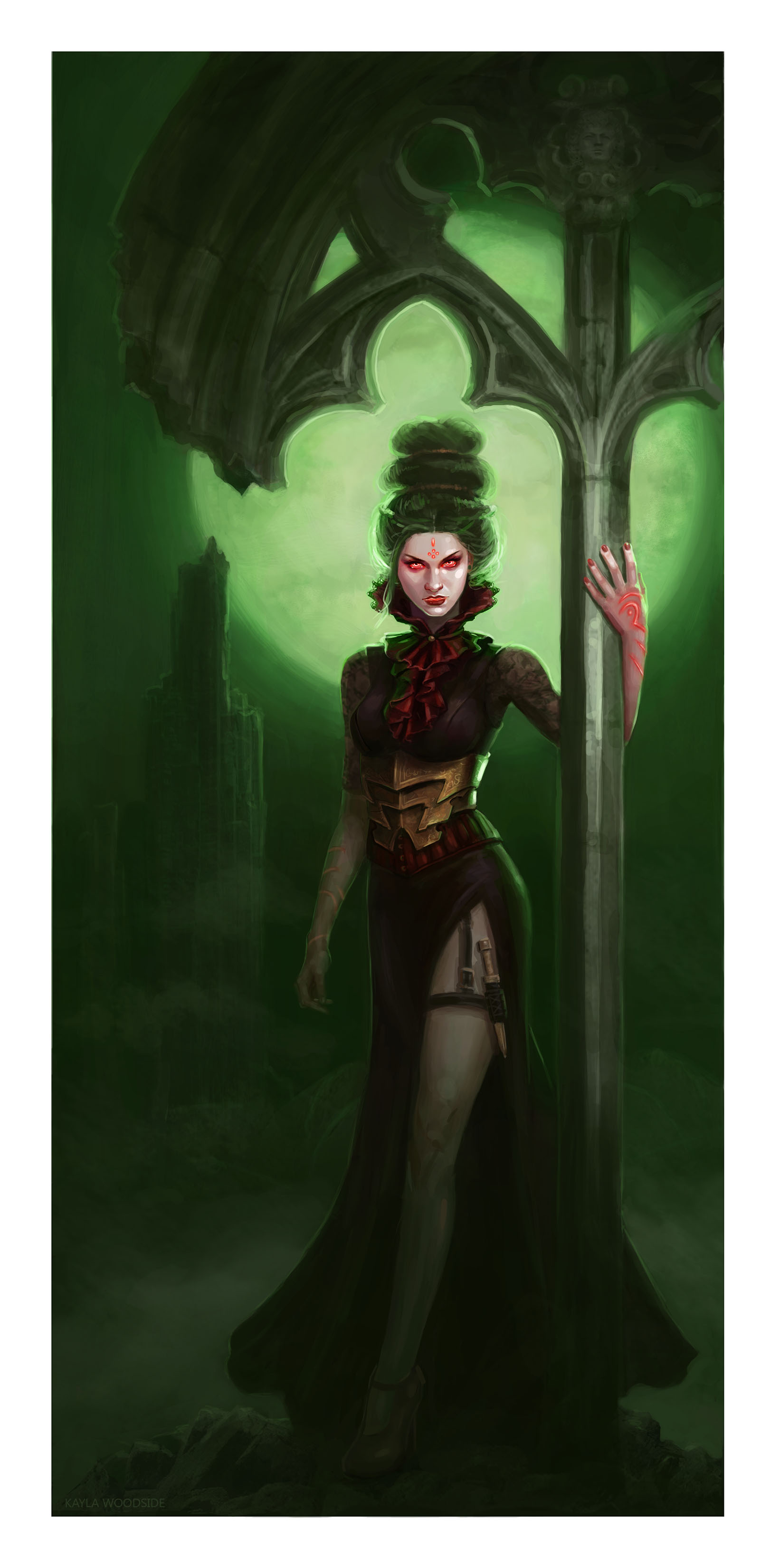
Melazarr of Caroline (painting by Kayla Woodside)
In all of the books, Melazarr’s lineage and general appearance are the same. She is an heiress of the Xaphan House of Caroline, born in the vast halls of Wilhelmina Castle. She is the 25th daughter of the current line. She has one father and ten mothers–the Carolines often indulge in the practice of gene-splicing to produce the most desirable of children. One genetic flag the Carolines always opt for is the potential for Arcane-Interface.
As familial giantism is common in the Carolines, Melazarr is a gigantic woman, standing 7’1 and weighing over 300 pounds of soild bone and muscle. She is typically very lank and skinny, hiding her impressive weight. Her hair is a fawnish-blonde color, though she often paints it green or blue.
She is a Tropist, skilled in creating sexual pleasure merely by touching non-erogenous parts of the body.
A MERTEN:
Melazarr is also always an Extra-Planar Entity known as a Merten. A Merten is a person who, for unknown reasons, carries important messages from the Universe. A Merten is never aware of carrying these messages, and, extracting them is most often fatal to the Merten. When in the presence of a person known as the Kaidar Gemain, a Merten will fall into a trance speak, sing, or draw out the message they carry. Others seeking the messages would have to extract them via sex, burning, torture or drowning. Mertens often die divulging the information they carry.

Melazarr, drugged and in a trance, is the Tropist of Rodrigo of Burgon (Painting by Carol Phillips)
CHANGEABLE PERSONALITY:
Melazarr’s mannerisms vary greatly from universe to universe.
A Harlot:
In some, she is incredibly shy and insecure in the Court of Wilhelmina amid all her rival sisters, hiding the fact by painting herself in make-up and wearing bolabungs designed to make her fierce and confident. All “bunged Up”, Melazarr presents herself as an outrageous and rather debauched woman, reveling in Xaphan society. Often finding herself in dangerous situation, the VERY MARY, a garter belt that teleports a Caroline maiden back to the ancient Ruins of Caroline on Kana when she finds herself in mortal peril. Melazarr has turned up in the Ruins a record 57 times.
A Bound Tropist
In others, she is a bound servant of the notorious Xaphan Warlord Rodrigo of Burgon. Rodrigo often keeps her drugged into a trance-like stupor and bound to his side by a Chastity Key that has been branded into her neck. With the Chastity Key in place, she cannot venture more than fifty feet from his side. Rodrigo sometimes treats her with kindness, despite keeping her drugged and insensate.
DYING:
Melazarr, no matter her situation, is often killed, either by those attempting to extract the information she carries within, or by accident, misadventure and poor circumstance.
 Melazarr of Caroline appears in the League of Elder Book 9: “Stenibelle”, coming soon from Loconeal Publishing.
copyright 2015, Ren Garcia, Carol Phillips and Kayla Woodside
HoB: The Autopyle
March 16, 2015
Lady Poe of Blanchefort had quite a dilemma on her hands. A Silver tech female of growing regard, Lady Poe had become famous in Vithland for her Silver tech familiars, that she could create from thin air in a matter of moments.
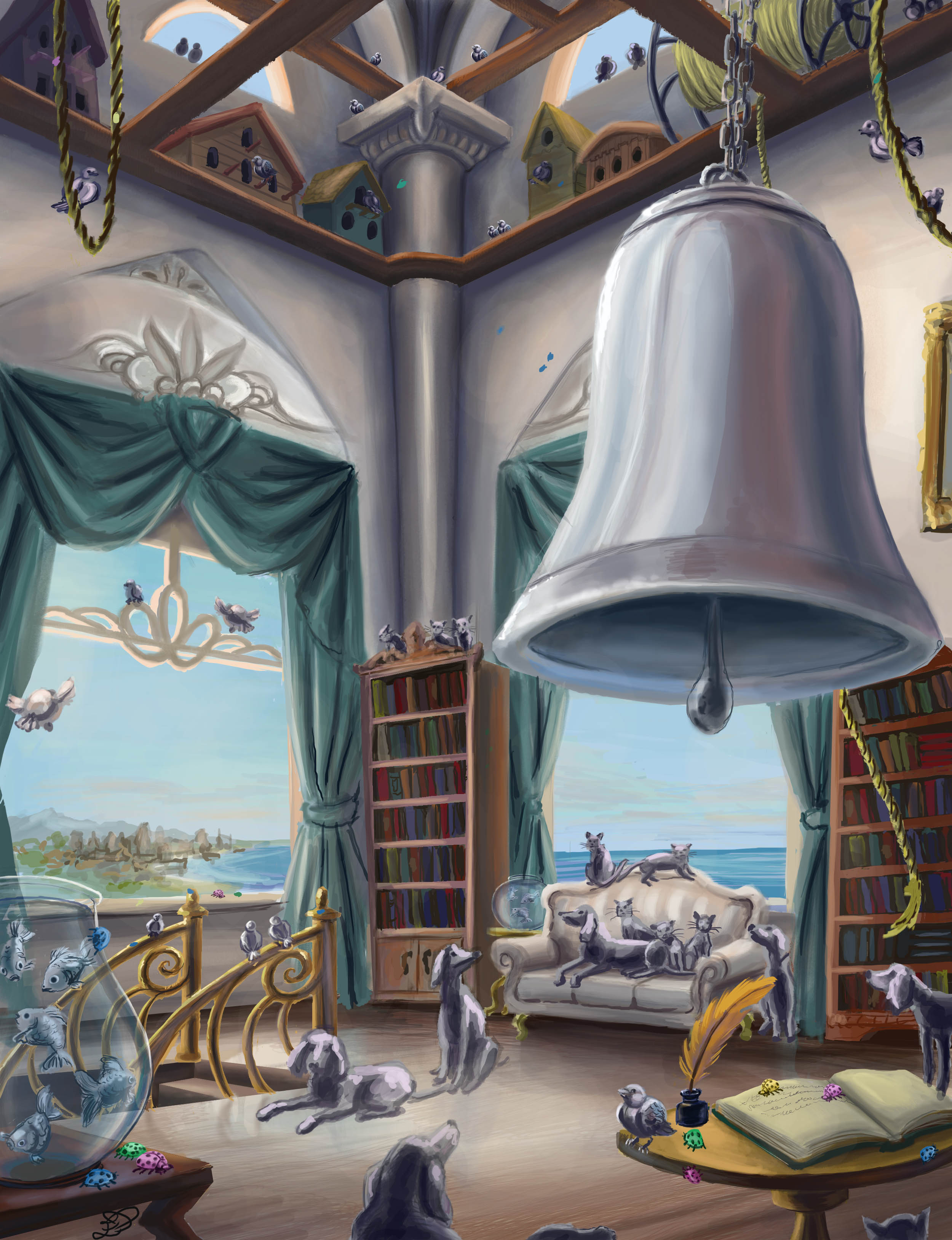
The Autopyle room overlooking the Bay of Bloodstein (painting by Ewelina Dolzycka)
She had a vast collection of them: Bark the hound dog that could act as a tireless extension of one’s eyes and ears, able to detect even cloaked persons. There was Shadow the cat that could uncover and destroy Shadow tech, Fins the fish that healed wounds and Whisper, the over-sized lady bug that could cloak one sight and sound.
Most popular of all was Tweeter, the little bird that could get one to where one needed to go without fail.
Lady Poe was always happy to create a familiar when one was needed, however, the demand for them became more than she could keep up with. She was a mother and busy tutor of the Blanchefort children after all, but she was the type of person who never wanted to let anybody down.
She tried creating a great number of her familiars to have on-hand for use in case one was wanted, however, the familiars only last for a week before they fade away into nothing and she’d have to start all over again.

Lady Poe of Blanchefort had no idea the trouble her Autopyle would create (Carol Phillips)
She needed a method to keep her familiars functioning for an indefinite period of time, that way she could always have a small flock of her creations around for any who needed one. She eventually came up with a very clever and seemingly harmless answer to the problem.
Lady Poe created a Silver tech device she called the Autopyle. As she wanted to use an abandoned bell tower in the western face of Castle Blanchefort to keep her familiars, she formed her Autopyle into the shape of a massive bell. The Autopyle transmitted vast amounts of energy, and, with it in place, her familiars would last indefinitely. She decorated the bell tower, sanding and staining the floors, painting the walls, adding artwork, bookcases, draperies and couches, all done up in her provincial taste. In the rafters she added bird houses for her Tweeters and branches for the Whispers to climb on. When somebody needed a familiar, all they needed do was come to the room and sign one out on her ledger so she would know what needed to be replenished. The room became very popular. It was considered very relaxing to go into the nicely decorated room and play with all the animals.
RUTHINKILN OF WAAM:
Lady Poe had little idea the trouble her Autopyle creation would cause. Word eventually got out of the wondrous Silver tech creation Lay Poe had invented. Its news made it all the way into Xaphan space and into the ears of Ruthinkiln of Waam, a foul Black Hat and sister of the long lost Ethylrelda of Waam. With such a wondrous device, Ruthinkiln could create Shadow tech monsters the League had never seen before, and, on no less than ten separate occasions, she attempted to infiltrate Castle Blanchefort with her Spectre henchmen, the Drunes. Their intent was to steal the Autopyle and take it back to Xaphan space where its secrets could be unveiled.
Fortunately, all of Ruthinkiln’s infiltration efforts were detected and quashed. Lady Poe’s daughter, Millie, and Sebastian, son of Magistrate Kilos, made protecting the Autopyle room their personal quest as they grew into adults.
copyright 2015, Ren Garcia, Ewelina Dolzycka and Carol Phillips
Book 9 “Stenibelle”: Out of the Darkness
March 11, 2015

Front Cover of LoE Book 9 (artwork by Carol Phillips)
It doesn’t happen too often, especially in my case, but on select occasions your own characters can jump up off the page and surprise the heck out of you.
Such was the case with Stenibelle, a character I dreamed up on a lark.
OUT FROM THE DARKNESS:
I was working on The Shadow tech Goddess, a tale dealing with alternate universes and Extra-Planar Entities. Our hero, Paymaster Stenstrom, Lord of Belmont-South Tyrol, had been informed that there are many Wvulgroms. alternate versions of himself running around, all somewhat similar to himself but undeniably different–such is the basis of the entire Shadow tech Goddess storyline. It’s not an unfamiliar concept, we’ve seen it before in various media: fiction, TV, comics, films (the Star Trek episode “Mirror, Mirror” immediately comes to mind). In many cases, these “alternate entities” are a study in opposites: good vs evil, chaste vs immoral, that sort of thing. In my case I wanted these Wvulgroms (qv=alternate entities) to be merely a product of their circumstance. They can be very different from the character we’ve come to know, or, they might be very similar, it all depends.

Back cover of LoE Book 9, featuring the irascible Hannah-Ben Shurlamp, EVoR (Painting by Carol Phillips)
In the case of the Shadow tech Goddess saga, eight different versions of Paymaster Stenstrom are involved. They all have similar experiences: they all served as paymaster aboard the Fleet ship Seeker for Captain Davage, and they all bought the captain’s chair of the Seeker later on. They all had various levels of failure/success in the Seeker Affair, as it was known. Some had no trouble at all securing the Seeker’s chair, some had a bit of rough sledding, others failed spectacularly. One was imprisoned, one was enslaved in a sex pit, and one was killed.
At the end of Book 8, all of these various alternate versions are brought together in the smothering darkness of the Shrine of Boraster on the Planet Eng and sorted out, each sent on their merry way.
As I wrote the final scene, each Wvulgrom was brought forth and presented to the central version of Paymaster Stenstrom–all of them tall and handsome.
And then the 3rd version was presented. As I wrote, my fingers worked the keys all by themselves. The third version presented was a small, comely woman. I had established earlier in the story that the Wvulgroms of Paymaster Stenstrom didn’t all have to be as is, they could be of differing race, of differing species, and, of differing gender. Such was the case here–the 3rd version was a woman named Stenibelle.
Lord A-Ram told him: “In another universe, you are a woman, and you would be most proud of her.”
So, that’s all I had, just an odd revelation that he, somewhere out in the universes, was a she.
STENIBELLE:
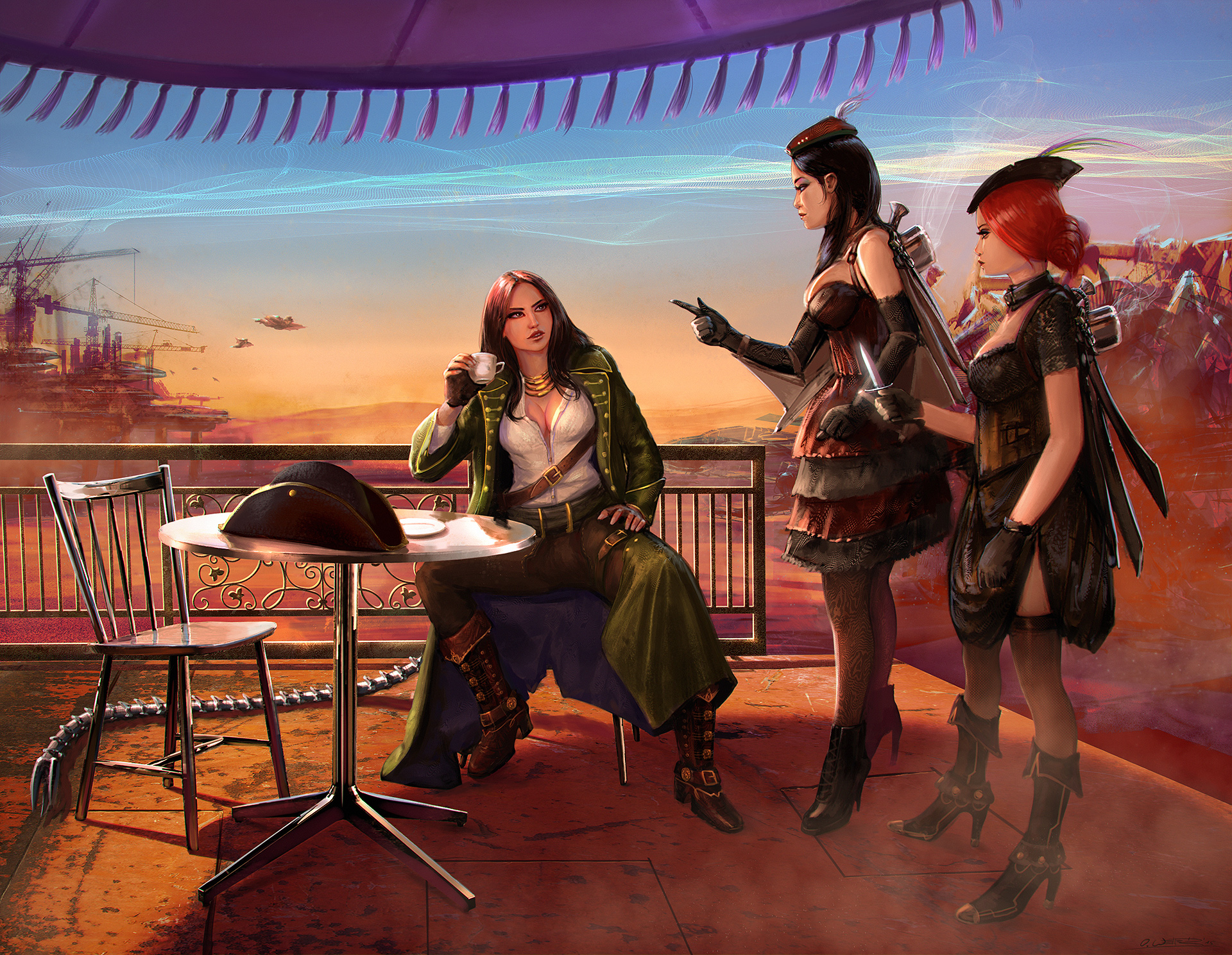
Stenibelle accosted by hookers on Hoffman Plate. (painting by Fantasio)
Shortly after I finished the first draft of the Shadow tech Goddess, I developed the idea of writing a series of smaller, shorter books detailing the activities of the alternate Stenstroms’ as pertaining to the main story. I started writing them all at once, but the one that stood out most in my head was Stenibelle, the female. I began writing a quaint story dealing with Stenibelle’s quest to discover the way to long lost Cammara, an abandoned home-world of the League lost for over 200,000 years. At first, Stenibelle had all of the “It Man” abilities the male versions of Paymaster Stenstrom have: super strength, invulnerability, flight via mind power, and so on. The only thing she couldn’t so was fire the NTH pistols, which require a male-hand to shoot. I wrote her as a demure, considerate woman doing her best for her House under bizarre circumstances.
I quickly got bored with her. Where was the growth? Where was the potential? I really didn’t see it. I put her down for a long time and moved onto other stories. I considered deleting her altogether.

Stenibelle, Lady of Belmont-South Tyrol (painting by Eve Ventrue)
Then, it occurred to me that I’d been doing Stenibelle a great disservice. There was no depth to her, no agency, no room for personal growth. I’d been treating her with kid gloves, and she, though she had a great deal of power, was essentially helpless, like a princess in a tower.
Time for the gloves to come off. Time for Stenibelle to face the world. I was going to lay her bare and watch her grow into something new–not a perfect person, mind you, not invincible, not a cold, gritty tent-pole character, but a human one, full of successes and failures, remorse and joy, frailty and determination, and the capacity to better herself and her House.
First, I removed all of Stenstrom’s It Man powers. She still possessed all of her skills in Tyrol Sorcery, the vanishing, the lock picking, all of that, but no more super strength, no more flying and TK’ing. I took away all of the vast sums of money Stenstrom has available to him and made her a pauper. I also stuck her in prison. I made her angry and unsure of herself. I put her under the sway of powerful people and I addicted her to personality-altering Bolabungs.
Through all of that, Stenibelle had to make do, had to overcome poverty and addiction, had to learn to stand up for herself in the face of powerful people, had to learn to trust and seek help when it was needed, and to come to terms with her own heart. The character that grew before me was quite a welcome surprise, becoming more whole and complete than I has first thought possible.
I put her through a lot, and the person she became is something anybody can relate to and cheer for.
That’s what I was hoping for all along.
League of Elder Book 9: Stenibelle will be available summer 2015 from Loconeal Publishing.
copyright 2015: Ren Garcia, Carol Phillips, Fantasio, and Eve Ventrue
HoB: The Dark Plants of Queen Ghome
March 2, 2015
Queen Ghome’s reign over the border world of Trimble was certainly memorable. Trimble was, traditionally, a quiet place ruled with a steady hand by the House of Sevarr. When the last of the Sevarrs, Queen Xo, died at a young age, her wife Queen Ghome took control, and very quickly, her fiery, tyrannical nature became evident.
Queen Ghome was an accomplished botanist. When she wasn’t murdering would-be lovers, starting wars on Xaphan worlds or killing off her own people by the thousands, she loved to relax in her bastion of the Garden of Zama and dream up new and exotic types of plants–most of which were either poisonous, carnivorous or contained a deadly property. Here are three of the most famous.
HORVATH CREEPER:
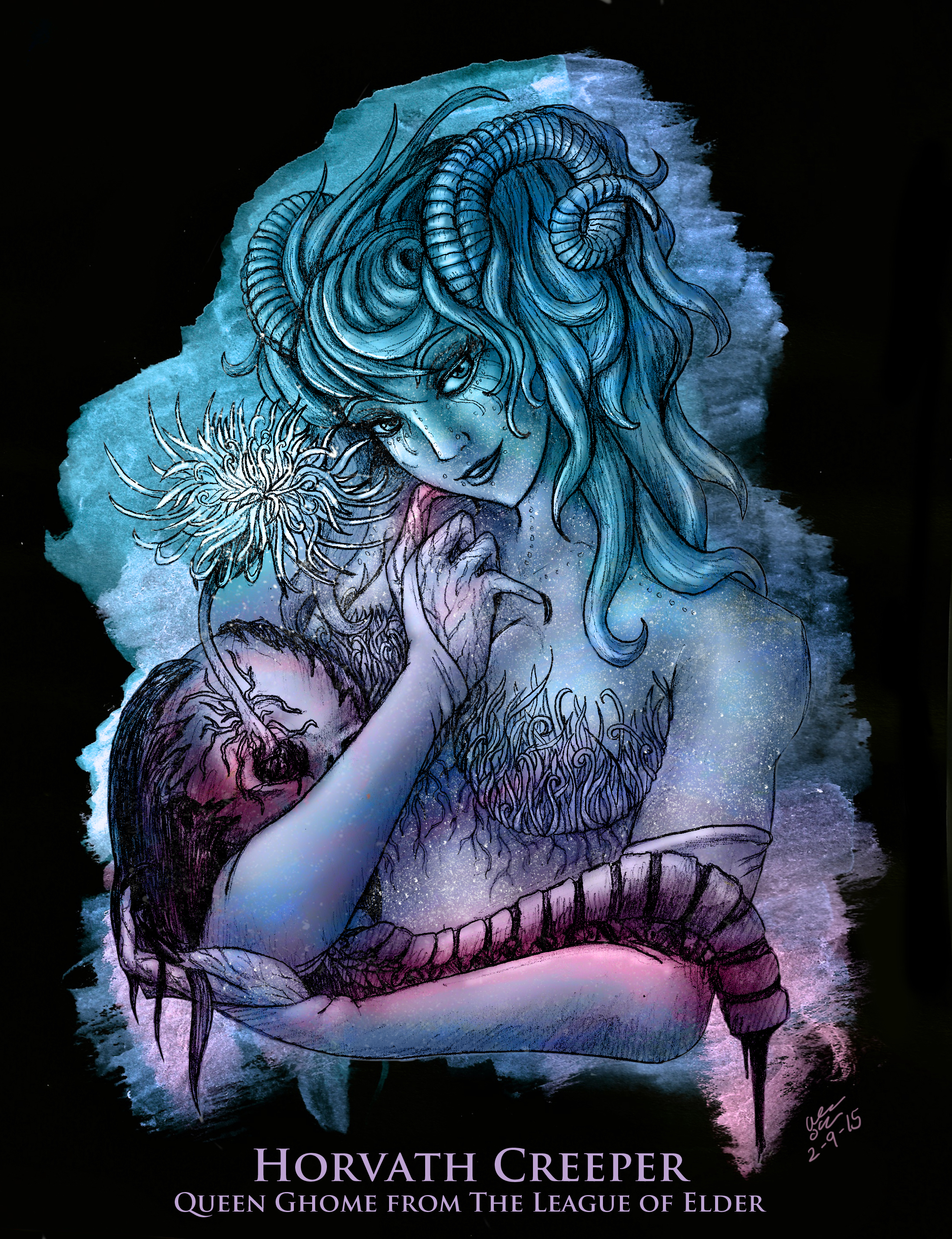
The Horvath Creeper (painting by Alexander O’Riordan)
The Horvath Creeper was a large, slow-growing plant with a white, meaty flower that grew in calm pools of shallow water. It had a fairly strict list of requirements in order to thrive and was, accordingly, a rarely seen plant in the wetlands of Trimble. That is until Queen Ghome when to work on it.
She enhanced the benign plant, giving it an utterly sinister life cycle turning it parasitic. The Creeper now depended on human beings to survive, specifically, Gifted humans, those with the Seven Gifts of the Mind. The golden spores of the Horvath Creeper, laced with narcotic perfume, get into the sinus of its victims and embed themselves. Those who do not have Gifts, the spores wither and die. However, those with the Gifts of the Mind provide fertile ground for the Creeper to thrive. The spores latch into the nervous system of the host and wait for the moment to strike. When the host encounters a pool of calm, shallow water, the spores activate and take-over the mind of the host, compelling them to jump into the water and drown themselves. Several weeks later, a large Creeper flower bursts from the victim’s skull, breeching the surface of the water. If allowed to fully grow, the Creeper will eventually tangle throughout the victim’s body, leaving a vine covered skeleton with a single white flower coming out of the skull.
Queen Ghome loves using the Creeper against enemies with Gifts of the Mind. All it takes is one good whiff of the spores and the victim is infected. Additionally, the spores deaden the victim’s use of their Gifts, making them unavailable for use. For those with the Gifts of the Mind, the mere sight of the Horvath Creeper is enough to inspire dread and terror.
ABOLETH:

Aboleth (painting by Alexander O’Riordan)
An innocent lily pad, Aboleth is one of Queen Ghome’s most deadly creations. Aboleth belongs to a sub-genus of the common lily pad. In her long reign on Trimble, before being deposed from power at the Battle of the Tomb, Queen Ghome discovered a secret hiding in this innocuous plant. When harvested at the correct age, allowed to dry and when soaked with a few secret chemicals, Aboleth reveals an amazing secret: it explodes.
Aboleth explodes with remarkable force, easily releasing as much energy as a comparable artificially-created explosive of similar weight. Another remarkable property: Aboleth explosions are shaped, it releases its energy in one direction, always following the path of least resistance. It also cuts through armor and composite materials like they are not even there.
Queen Ghome and her followers wear Aboleth like body armor, powdering it and bushing it on. Many times, they dye the powder, painting into their bodies in decorative dots and swirls. Other times, they put it on plain, where it becomes invisible on the skin. Any forceful contact, and the Aboleth goes off. Warlord Crantz of Sorrander once tried to seize Queen Ghome and forcefully drag her on to his starcraft. The Aboleth explosion that followed took his whole arm off. Ghome and her followers are adept at using the Aboleth as deadly weapons, easily able to attack and kill armored enemies.
DEATH EYE:

Death Eye (painting by Alexander O’Riordan)
A bizarre and completely original creation of Queen Ghome, Death Eye has a number of medical uses and has been smuggled off of Trimble. League Hospitalers use the cocktail of chemicals found within it for various medications.
Death Eye appears as a colorful fungus with a fruiting body resembling a single eyeball. The fungus is quite toxic with a 90% mortality rate in those attempting to ingest it. Eating Death Eye creates extremely vivid hallucinations, which are often psychically accurate down to the smallest details. Additionally, those eating Death Eye can sometimes alter reality to suite the details of their hallucinations.
Queen Ghome had an endless stream of criminals (often-times, these criminals were innocent people arrested on ficticious charges) she forced to eat Death Eye to give her information she needed. She learned the location of the Urn of Anabrax from an eater of Death Eye. She also foiled the actions of her greatest enemies, the BMQ (Brotherhood of the Murdered Queen) by changing reality to undermine their activities to oust her from the throne.
In the League, the Hospitalers extract the drug Stenotarcin from Death Eye and use it in their Gaming Sessions to discover hidden secrets.
copyright 2015, Ren Garcia and Alexander O’Riordan
.
HoB: Waiting for #6
January 8, 2015
Nobody’s perfect.
In Book V: The Temple of the Exploding Head, the heroine of the story, Lady Sammidoran of Monama, is transformed into a homicidal Berserkacide bent on killing her love, Lord Kabyl of Blanchefort. The Berserkacide detested everything Sam loved. It hated “Kay” most of all, and he shot her dead in the ruins of the House of Bodice.

Sam waiting in the Grove at the foot of Carahil’s statue (Painting by Fantasio)
But wait …
Though it’s not covered in the pages of the book, a lot of things happened in the year or so Sam was in her tomb on Dead Hill. Life, reluctantly, went on. Kay, though heartbroken at the loss of Sam, was an eligible young man, a sought-after prize, and many sought to take his hand. One of the prime suitors, hand selected and approved by Kay’s mother, Countess Sygillis of Blanchefort, was an ex-Black Hat and member of the Xandarr 44 Sisterhood named Domeneau of Holly, or #6 as she was designated within the Xandarr 44 sisterhood.

#6 (sketch by Carol Phillips)
It became a foregone conclusion, that #6 would become the next countess of Blanchefort. She even had a great number of her clothes sent to the castle.
But then, there was Sam, laughing, smiling, back from the dead, ready to resume her life with Kay as if nothing had happened. Sam was in, #6 was out, and she wasn’t happy about it.
As Sam discovered what had transpired while she was dead, she became rather put-off. Sam has quite a possessive and jealous streak and, in her private discussions with Kay’s sister, Lady Kilos of Blanchefort, revealed that she would have hoped that Kay would have grieved over her for the rest of his life. She considered #6 a home-wrecker and a rootless usurping slut. She even thought that forgiving Kay for “cheating” on her while she was dead was a great display of character and charity on her part. Sam found the trunk full of #6’s clothes and sent them back to Xandarr in tatters.
Conversely, #6 developed an intense hatred of Sam, the woman to wouldn’t stay dead. She had been warned in Gods Temple that the spirit of Sam was nearby and would attempt to re-enter the realm of the living. Fearing Sam’s “recorporation”, she snared her tomb with StT’s, intending to re-kill her should Sam rise from her grave. Obviously, her efforts failed terribly.
Sam developed an intense desire to confront and kill #6. She wasn’t proud of those feelings and kept them to herself. She took to creeping out to Carahil’s statue in the Grove to wait and see if #6 showed up to pray. Sometimes she would sit out there all night, waiting in the dark with her claws sharpened.
Sam’s strained relationship with #6 is further explored in LoE Book 10: the House of Bloodstein, coming soon from Loconeal publishing.
copyright 2015: Ren Garcia, Carol Phillips and Fantasio
 The Temple of the Exploding Head