StG: Extra-Planar Entities
December 2, 2013
Production on LoE Book 8: The Shadow tech Goddess is well underway. Featured heavily in the book is the concept of multiple universes/realities and how they interact together.
The Hospitaler Theory of Opposing Mirrors states that, while mass is finite, the number of realities mass can inhabit is infinite. Reality is simply a partitioned, defined reflection of a Common State and, therefore, an infinite number of realities can exist. The farther away a reality exists from the Common State, the more variation will occur.

The Professor discovered and proved the Equation of Opposites, a formula determining how many Wvulgroms of a single person may exist (Bea Kimura)
Extra-Planar Entities go hand in hand with this concept. Extra-Planar Entities are, in most cases, beings from a different reality. They can also be beings who have been assigned a special status in the grand scheme of the universe, these select individuals are known as Planarites.

One or more Wvulgroms of Paymaster Stenstrom are female. (Eve Ventrue)
Wvulgrom: A Wvulgrom is an alternate version of yourself from a different reality. A Wvulgrom is not a copy of you and nor is it a changeling or doppelganger. A Wvulgrom is you, it even shares your atomic mass, it simply exists in a different reality. They can be of a similar note in terms of wants and needs, or they can be completely different. It is possible for a Wvulgrom of yourself to be either dead or not yet born. Vast gulfs of time can elapse between the lifespans of Wvulgroms. In some instances, your Wvulgrom might look completely different than you do, or, in rarer cases, might be a different gender or might not even be human.
PLANARITES: Planarites are individuals who, knowingly or unknowingly, enjoy a special Extra-Planar status across the various realities.
Kaidar Gemain: The Kaidar Gemain or “The One Who is Everywhere” is a person who exists in all realities. This is a very rare circumstance as most beings do not exist in all realities but only a small percentage (The Equation of Opposites determines how many Wvulgroms of oneself may exist throughout the realities). The Kaidar Gemain commands vast extra-planar powers. People are drawn to him or her. They are often highly lucky, often gifted in unusual ways. The Kaidar Gemain is the pinnacle of extra-planarism.
Merthig: The Merthig is an unusual entity. “Merth” is the old Cammarian word for “soul“, therefore the Merthig is the soulmate of the Kaidar Gemain. The Merthig is most often the pre-selected mate of the Kaidar Gemain, and is with him or her the most (but not always) across the realities. In realities where the two are together, they are both much more potent than they would have been otherwise. The Merthig often displays astounding skills, Gifts or other talents–this they derive from their association with the Kaidar Gemain.
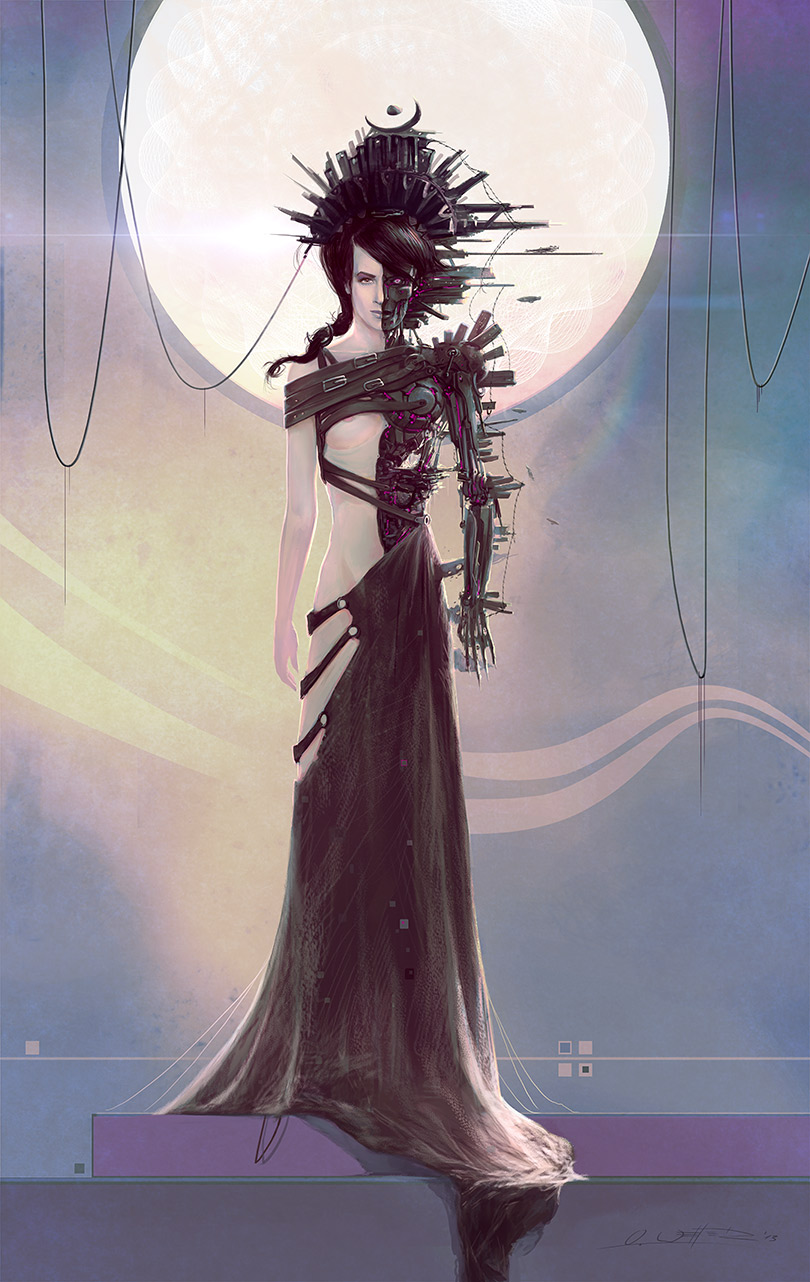
Bellathauser, the alter-ego of Queen Wendilnight is a well- known V Dogan demon (Fantasio)
V Dogan: Possibly one of the most bizarre of all the Planarites, the V Dogan is a type of demon that has escaped its universal shackles and exists within the Nodes of Reality. The V Dogan has no fixed place of universal residence and can appear out of any Hall of Mirrors. They attempt to get past the Anatameter and exit via the Hall of Mundane, though they are normally unsuccessful. In cases where a universe had become a Spiralata, the V Dogan is more likely to be successful in escaping. V Dogans are spreading, multiplying like a virus and, just when one has been destroyed, another pops up again elsewhere. They tend to create chaos and are generally quite destructive to the fabric of the universe it has contaminated, often leading to destruction by the Shadow tech Goddess.
A V Dogan can look and act completely different, depending on the Node of Reality they appear from. They can, on occasion, be reasonable, other times they can be mindless and demented. They are persistent and extremely difficult to be rid of. The cybernetic creature Bellathauser is a known V Dogan demon.

The Tempus Findal (early conceptual sketch by Fantasio)
It, more than any other creature, is drawn to the Kaidar Gemain. Once it detects one, it will travel across the universe if it must to get to him or her. It will kill any in its path, especially the Merthig whom it takes great delight in killing, and then it will latch onto the Kaidar Gemain and bleed him or her dry, feeding like a parasite though it can appear charming and benevolent. Once it becomes gorged with power, it will sometimes forget what it is and believe it is a simple mortal again, but always, its hunger will grow and drive it mad afresh. If two Tempus Findals enter the same reality, they will locate each other and fight to the death.
A Tempus Findal, if allowed to feed unchecked, will drain a Kaidar Gemain such that they fade out of existence in a reality and, therefore no longer exist in all realities. They become a sad, forlorn creature called a Gogol and fade from existence.
These Extra-Planar Entities and many more appear in The League of Elder Book VIII: The Shadow tech Goddess coming soon from Loconeal Publishing.
copyright 2013, Ren Garcia, Eve Ventrue, Bea Kimura and Fantasio
The Story of Maiax and the House of Bodice
October 3, 2013
Sorry I’ve been away–the Con Season has been a pill.

“Tree of Life” by Ewelina Dolzycka. The plot of Book II is told in this mural, with Carahil in the center as protector, the Planet Xandarr the object of his protection, and, in the wings, a weeping Maiax.
The story goes like this:
In 099989EX, the House of Bodice found themselves beset by demons. Their land in the northern Hala region of Kana went bad and they heard never-ceasing drums in the night. They went to the Sisterhood of Light for help, but were politely turned away. The Sisters did not believe their lurid tales–certainly they were over-exaggerating. (As it turns out, the Bodice’ land was sitting directly over the terrible Temple of the Exploding Head, and the demons they saw were the comings and goings of the Killanjo, the skinless servants of the Horned God who lived there.)

“Maiax Deceives the Bodice”, by Justine Marie Hedman
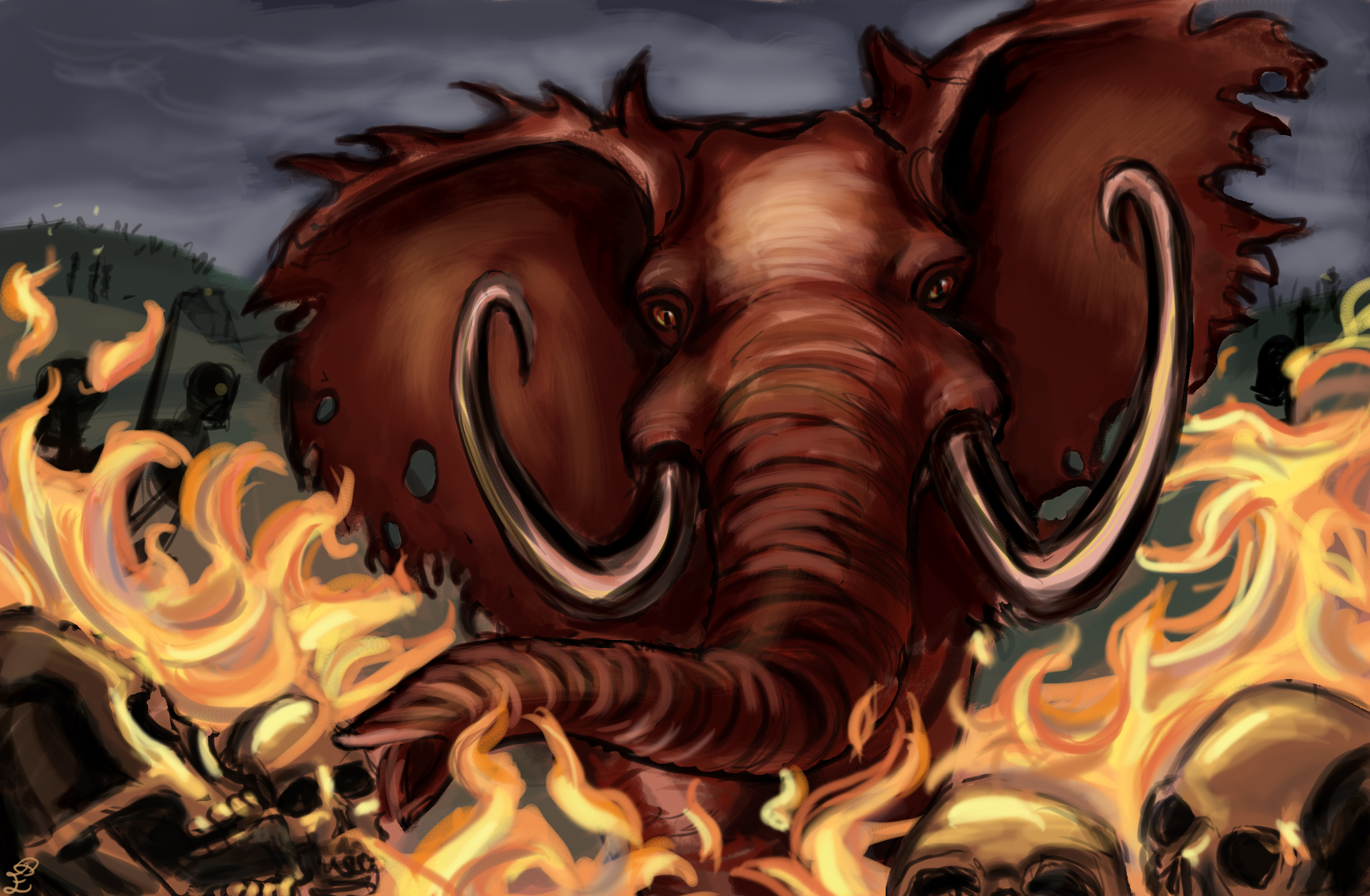
“Maiax in Flames” by Ewelina Dolzycka. Storytellers eventually cast Maiax as a liar and deceiver who personally oversaw the death of the Bodice

The Sisterhood of Light realized they failed the House of Bodice and erected a statue in the ruins of their manor. They created the holiday St. Porter’s Day in their honor (art by Carol Phillips)
Eventually, Maiax escaped the Windage, along with Barr, the monkey god, Ibilex the crane and Mabsornath, the cat goddess. The foursome dogged Carahil as he attempted to save Xandarr and even tried to tempt him into becoming a demon himself. Carahil soon turned the tables on them and reminded Maiax of the tragedy of the Bodice. Still feeling the weight of their deaths, Maiax collapsed in misery. Carahil eventually forced the Celestial Arborium to forgive Maiax and the rest, to give them a second chance. Maiax though, was unable to forgive himself.
The story has a happy ending. Gathering his courage, Maiax goes to the spirits of the Bodice in Paradise to beg them for forgiveness (something he was forbidden to do as a demon). To his surprise, they are overjoyed to see him. They surround him and sing his name. They tell Maiax the one thing they lacked in paradise was him, and that they had missed him. He joins them in celebration forever.
copyright 2013, Ren Garcia, Ewelina Dolzycka, Justine Marie Hedman, Carol Phillips
Carahil’s Busy Morning
July 9, 2013
It’s odd. I’ve been working on the latest LoE manuscript: The Shadow tech Goddess for almost three years. It’s been, by far, the longest slog I’ve ever had in writing a book.

“Carahil’s Busy Morning” (Artwork by Carapalou)
Well, not so fast, let me explain…
I’d learned a few things going to shows over the years. One: books that really sell are YA and children’s. I hate to say it, but that does seem to be the case. Most of the people browsing around are parents looking to buy a book for their kids. My science fiction books (richly illustrated by Carol Phillips) tend to catch the eye, People passing by often stop, pick one up, and ask “Are these books for kids?”
Kids?? Of course I could have lied and said “Sure … kids will love these.” My LoE series is not for kids–too much violence, too much darkness floating around. It is what it is.
But then I thought about it. One character that is a continual ray of fresh light in the series is Carahil, the Great Nargal Spirit and patron god of the House of Blanchefort. Just a big kid himself, Carahil would do well in a children’s series, and if I ever got around to writing one he would be the subject matter. I put that thought on the back burner and let it simmer.

Carahil and Mabs beginning their life together (Carol Phillips)
It occurred to me that all the weirdness in the world really doesn’t matter much, as long as there is a familiar framework in which to paint and give it perspective. And, what could be more familiar than a nuclear family setting–a father, a mother, the kids and all the pressures and situations that come along with such a setting. A family of odd creatures in space is really just the same as the family next door. I began thinking about Carahil’s family.
I knew that Carahil had taken up with Mabsornath, the Cat Goddess seen in LoE Book II: The Hazards of the Old Ones. Mabs was actually the main bad guy in the book, plotting the destruction of the planet Xandarr. Being the straight shooter that he is, Carahil managed to turn Mabs around. In the end, they became close, eventually committing themselves to each other and mutually sharing their secrets (a very big deal among the gods). As the LoE Series progresses, we see Mabs pregnant, and, eventually, the proud mother of seven children. In a vision, Captain Davage and Countess Sygillis see them playing at her feet.

Atha, as a sultry adult and as an innocent child (Fantasio and Carapalou)
So, then I had it, all at once. I had the characters and I had the setting. In five minutes of working on my manuscript, I also dreamed up a 1000 word story of Carahil and Mabs raising their seven children at the Top of the Universe, encountering surprises, and teaching their kids important lessons. It was the easiest writing I’ve ever done. It just felt right.
Dreaming something up and writing it down is the easy part, turning it into a living, breathing story is hard. As it’s only a 1000 words, the story would need to be driven by the artwork, and that would take an artist of exceptional skill. My good friend BeaKimera, an amazing Manga artist and a representative of many others soon had the solution. Bea embraced this project and showed real enthusiasm. She had a whole portfolio of artists for me to look at, all of whom were immensely talented–one, though, was the clear choice, with a clean Manga style and a flair for story-telling: Carapalou.
Seven months and a lot of hard work later, here we are with a finished book, each page a masterpiece. The end of a long, hard road in publishing is an ISBN and a barcode. CBM now has those things and I can’t wait to share it with the world.
Carahil’s Busy Morning will be available in late June from Loconeal Publishing.
copyright 2013, Ren Garcia, Carapalou, Fantasio and Carol Phillips.
LoE Characters: Queen Ghome
June 9, 2013
After Seven books and counting, the LoE Universe has grown by leaps and bounds. It is bursting with characters and places, most of which were created in mere passing and then expanded upon at a later time.

Queen Ghome, by Carol Phillips
Flash forward six books. As I puzzled out the plot for LoE Book VIII (or IX depending on which gets published first) is need a villain character and, for some unknown reason, the name Ghome flashed into my head. Without knowing anything about the character, I decided Ghome would be the main villain of Book VIII. I spent a bit of time thinking about the character, and then it hit me all at once.
RULER OF TRIMBLE:
Bad guys are so fun to play with, the possibilities are truly boundless. Queen Ghome’s roots are lost to the ages. She entered Xaphan social circles from nowhere in 000701AX. She had all the assets one would need to thrive in Xaphan society: she was beautiful, had money, was ruthless and cunning and brimming with ambition. Where she came from was always a topic of speculation, most believed she was an exile from the League. She flirted with The Court of George for a time, and even picked up their habit of casual cannibalism.

Queen Ghome’s appearance changed frequently, but, her eyes with their terrible, withering stare, were always the same
Her lore grew quickly. For one, she was a tyrant of the most despicable sort. Cruel and despotic, she was given to fits of rage, paranoia and occasional madness. She carried a spiked scepter forged of iron and rarely hesitated to use it when the mood struck her. Also, her appearance changed often, not simply changed in terms of hairstyle, hair color or wardrobe, she looked like a completely different person with only her scepter and her eyes giving her away.
She planted and designed her infamous Garden of Zama, a gigantic garden and reflecting pool near Trimble Palace off the west lawn. The garden was huge, with many intricate paths leading in a bewildering, maze-like tangle. It was populated with an endless host of deadly carnivorous and poisonous plants cultured and developed by Queen Ghome herself.
WAR WITH THE LEAGUE:
Many suitors came to Trimble seeking Ghome’s hand, and her price for entertaining these suitors was invariably a quest to fetch some item or parcel of land which would end up in war with the League. Many Xaphan Houses were severely weakened, and a few went extinct altogether as a result of these wars.
VEHELM OF WAAM AND GHOME II
One of the suitors for Ghome’s hand was a tiny man from Gothan named Vehelm of Waam who was a noted maker of fabulous jewelry. Ghome created a workshop for him in her Garden and compelled him to make for her a new treasure every month otherwise she would allow him to starve or be killed in the depths of the Garden. To the surprise of many, he survived and became a favorite in her court.
An odd change came over Ghome at that time. She appeared to have experienced some sort of revitalization or rebirth. She cast aside her thuggish ways and became a true visionary and leader for her people, with Vehelm of Waam at her side. The people began referring to her as Queen Ghome II as she led them into a new age of prosperity and learning. Ghome II stopped carrying her iron scepter and had the Garden of Zama walled up tight.
THE END OF QUEEN GHOME:

The Horvath Creeper and the Aboleth Lilly were just a few of the deadly plants Queen Ghome cultivated
But, by this point, Ghome had alienated too many Houses and the end was near. The House of Sorrander came in force and subjugated Trimble. They toppled Queen Ghome’s palace and burned the Garden of Zama to the ground. The Sorranders then occupied Trimble for five centuries.
What became of Queen Ghome after that was unknown. It was assumed that she was killed during the Sorrander attack, though her body was never found.
copyright 2013, Ren Garcia and Carol Phillips
Schools of Magic in the League of Elder
May 9, 2013
As with many things in the League of Elder, the concept of Magic is a rather odd thing. It is the purview of a few, yet it can be had by any with the temerity to claim it.
THE THREE SCHOOLS OF MAGIC:
There are three distinct schools of magic in the League of Elder: TK, Vortex and Gellar.

TK Magic is practiced almost exclusively by the Sisterhood of Light (Eve Ventrue)
A course in TK magic was once taught at Sarfortnim College, where it was said students began demonstrating great mastery of it. The Sisters abolished the course and forbade its further teaching. The Hertogs, a hidden sects of scholars and other professionals who are frequent critics of the Sisters, seek to uncover the secrets of TK magic.
In Xaphan Space, the Black Hat Sisterhood also makes use of TK magic, though their mastery of it is not in the same category as the Sisters.
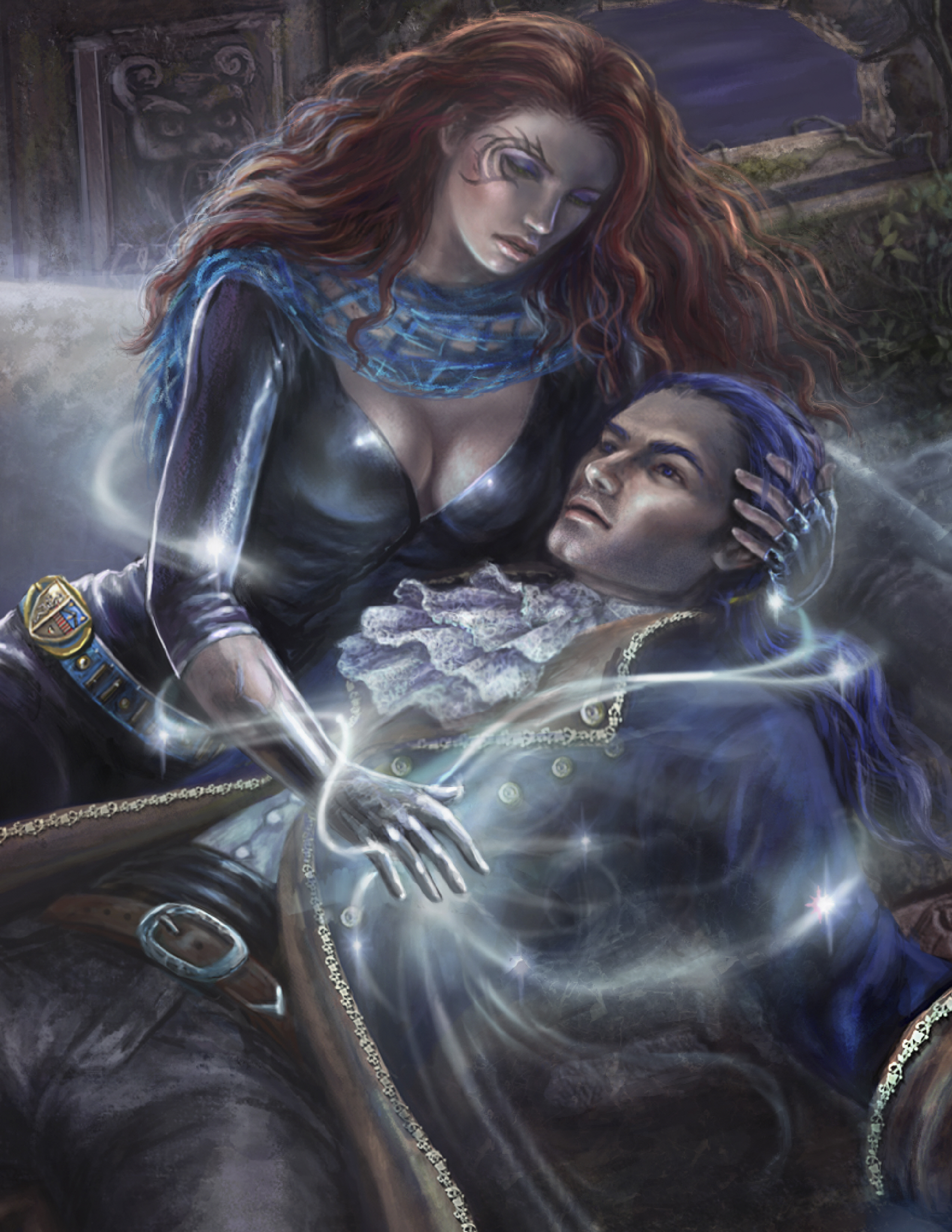
Sygillis of Metatron using Silver tech (Vortex magic) to assist Captain Davage.
The study of Shadow tech has been illegal in the League since the ouster of the Grand Abbess of Magravine in 144670AX, therefore Vortex magic is practiced mostly in Xaphan Space. The Black Hat Sisterhood makes great use of Shadow tech, often clashing with the Sisters. Their Shadow tech can often match the Sisters’ TK magic.
All schools of magic can vary depending on their application, however Vortex magic manifests extreme differences in terms of Good (Silver tech), Neutral (Emplosser) and Evil (Shadow tech). The use of Silver tech was recently legalized by the Sisters and is studied and practiced by the Xandarr 44 and a social circle of married ex-Black Hats known as the Silver Circle.
GELLAR: Gellar magic, or Acquisition Magic is the largest and most widely practiced magical school in both League and Xaphan Space. The prime tenet of the school states that objects, both arcane and technological, have power, and to collect a vast number of objects imparts magical power on the owner of said collected objects. The more objects acquired the greater the power. The word “Gellar” comes from the godlike legendary beings outside the League said to be able to control man, animal, and plant.

Admiral Pax, by way of his vast personal collection, is able to influence the thoughts and feelings of those around him via Gellar Magic (Eve Ventrue)
The Old Vith were said to have achieved great strides in the development of Gellar magic. They devised the Gellartron, a structure housing their arcane objects, focusing it into vast power. Most of the Old Vith castles dotting the north of Kana, including Castles Blanchefort, Durst and Bloodstein, were functioning Gellartrons wielding power approaching that of the Sisters. To protect their cashes of treasure, the Vith invented the Bowerchest, a great animated construct usually in the shape of a mystical creature, where they kept their prize posessions.
The Sisters became quite fearful of the Vith and began an active campaign to take their arcane items, seize their Bowerchests, and deactivate their Gellartrons. The Vith were said to have hidden their Bowerchests in a distant place known as Edamathrombo to protect them from the Sisters. In time, the Sisters were successful, the Vith were reduced in Gellar power and their Gellartrons were deactivated. Edamathrombo, and the riches kept there, was largely forgotten in Vith lore.
Though the Vith Gellartrons are all non-functional, the Sisters strongholds of Westron, Valenhelm, Kurtiss and Kentaro are all said to be functioning Gellartons granting the Sisters vast power.
copyright 2013, Ren Garcia, Eve Ventrue and Carol Phillips
The Many Faces of Carahil
April 20, 2013

“Carahil”, by Felipe Montecinos
There are several aspects of the character you may or may not be aware of:
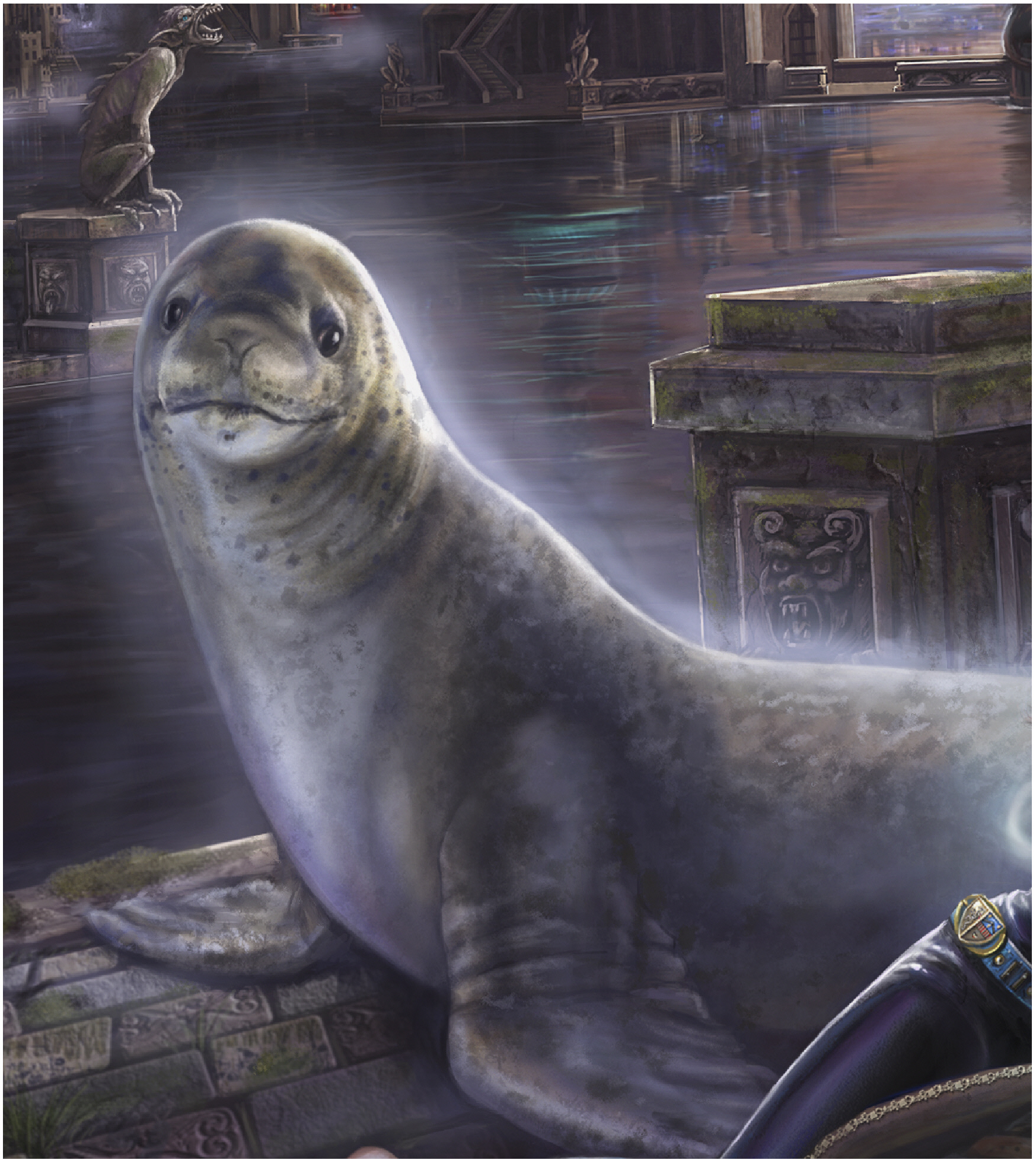
Carahil 1 (Carol Phillips)
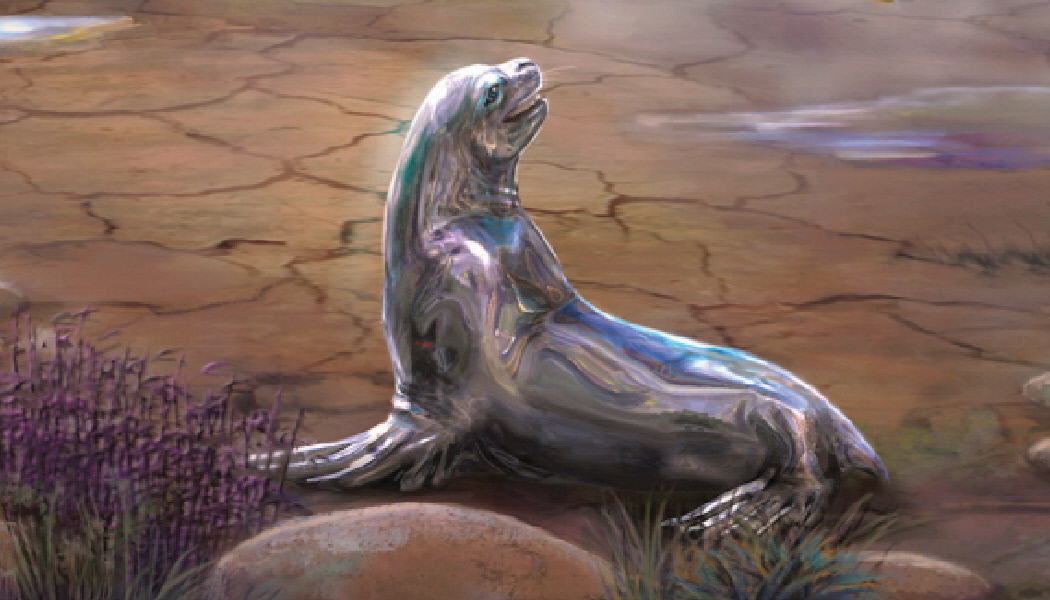
Carahil 2 (Carol Phillips)

Carahil, as a human, with a pregnant Mabsornath (Carol Phillips)
Lady Poe was delighted with Carahil and considered him to be her first child. She created a number of medallions which would summon carahil when needed. Carahil 2 brimmed with power. He loved rescuing small animals and nursing them back to health. He also had a love of jokes and pranks. His favorite prank was stealing gowns from Countess Sygillis’ wardrobe and hanging them from a flagpole.
Carahil’s abilities have never been fully tapped or displayed. He is powerful enough to be invited to join the Celestial Arborium, an organization of gods seeking to maintain Universal Balance. Carahil follows the rules of Universal law preventing him from using his abilities to their full extent. He is known to change his shape at will, become larger or smaller, use TK, control the weather, control animals, travel vast distances in moments, become ethereal or astral, ward away evil and destroy Shadow tech.
XANDARR:
Carahil took an active role in saving the Planet Xandarr from a Black Hat attack. Ever after Carahil was considered the protective patron god of the planet.
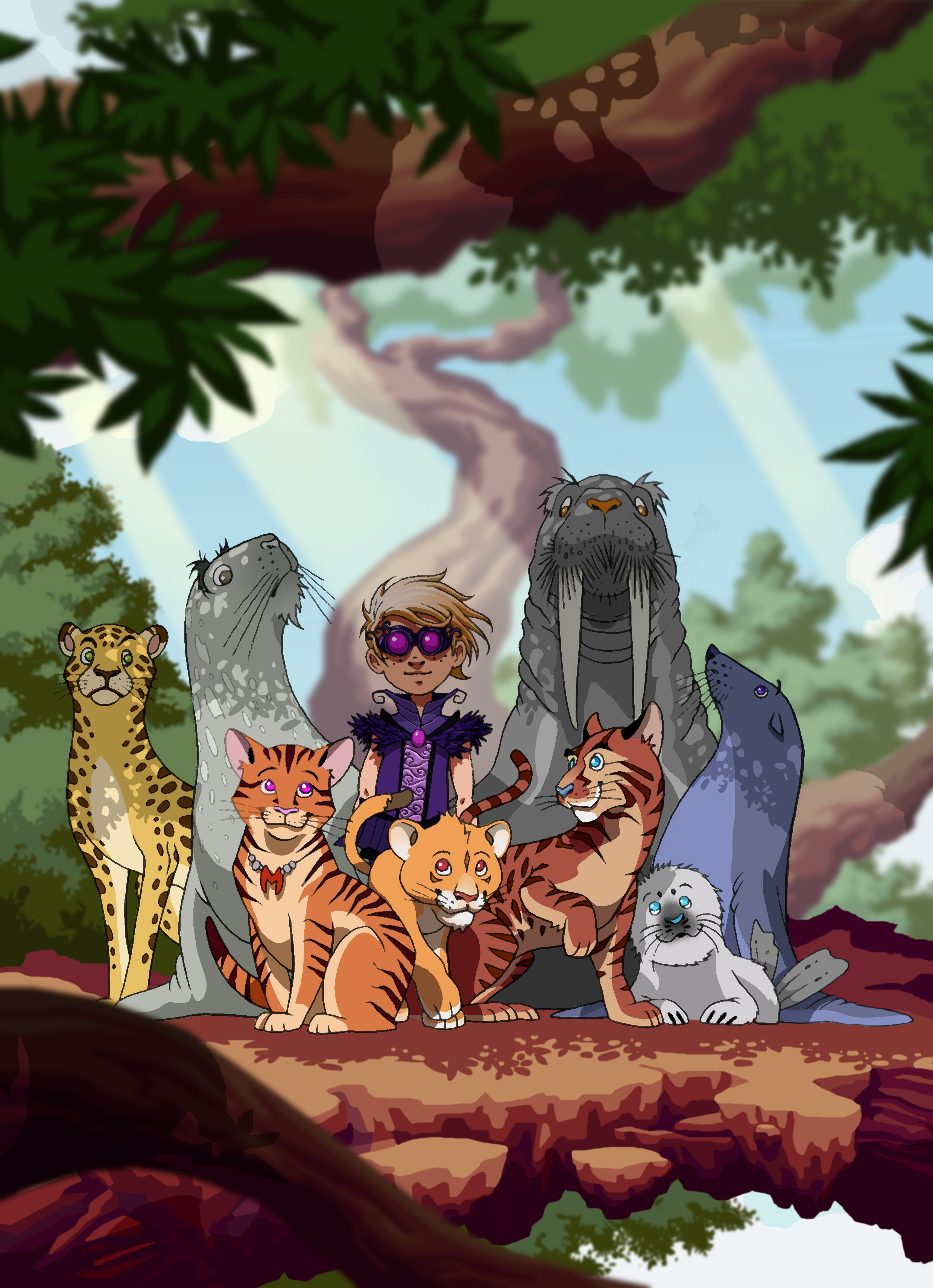
Carahil and his family (Felipe Montecinos)
CARAHIL’S TEMPLES:
There are a number of mystical places associated with Carahil. The places are usually fun and filled with Carahil’s light. The Mystery Library in Castle Blanchefort, 1000 Carahil Park and its Gift Shop on Xandarr have both been confirmed as temples dedicated to Carahil.
There is another place associated with Carahil that is very frightening and dangerous, the Cathedral of Bone and Wire where a hideous demonic beast resides. How Carahil could be associated with such a dark place is not currently known.
copyright 2013, Ren Garcia, Carol phillips and Felipe Montecinos
Where a Dead Man Falls, a Flower Grows: The Horvath Creeper
April 15, 2013
The Horvath Creeper in its favorite setting. (Carol Phillips)
THE HORVATH CREEPER: AN ODDITY OF NATURE. The Horvath Creeper is a freshwater flowering plant native to the temperate regions of the planet Trimble, an N1 world in Xaphan space. Prior to human colonization in 000024AX, it was a slow-growing plant with a large, meaty flower requiring clean, still water and ample branches or twigs to cling to. A number of conditions had to be met in order for it to thrive and its mortality rate was high. Those specimens that did manage to grow large were often fed upon by local fauna.
However, that all changed when man came to Trimble several centuries back. The Creeper, in the presence of man, turned out to be a parasitic opportunist. Its spores had a tendency to collect in the maxillary sinus of any who breathed it in. In some cases, the spores actually sprouted, resulting in the death of the victim. Weeks after the person’s death, a flower would burst out of the victim’s skull. The Creeper found the brain matter of those possessing Gifts of Mind were rich in nutrients required for germination. In a few cases, people infected with the Creeper found themselves taken over by it. They were compelled to seek out calm pools of water and drown themselves in it. There, the Creeper would emerge, devouring the victim’s brain and using their skeletal structure as a framework from which to cling. In time the symptoms of carrying the Horvath Creeper’s spores became known: the inability to use the Gifts of the Mind, confusion, and a fervent desire to drown oneself.
Queen Ghome I of Trimble was enchanted by the macabre nature of the Creeper and added it to her deadly Garden of Zama. There, she bred it and enhanced its sinister characteristics until it became her favorite, and the phrase: “Where a Dead Man falls a flower grows.”
copyright 2013, Ren Garcia and Carol Phillips
Age and the League of Elder
March 4, 2013
One of the more confusing aspects of the League of Elder concerns age and the process of aging. How do people age in the League? Why don’t the characters get old? How long do they live? Are they Immortal??
Let’s take a look.

Captain Davage and Countess Sygillis, both over 100 years old (Eve Ventrue)
A little history. Way back in the CX Time Epoch is when the people who would one day become the League were given the Gift of Youth and Health. The 25 god-like Elders, whom they faithfully served, decided to reward their loyal servants and engineered the ravages of old age and infirmity out of them. The effects of this engineering essentially granted them the energy of youth throughout their lives and disease became a thing of the past, such that knowledge of the medical arts was no longer considered necessary and was therefore lost to the ages, not to be rediscovered until the EX Time Epoch by the Hospitalers.
Here are a few facts:
The average Elder (or Leaguer) lives to be 220 years old. For example, Captain Davage is about 120 years old, while his wife, Countess Sygillis, is well over 200, though her exact age is unknown.
THE PUFFIES and TWEENERS:
One of the side-effects of their condition is a very malformed and somewhat grotesque youth. Children 15 and under are often rather malformed and puffy in appearance. Those with the Gifts of the Mind suffer from it the most, while the Browns hardly have it at all. Lady Kilos of Blanchefort is a well-known sufferer of The Puffies, having it well into her twenties, while her elder brother, Lord Kabyl, never had it at all. The Puffies normally clear up by their mid-20’s.

A-Ram and Alesta (Eve Ventrue)
THE LENTICONS:
There are some in the League who, through a malady of the flesh, grow old and only live to be about 100. They are known as Lenticons and are generally considered products of bad breeding. The Esther House of Milke is known to be thusly afflicted.

Monamas, like Lady Sammidoran, are not engineered to remain young, and age normally as they get older. (Eve Ventrue)
THE TIME OF GOODBYES
One severe drawback of their perpetually young bodies is that the Leaguers are never quite certain when they will die. Death strikes without warning once a certain age has been passed. A usual tradition is for people turning 220 to perform the Time of Goodbyes ritual to get their affairs in order and bid their loved ones farewell, just in case they die in the night. Lady Poe of Blanchefort is well past her Time of Goodbyes, her long life possibly due to her status as a Shadow tech Female (see below).
IMMORTALITY:
It has been long suspected that the Elders not only made the Leaguers young and healthy, they made them immortal as well. The Hertogs, a group of disaffected scholars and detractors of the Sisterhood of Light, often make that claim. They maintain that the Sisters are actually doing something behind the scenes to suppress their immortality. That argument has yet to be fully proved. The Hertogs make it their business to track down those they believe are Immortals and collect them, so to speak. Their code-name for a suspected Immortal is: Rundlepharge. The Xaphan tyrant Queen Ghome of Trimble is a suspected Immortal.
Immortality aside, there are certain variables which appear to grant certain Leaguers exceptional long life. Shadow tech females, such as Sygillis of Blanchefort, are known to live to incredible old age, unchanged with time. Additionally, proximity to Elder-tech and with alien power sources are said to expand one’s life. The Xaphan House of Burgon, the Court of George in particular, often engage in the practice of cannibalism, which they claim also expands life.
copyright 2013, Ren Garcia, Eve Ventrue
ATD: Legendary Objects–The Paramel
December 24, 2012
There are a number of legendary objects floating around the League and Xaphan space, however, none are more sacred and potent as the objects known as the Noabs. The Noabs are 25 objects pertaining to or collected from the 25 departed Elders, one object for each Elder. All of the Noabs are currently in the possession of the Sisterhood of Light in their stronghold of Westron in western Vithland. Many of the great Noabs are not known to the general populace of the League.
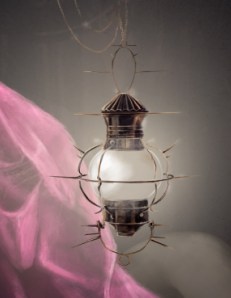
The Paramel, by Eve Ventrue
The attributes of the Paramel are in dispute outside of the Sisterhood of Light, though it is generally acknowledged by those learned in its lore that it is very powerful and not to be trifled with.

The Paramel provides power to the Missive’s Panel on the Seeker (Carol Phillips)
The Paramel has, at various times, displayed a cantankerous, wandering nature. It has escaped from the Sisterhood in the past, moving on its own like a living thing and “hid” in plain sight hanging like an ordinary lantern on Goddown Street in the city of Saga. It powered the Lighthouse of Tuk for several years and lit the Hall of Ethers in Alderveryl Convent. On those select occasions when the Paramel does escape, the Sisters relentlessly pursue it, though it sometimes takes them years to catch back up with the artifact. Any caught in possession of the Paramel are punished by the Sisters, though the Paramel itself has intervened on their behalf in the past, sparing innocent people the Sisters’ wrath.
copyright 2012, Ren Garcia, Carol Phillips and Eve Ventrue
Carahil’s Busy Morning
December 3, 2012
As the LoE Universe has expanded, Carahil has become one of my more popular characters. Smiling and affable, his pure soul and innocent spirit just tends to make people happy.

Carahil and his family, by Felipe Montecinos
I did a show in Cleveland last year. A question that kept coming up: “Do you have anything for kids?” Of course, the answer to that question was a resounding “NO!” As the rest of the day progressed I thought about it and, slowly, ideas entered my head.
A children’s story?
Should such a thing exist, the clear candidate for such a story immediately presented himself: Carahil, as he is basically a big kid himself. I had written in a small sub-story in the Temple Trilogy about Carahil, that he had taken up with Mabsornath, the Cat Goddess , and that Mabs was pregnant. I decided to develop Carahil and Mabs’ children, coming up with seven of them. In a sort of Lady and the Tramp, moment, all of their sons are seal-type creatures and all of their daughters are cats, except for one: Atha. I saw Atha in my head as the youngest of the group and the most chaotic. Of all of them she is the only one who prefers to appear as a goggle-wearing human child instead of in their usual animal shapes. In the novels, Atha is a seductive, rather unpredictable siren, for the children’s book, she is simply an innocent, precocious kid who, unlike her brothers and sisters, isn’t afraid to make use of her goddess-like power.
For the first book, Carahil’s Busy Morning, Chilean artist Felipe Montecinos will be doing the drawing. It should be ready by June, 2013
copyright 2012, Ren Garcia
 The Temple of the Exploding Head