SOTSE Characters: Lady Alesta of Dare
September 28, 2012
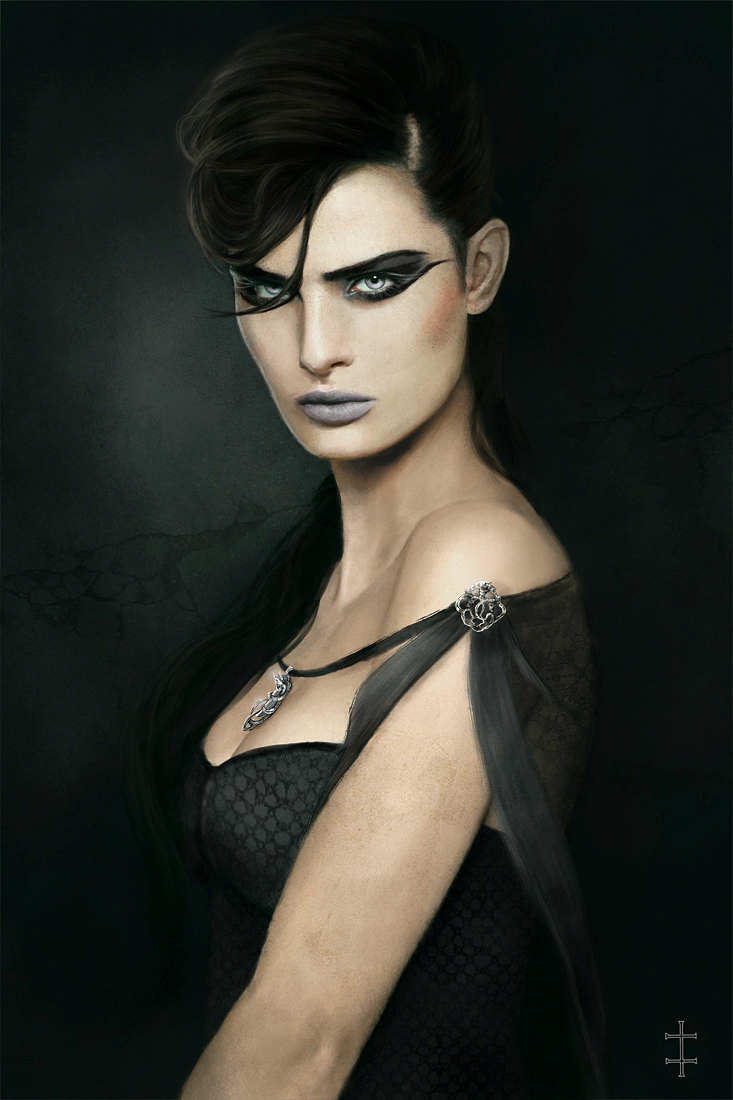
Lady Alesta of Dare is a girl of Barrow stock hailing from the western city of the same name. The Dares are the largest extended family on Kana with over sixty percent of people of Barrow stock being Dares.
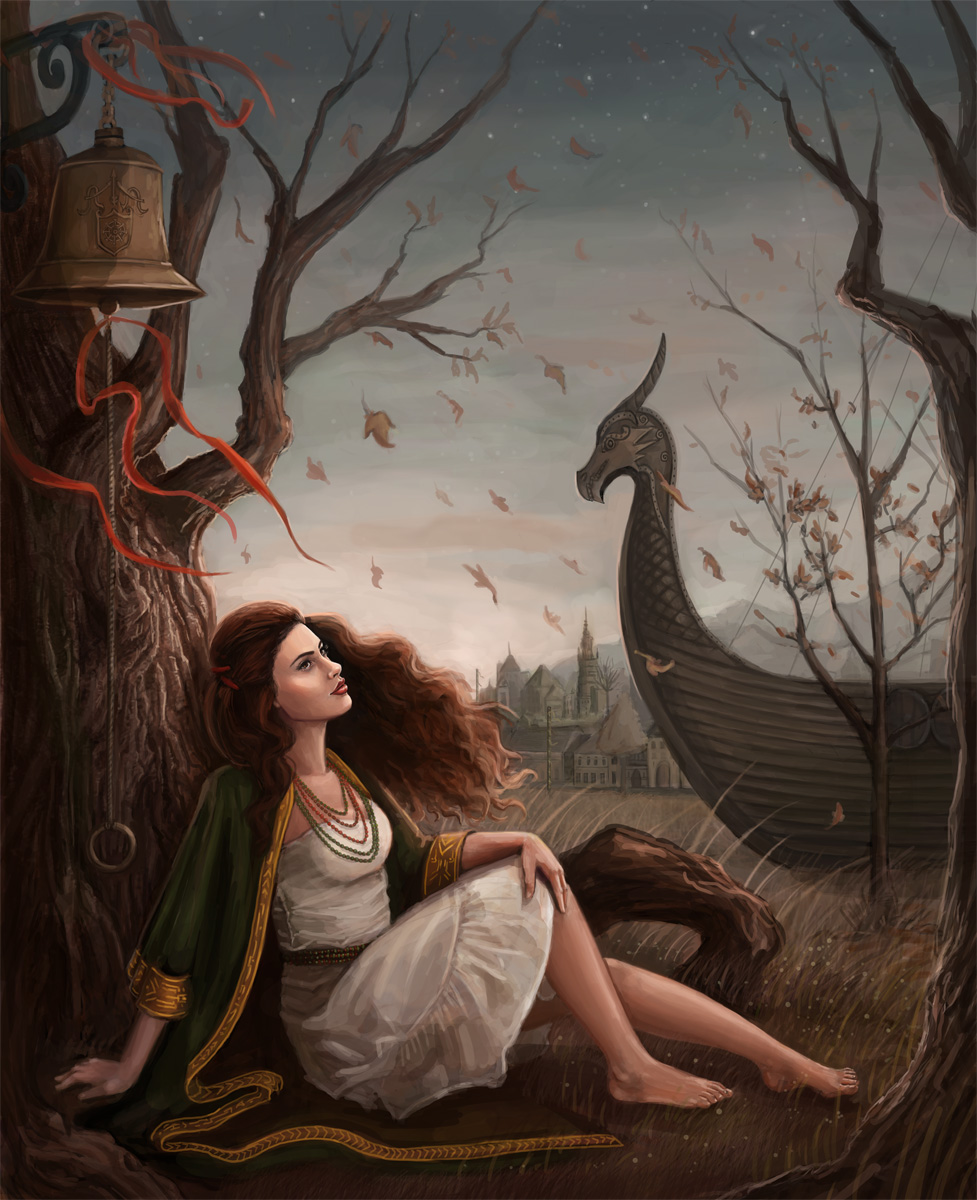
“Lady Alesta of Dare” by Kayla Woodside
When visiting the marketplace with her mother, she often saw a group of apparently impoverished beggars being harassed in the town square by gawkers. She asked her mother who the beggars were and her mother told her: “Pilgrims of Merian,” and she said nothing more, hurrying on.
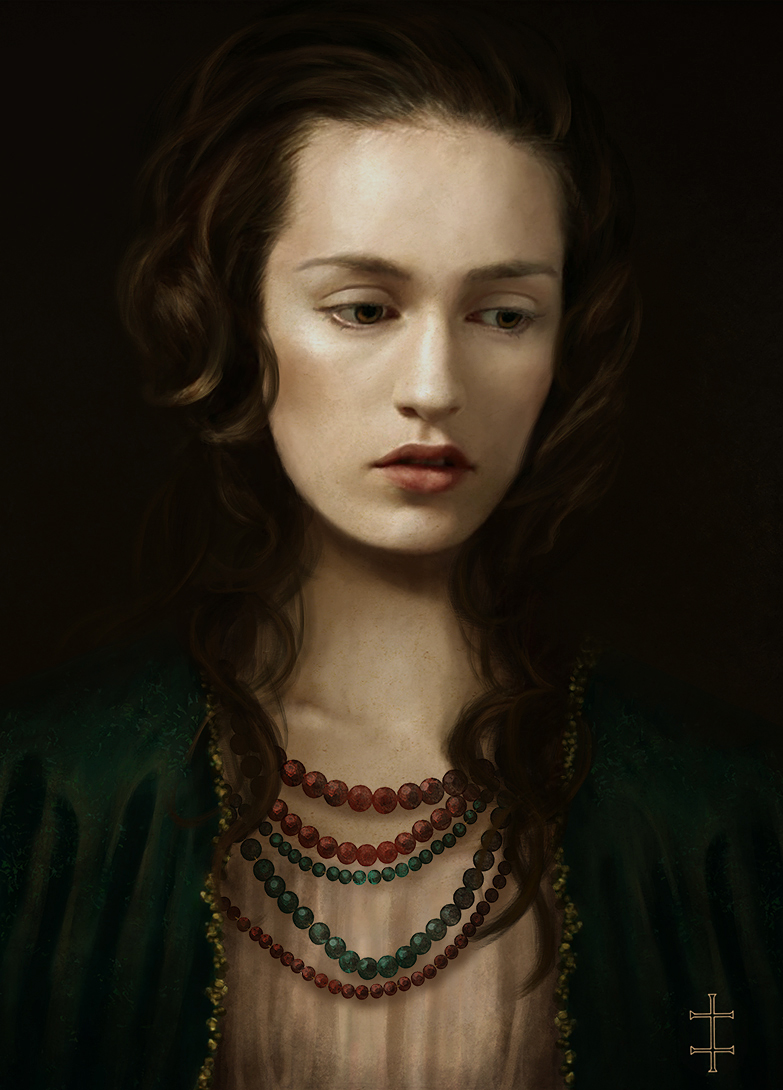
“Alesta” by Eve Ventrue
One day, she stopped to listen to what the Merians were saying. They said, amid the jeers, that the Elders were not gone, and to see them one need only open one’s eyes. The Merians mentioned their Star–a yellow star to the west. The people listening to them laughed. What star, they asked. There is nothing there.
“I see it!” Alesta cried. The Merians turned to her and she pointed right toward it.
Though her family protested, Alesta had found her calling. She left her family in Dare and set out, traveling in the meager wagons of the Pilgrims of Merian. She quickly discovered that there was much more to the Merians than they let on to the public. They took her to a sacred mountain to pray and discover her path. She knelt in the snow at the summit for hours waiting to hear the yellow star speak.
At last, she heard a kind voice whisper in her ear: “Save all those who fall astray.”
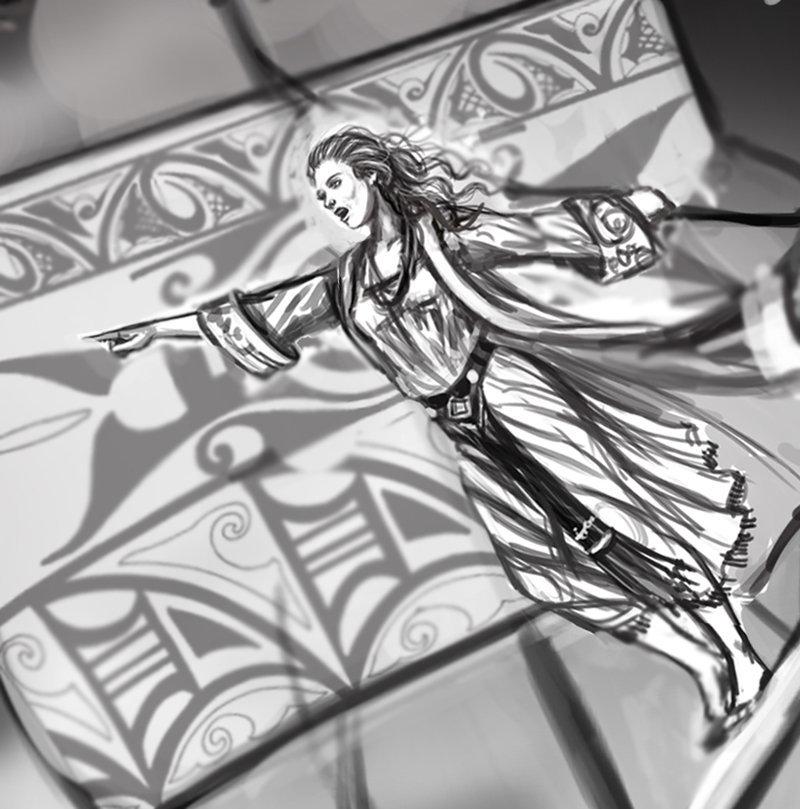
Alesta on the Merian Ship (From LoE Book VII cover, by Carol Phillips)
Though threadbare and impoverished, her star protected her. She wore a belt that allowed her to walk invisibly if she so wished and had beads that shielded her mind from attack.
She eventually ended up on a small outpost overlooking a watery world of evil unknown to the Sisters or the Fleet, hiding right under their noses where the unwary were lured in and killed. It was very dangerous, and should she and her Merian order be discovered by the caretakers of this world, there would be no mercy and no help for them. As always Alesta and the Merians were on their own in a dangerous world.
One day, she saw a star fall, and that was beginning of the end …
copyright 2012, Ren Garcia, Eve Ventrue, Carol Phillips and Kayla Woodside
From the Gates of Hell, the Heade-On-The-Hearth
September 13, 2012
Wherever people have sailed, be it across the seas, over the mountains, or through open space, there have always been tales of lost ships, the ghost ships: The Flying Dutchman, the Mary Celeste, the Edmund Fitzgerald, and on and on.
And so goes the Heade-On-The-Hearth, a warship in the League’s Fleet like many others, she has assumed a unique place in the lore of inter-stellar shipping, the demon ship that comes upon one in the emptiness where there is no help.

The “Heade-On-The-Hearth” by Fantasio
The Heade served for only a short period of time. Shortly after her maiden voyage, she was conscripted into battle with the Xaphan armada at Sorrander-Quo. There, she sustained major damage to her starboard fairing and had to be towed from the theatre. Eventually she was scuttled and left to drift in The Kills region of space. She was removed from the Fleet’s active books.
Several months later, mariners began issuing warning of a pirate ship sailing the deep sea between Kana and Onaris. Witnesses claimed a black Webber ship came at them from nowhere bent on theft and mayhem, a ship missing its starboard faring. Eventually the name of the offending ship reached the ears of the Fleet admiralty: the Heade-On-The-Hearth was doing the pirating. An investigation of The Kills revealed that her hulk was missing. It was later discovered that a band of pirates from Onaris, the Drury Brothers as they were known, had stolen the Heade from The Kills, strapped on a set of old Woburn rocket engines and brought the Heade back to life. The Druries used the Heade to great effect, able to fall on the weak and helpless and flee just before any dispatched to stop them could arrive.
Eventually the Fleet set a trap for the Druries off of Exeter’s Belt (a nebula eventually renamed Druries Belt). The Druries took the bait and, in the ship battle that followed, were sunk by the Fleet after hours of fierce fighting.
So much for the Drury Brothers …
However …

The Heade-On-The-Hearth modified with spotlights and tentacles (by Carol Phillips)
Eventually, the sightings died down, and the Druries and their black ghost ship faded into lore. On the new world of Bazz, they said the Devil had a new assignment for the Druries, to feed his children.
They still say if one dare to venture alone from Kana to Onaris and one wander off the shipping lanes, the Druries will get you.
copyright 2012, Ren Garcia, Fantasio and Carol Phillips
A Fake Interview with Ronda Rousey
September 5, 2012
The following has nothing to do with my science fiction/fantasy book series. Just some thoughts on a sport that I love and respect. WARNING–there’s a bit of foul language.

Ronda Rousey
TOTEH: So Ronda, we appreciate the opportunity to sit down and speak to you today.
RR: …
TOTEH: In your last outing, you beat Sarah Kaufman in just under a minute of the first round via armbar. What can you tell us about that fight?
RR: No, no, I beat Sarah Kaufman in about ten seconds, really. I bull-rushed her, knocked her down using some judo stuff that I know and then she spent the rest of the fight trying to avoid the inevitable. I snapped her arm off like a twig–you saw it. She was all patriotic before the fight, saying the belt was going with her back to Canada. Looks to me like the belt’s staying right here in the US. I’m amazed maple syrup didn’t come gushing out when I broke her arm off. How’s that for promoting US-Canadian relations??
TOTEH: You’ve won pretty much every fight you’ve ever been in, either amateur or pro, by way of armbar. Your critics call you one-dimensional–that’s not me talking, I’m just saying. What’s your take on that?
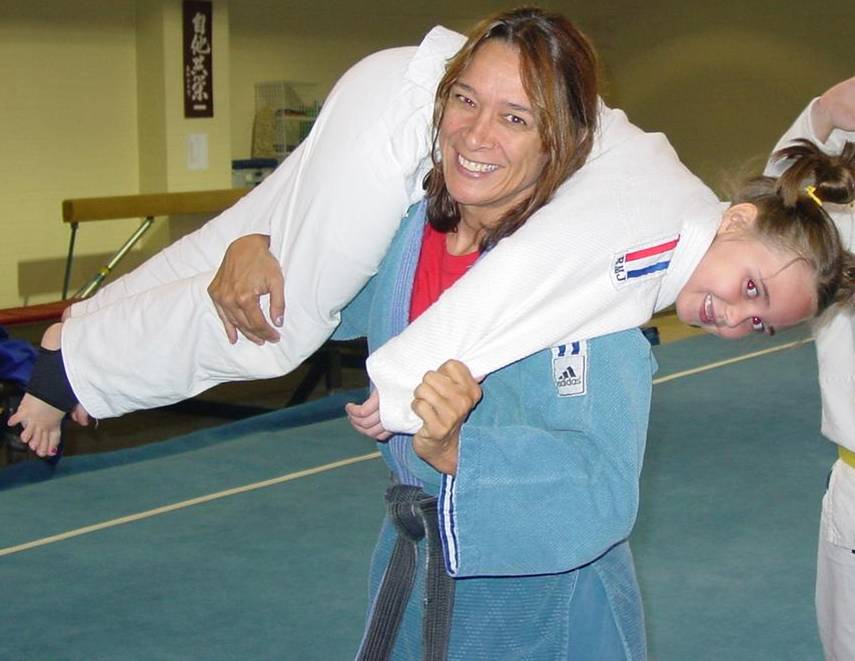
Anna Maria Rousey DeMarrs
TOTEH: Your Mother is Dr. Anna Maria Rousey DeMarrs, a very famous judoka of the `70’s and `80’s.
RR: Damn right. The only chick out there tough enough to beat me is my mom, and I don’t think you’ll be seeing her stepping into the cage anytime soon.

Miesha Tate
RR: Oh, f— that bitch! No–take that back, I wouldn’t f— that bitch if I was a guy, see? Did you see that scene while I was kicking Sarah Kaufman’s ass? She was sitting there eating a cupcake or something, and got frosting in that stupid hair-doo of hers. See, I frighten her so much, she can’t even eat a cupcake in my presence without embarrassing herself. So me and Kaufman are rolling around and I’m like: “Why don’t you take that forked tongue of yours and lick that frosting off of there, bitch, I mean Miesha!” Ha! Miesha Tate … Thanks to me, we all know what the inside of her arm looks like.
TOTEH: But, she …
RR: Next question, she’s old news and out of the picture. F— her. Did you see her almost lose to the dried up Earthly remains of Julie Kedzie in the under, under, under card that night? Heck, I could help Julie Kedzie cross the street and she’d end up with a broken arm and a busted hip. Julie Kedzie needs to apply for AARP or for one of those scooters old ladies rumble down the sidewalk on. Time to retire, Julie! You know what Tate’s trying to do, right? She’s trying to create some sort of cross-association linking her name to my name to get her places, sort of like Tonto and the Lone Ranger, Bigfoot and Wildboy, Batman and Robin. She’s like the ghost of some nameless person whose ass you’ve kicked and wants to haunt you forever. Let “Cupcake Girl” win some fights against non-senior citizens and eat some cupcakes without getting it in her hair and we’ll see. I’ll add her other arm to my collection.

Cris Cyborg
RR: What do I say?? I say there’s two types out there, there’s the “Champ,” and then there are all the “Chumps”. If you’re not the Champ, then you’re a Chump. I don’t see a belt around her waist, and therefore she’s a big, sorry-looking Chump from Brazil. Maybe there’s a problem with the Portuguese to English translation, but the Champ does not come up to the Chump’s weight class. No, no, if the Chump wants to fight, then she’s going to have to put down the `roids and the creams and the clears and come on down to where I am and we’ll fight. I wonder, when I rip her skinny, cut-weight Chump arm off, if it’ll wiggle around on the mat and do a little Chump Samba for me. What do you think?

Michael Phelps
RR: What’s to expand? He was a big guy around the Olympic village in Beijing–didn’t hang out, didn’t participate in stuff with everybody else, played by a different set of rules. Sounds like a Diva to me. Sounds like he ought to be dating Miesha Tate and they can hang out and be Divas together. I hung out. I made friends. Oh, by the way, he’d last about as long as Sarah Kaufman did against me.
TOTEH: Well, he’s not an MMA guy, he’s a swimmer. I don’t think he knows judo.
RR: I don’t know judo either, I just rip arms off. If he’d like to swim, we’ll swim. I’ll jump into that pool and armbar it into submission in world record time.
TOTEH: Well, er …
RR: You know, sometimes when I’m working out and I get a real sweat going, I think I can see through time. You know what I see there at the end of time?
TOTEH: What?
RR: I see a big arm there, ripe and sweaty, just waiting for me to grab hold and hyper-extend it.
TOETH: Miesha Tate’s arm?
RR: Oh, hell no–she wishes. She’s at minute 14 1/2 of her 15 and we’re moving on without her. Nope, it’s just an arm, and one of these days I’m going to reach out and it’s going to tap.
RG
TOTSE: The Pilgrims of Merian
September 2, 2012

Sketch of the cover to LoE Book VII “Against the Druries” featuring a Merian ship attempting to rescue the wreck of the Demophalon John (Carol Phillips)
The chief tenet of their teachings is that the Elders of Old are not gone, only relocated. They believe in the Star of Merian, the astral presence of the Elder Merian thought to be long dead. They say those with clear sight can see the Star of Merian as a great yellow star, easily visible in broad daylight, and that it is wreathed in a twisting red cloud. A prerequisite to joining the order is to be able to see the star.
The Merians travel the countryside by way of floatwagons covered with tarpaulins. They have no known permanent headquarters and make a meager living selling hand-made trinkets and cloth and performing calligraphy (see below). When asked where they come from, the Merians always say “Westwood“, though such a place has never been located. Occasionally, the Merians will stop and settle in one place for a year or two. They often ask the local Lord or Lady permission to settle, and, when granted, build a temporary village called a Hermitage. The estate of Belmont-South Tyrol resides on the grounds of an old Merian Heritage. Though they are impoverished in the extreme, those who enter a Merian Hermitage are welcome to share in anything they have.

“Lady Alesta of Dare and Pilgrim of Merian” by Eve Ventrue
Though threadbare and impoverished, it is said in some quarters that the Merians are much more capable and advanced than they let on. Some say that their belts allow them to pass unseen if they wish, and their beaded necklaces shield the wearer’s mind from attacks and illusion. There is also the various tales that the Merians may travel virtually anywhere they wish at the blink on an eye via an arcane bridge called The Merian’s Road. Xaphan Traders often tell tales of selfless, green-robed people who walk into peril to rescue those in need and that they travel by way of a “Road” wreathed in fog.
Such tales have never been verified and the Merians themselves never speak of such things.
copyright 2012, Ren Garcia, Eve Ventrue and Carol Phillips.
Gencon vs Catholic Bake Sale
August 22, 2012
 Still trying to collect my thoughts from my furious weekend at Gencon in Indianapolis, Indiana.
First of all, what an amazing convention. It was huge, stocked full of cool stuff and interesting characters. I met amazing people, like artist Kayla Woodside, whom I plan on giving a lot of commissions to, and fellow Seventh-Star Saint Georgia L. Jones . I also sold more books there than I ever have at any one convention. Sounds great, right, but … before we get carried away and proclaim the Gencon experience the ultimate an author could ask for, let’s compare it to another fair I recently attended, the affable Stillwater Arts and Crafts Jamboree in Dayton, Ohio (basically, a Catholic bake sale).
Outperformed by 30%
First, the hard numbers. Over four days at Gencon, I sold a total of 64 books. I was able to sell all books in the LOE series, including the usually difficult to sell Book II and the Temple Trilogy which made me very happy. Meanwhile, at Stillwater, I sold 22 books in one afternoon. Comparing the two events, the Catholic bake sale actually out-performed Gencon by 30%–I didn’t sell as many books of course, but I was only there one day for four hours, while I averaged only 16 books a day over four days at Gencon. Just looking at the cold, hard numbers, the Bake Sale took Gencon down, it stands to reason–Gencon was a bewildering kaleidoscope of books, artwork, games, shirts, monsters, costumes and dice. Many people in a daze, walked past my table, smiled, and said “Just looking”. Some, who might have wanted to buy a few of my books, said they couldn’t find me again. There’s also the novelty factor. At Gencon, I was surrounded by artists and other authors while at the Bake Sale I was the only bookseller there amid a sea of oven mitts, aprons, cookies, cakes, doilies and other homemade treasures, the novelty of being an author of a book series was pronounced and a key selling point, while at Gencon it really wasn’t a big deal. One final note–my expenses for Stillwater were virtually nil, amounting to a $25 table fee and a tank of gas to get there, while Gencon carried significant expense.
The Portal to Hell
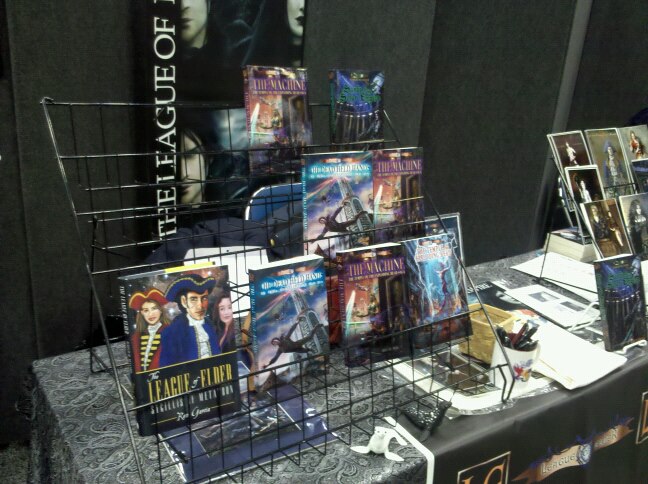
My depleted rack at Gencon as the show concluded
So, next year, I look forward to another outing at Gencon, and I also look forward to another go at Stillwater where vice and all that goes with it makes for great sales.
Bowl Naked
RG
copyright 2012, Ren Garcia
Book VI Around the Corner
July 25, 2012
 LoE Book VI, The Sands of the Solar Empire, is finally just around the corner in time for the summer convention season. I should have it in my hand in time for Gencon in August. We will also be doing a few free giveaways on Kindle Select, something I’ve not tried before.
Now that the Book is nearly ready, the hard part comes: Marketing. Writing a book is easy, marketing it is hard, and it never ends.We’re going to try a few new avenue this time to get the word out. Most of my past sales are direct POS–conventions, shows, flea markets and other such places where I can set my table up and place my fanny. Of course, we’re going to do the standard Facebook/twitter rounds, and I might even try diving into avenues such as Smashwords. One avenue, though a little expensive, is Publisher’s Weekly. We’re thinking about doing a mass ad from Loconeal advertising a number of upcoming titles.
Oh …. this is so complicated and tiring. I just wanna’ write the books, somebody else do this!!
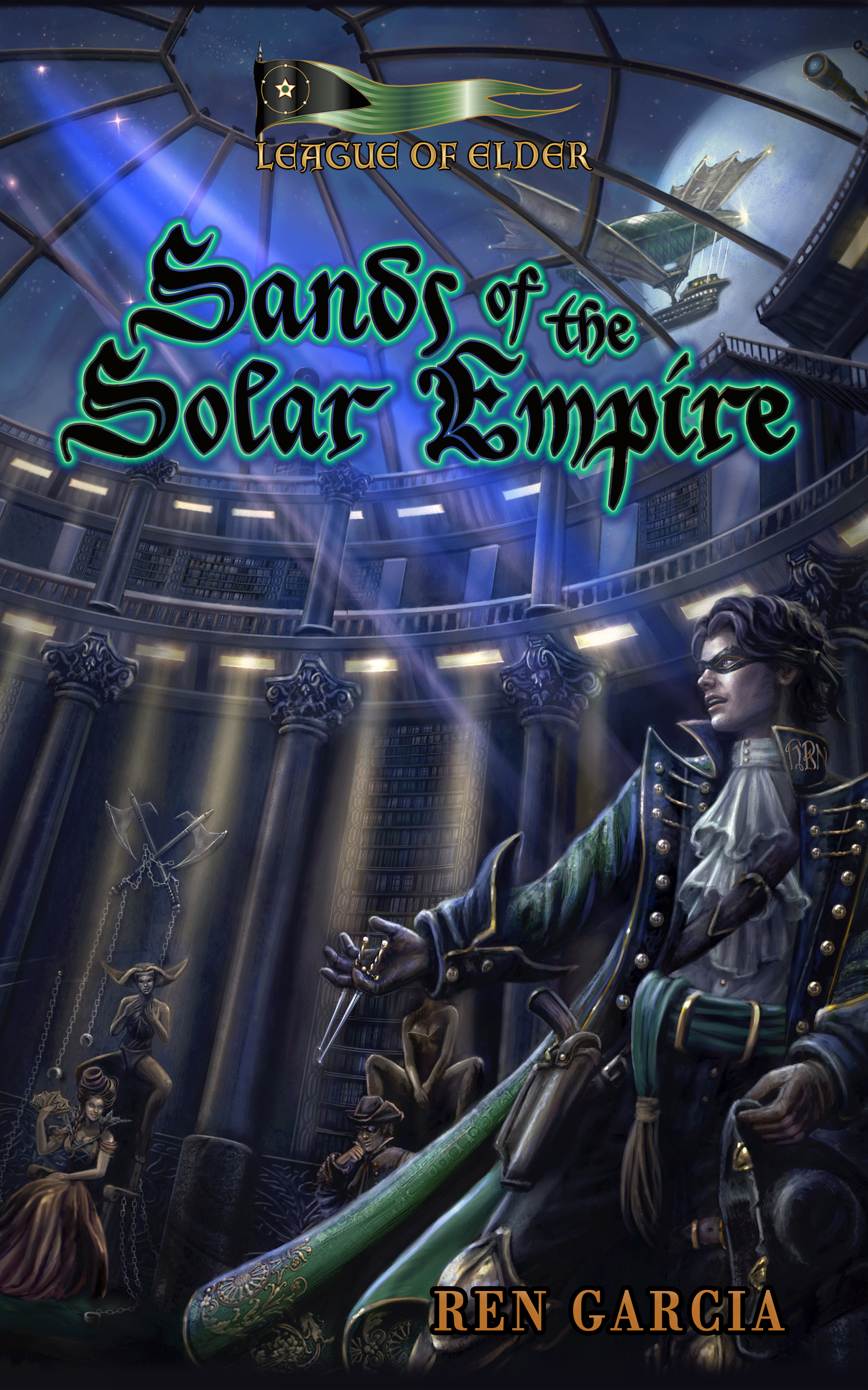 Sands of the Solar Empire from be out August 2012 from Loconeal Publishing.
Bowl Naked
RG
copyright 2012, Ren Garcia
This is a post from last year, though it’s one of my favorite postings. I still pursue the Gray Note with greater or lesser success.

Perhaps you’ll understand what I’m about to share with you, and perhaps you won’t.
I often seek something I call The Gray Note. What is it?? It’s a sound that, when you hear, it takes you away, time forgotten, and your mind begins working at an incredible pace and in a rare harmony. My mentor at Ohio State told me about the existence of the Gray Note–that it was something he experienced once years before and had sought it out ever since. You never simply hear the Gray Note, it pulls you inside, like the embrace of an ancestor, and once you’re there conception is unbound and you’ve access to places in your own imagination never visited before–places you didn’t know existed. It’s like unlocking a hidden floor in a department store, full of treasures, where the public normally isn’t permitted to see.
I encountered it once on the Roebling…
View original post 363 more words
The Fiend of Calvert
July 9, 2012
The mass murderer and psychopath who came to be known as the Fiend of Calvert terrorized the southern portion of Kana for well over thirty years. The Calvertlands of Kana have always been considered the lowest and meanest on the planet and the specter of a mad killer loose amid the crooked streets and seedy wharves wasn’t surprising to both the Sisterhood of Light and the League Ex-Commons–why they assumed such things were common in Calvert.
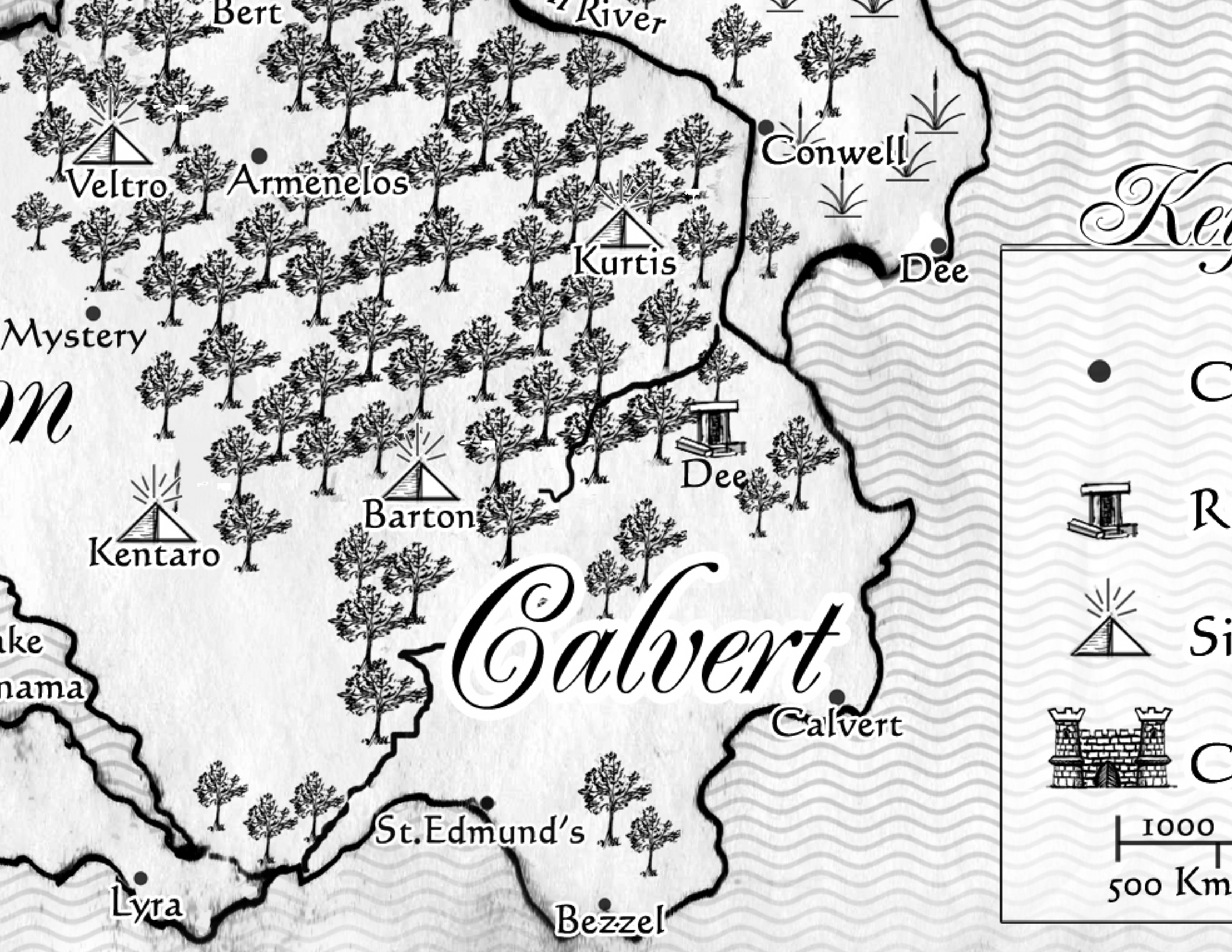
Map of the Calvert region of Kana
Coming of the Fiend
The murders began quietly enough, with various stumblebums and drunken sailors falling victim to the killer, sometimes out in the alleys and docks, sometimes in their modest rented rooms. The usual method of death: strangulation. The occasional death of a bum or sailor wasn’t unheard of in Calvert and not much attention was paid. But then more and more sailors and bums turned up dead, turned up missing. The Night of Unheard Cries in the city of St. Edmunds officially began the hysteria when ten sailors were found strangled to death in various sections of the city. The posts proclaimed: A Fiend Walks The Streets Of Calvert. The faceless killer now had a name.
There were plenty of clues to follow and it was assumed a simple genetic scan would bring the killer’s reign to a swift end. But, while the Fiend left a tantalizing abundance of clues: bits of cloth, shoe prints, partial fingerprints, his genetics were never found, not once in over a hundred murders. Another aspect of the Fiend’s work: he never harmed a single woman in thirty years, only men.
Lord Plaid, one of the Fiend’s more well-known victims
The Spirit of Calvert Dies
When the investigators from Calvert found the case too daunting, they brought in Gifted investigators from the west and the North, from Remnath and Vithland. Even they, however, could not stem the growing tide of death and mayhem and one of them, Lord Plaid, fell victim to the Fiend himself, found strangled to death in his room.
A result of all this was a pronounced change in Calvert. The locals began locking their doors at night, they began walking the streets with eyes down-cast and refusing a strangers’ needs. The greatest victim of the Fiend of Calvert was the spirit of the region itself.

The Mad Lord of Walther eventually put an end to the Fiend’s reign of terror
The City of the Dead
With the Mad Lord’s help, the rate of murders in Calvert plummeted. His presence appeared to hinder the Fiend and kept him in check in the final five years of his reign. The Mad Lord eventually made a key discovery. He located a vault near the Ruins of Woodward where a great many men from Calvert, assumed to be victims of the Fiend, were imprisoned. They seemed to be in a trance of some sort from which they could not be roused, and the posts called the vault the City of the Dead.
Harvesting a trove of clues from the Woodward vault, the Mad Lord successfully engaged the Fiend in St. Edmund’s and defeated him in battle. Wounded, the Fiend fled across the rooftops of St. Edmund’s with the Mad Lord in close pursuit, and he was not seen again.
And so passed the Fiend of Calvert.

Grand Dame Miranda of Rosel is a noted historian on the Fiend of Calvert
The Mad Lord, the man who stopped the Fiend, often wrote about him in his memoirs. The Mad Lord was always known to spin a good tale and his claims regarding the Fiend were particularly spectacular. He claimed that he saw the Fiend not as a man, but as a powerful woman dressed in gray.
None took the Mad Lord too seriously.
See the Fiend of Calvert in LoE Book VI: the Sands of the Solar Empire, coming July 2012
copyright 2012, Ren Garcia and Carol Phillips
SOTSE Characters: Lt. Gwendolyn
June 26, 2012

“Lt. Gwendolyn” by Eve Ventrue
Indeed, Gwen did have a bit of trouble with her temper. Her uncle of the Cone side of the family, Derlith, was fond of his niece and helped her channel her aggressions in constructive ways. He got her into contact sports: boxing, sambo, grappling–all things Zenon-girls was not expected to do. Gwen’s size and solidity helped to excel in those sports and Uncle Derlith took her to compete in tournaments every year on Onaris. She has a slight limp from a broken ankle suffered in one of those tournaments when she refused to submit from a sunk-in ankle-lock. Gwen also, unlike her sisters, mastered the FEDULA, the LosCapricos weapon of the Prentiss Household. She was quite deadly with it.

Lt. Gwendolyn wearing a Fleet Tremblar Uniform (note, the rapier-like FEDULA at her hip) –painting by Eve Ventrue
There was a darkness that seemed to hang over Gwen growing up. She had an aunt on her mother’s Cone side of the family who terrified her. Darkness seemed to walk with the woman, and when she came to Prentiss for a visit, Gwen often hid. Even the lurid sound of her voice scared Gwen. Through the vents in the manor, Gwen could hear her aunt frequently talking about some woman to the east whom she despised and cursed. She even hated her son, a boy named Stenstrom whom she hoped to torment.
And, eventually, her aunt would call for Gwen. “GWENDOLYN… COME HERE!!” rang out in her thoughts. Dreading each step, Gwen would come down the stairs and enter the parlor where her aunt and darkness waited.
copyright 2012, Ren Garcia and Eve Ventrue
SOTSE Characters: Lady Vendra of Cone
June 18, 2012
In what she thought would be the opening notes for the symphony of the rest of her life, the great Nether Day Ball in the city of Feren turned out to be one of the last.
“Lady Vendra of Cone” by Eve Ventrue
When she came of age, her mother persuaded her to join the Posts. For a small initial fee, one could leave a letter in a general Fleet Posthole and any Fleet member who was looking to have a pen pal could respond and strike up a rapport. Vendra thoughtfully penned her letter and submitted it. She got many responses, though most she rejected. One, however, stood out. Lord Stenstrom of Belmont, a young Com officer aboard the Fleet Webber Amazing had answered her post. Vendra liked his simple wit and fine penmanship and decided to answer his reply. They soon, via correspondence, struck up a healthy friendship. With each exchange of letters, Vendra was more and more convinced that Lord Stenstrom was the man for her.
When all of the Cone daughters, except for Sephla who was on the BANNED list, were invited to the much-anticipated Nether Day Ball in Feren, Vendra immediately penned Lord Stenstrom a note and entreated him to accompany her.
She promised it would be an evening neither would ever forget.
Though she reserved final judgement until she met him in person, Vendra felt herself losing her heart to Lord Stenstrom, and when she saw him at last tall and handsome in his Fleet uniform, that was all–she was in love. They took an introductory swirl across the ballroom floor, every step a wonder. She tingled at his touch. They were such a fine pairing. After the dance, Vendra excused herself and Stenstrom went to get her a glass of punch. She gathered her friends and pulled them aside. She could barely speak she was so excited.
Lord Stenstrom.
Lord Stenstrom!
Everything she hoped he’d be.
Tall.
Handsome.
A fine Zenon House.
Perfect.
“In love. I’m in love,” she told her friends, breathless, and they clapped and congratulated her.
In later years, as she sat in a daze in her dreary convent room on the nightmarish world of Carina 7, she would reflect back on that fateful moment, standing amid her friends, speaking so freely of the new love growing in her heart. She would reflect back on the great mistake she made letting Stenstrom go, of parting with him. She should have stayed and gotten punch with him.
She should have never let him go.
In her excitement, she forgot about her sister, Lady Sephla, and all the enemies she had rolling about Kana. She forgot about the social game on Kana, the one-upmanship, the tawdry little ploys ladies played upon each other.

“Lady Jubilee” by Eve Ventrue
When she returned to the ballroom floor, she couldn’t find Lord Stenstrom anywhere. Where had he gone? She smiled as she checked the nooks and corners.
Where could he be?
And then she saw him, out on the dance floor with some silver-haired girl Vendra had never seen before. She tried to get his attention, to pull him away from the intruder, but she could not. That woman was nailed to him, eyes locked, feet in step. Eventually, arm-in-arm, they left the floor and vanished, probably retreating to some quiet alcove or terrace, the silver-haired girl taking what should have been hers.
She would later learn that silver-haired girl was Lady Jubilee of Tyrol, one of her sister’s most heated rivals.
The anger, the rage, the broken heart. It was too much. She threw all her colorful Cone gowns out her window, put on an ugly gray suit, and threw herself out as well. She survived her suicide attempt and went mad. Her family, not knowing what to do with her, committed Vendra to a convent on Carina 7 where they heard she would receive the best of care.
As her family departed in their transport, the dames of the convent converged on her room and slammed the door behind them.
“We have things to teach you, Lady Vendra,” they said, eager. “Wondrous things …”
–Lady Vendra of Cone appears in LoE Book VI: The Sands of the Solar Empire coming soon from Loconeal Publishing.
copyright 2012, Ren Garcia and Eve Ventrue
 The Temple of the Exploding Head