Fiend of Calvert Horror/Mystery Anthology is Accepting Submissions
October 10, 2012
The author of the League of Elder series is looking for you! We’re collecting stories for an anthology focused on the Fiend of Calvert, a Jack-the-Ripper style killer featured in LoE Book VI: Sands of the Solar Empire.

Exterior of Fiend Pamphlet (Art by Carol Phillips)
What we don’t want: Stories with excessive profanity, erotica, splatter horror or hate fiction. Illustrations depicting explicit frontal nudity will not be accepted.
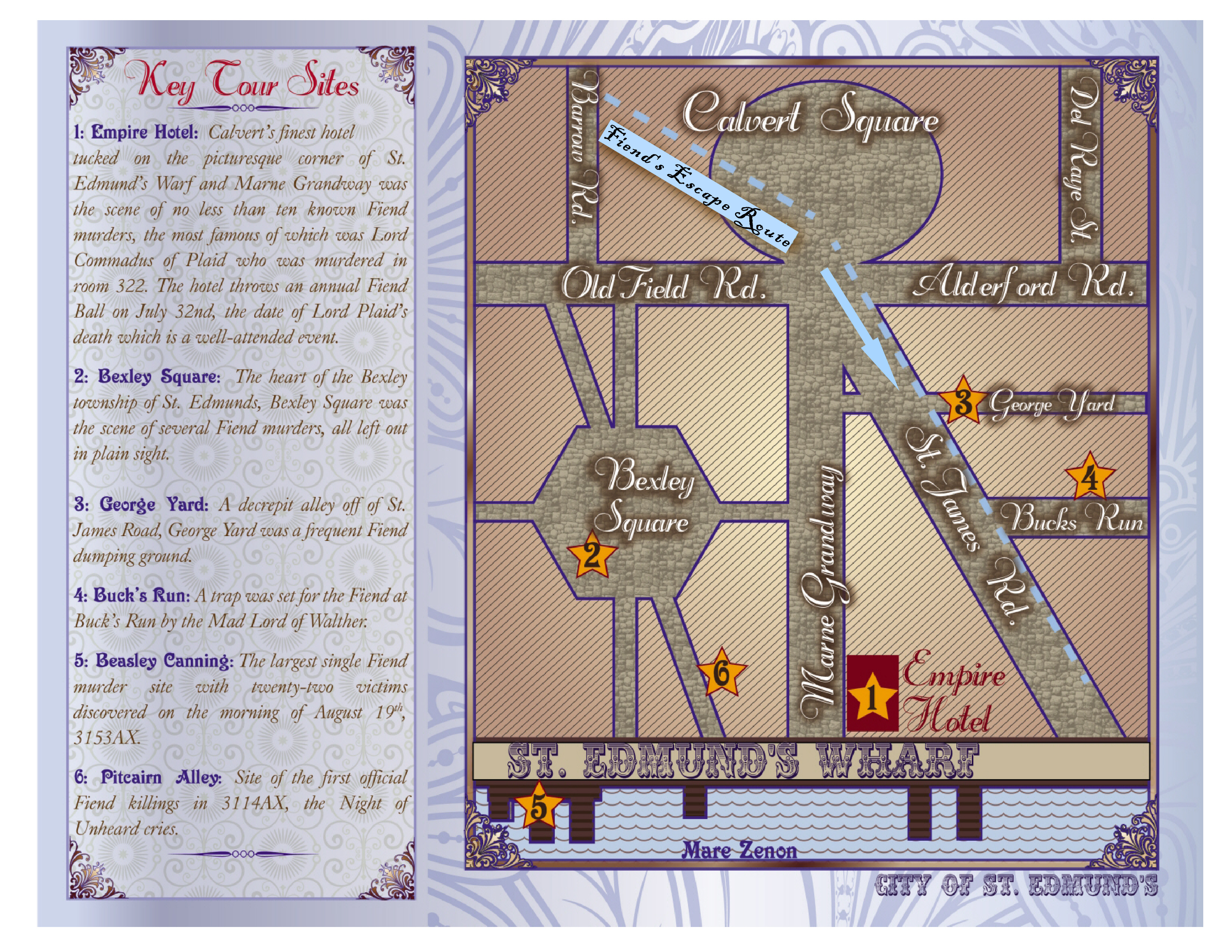
Interior of Fiend Pamphlet (Art by Carol Phillips)

Map of the Calvert Region of Kana
Payment: Payment for accepted submissions will be made in the form of a check within two months of publication. If preferred, payment may be made through a PayPal account. Authors of an accepted short story will be paid at the rate of 1¢ per word, up to a maximum of $100 US for stories and $50 US for poetry.
Rights: We purchase exclusive worldwide print and electronic rights. These rights exist from the point of contract to a period of two years from the date of publication. It is also understood and agreed that Ren Garcia may retain the right to archive the Work for reprinting use only in the anthology format. The author shall retain all other rights to the Work not specified here.
How to submit: Send us via email a short 150 word or less blurb (written in third-person) describing your story along with your planned final word count (approximating is fine) and what sort of story it is (sci-fi, horror, steam punk, etc). Please also include the first few pages so we can get a feel for your writing style. We’re flexible about silly stuff like spacing, font, justification and all that, however, if you turn in an overtly unprofessional submission it probably won’t go very far.
Multiple Submissions: Only one story, or up to 3 poems per author will be considered. Illustrators/artists may submit up to two illustrations. All submissions must be submitted separately (one submission per email).
Simultaneous Submissions: Simultaneous submissions are not permitted due to the fact that the Fiend of Calvert and associated characters/environs are League of Elder trademarks.
Response time: 1-4 months depending on your submission date. Our responses will come in the form of a simple form letter via e-mail.
copyright, 2012, Ren Garcia and Carol Phillips
TOTSE: The Pilgrims of Merian
September 2, 2012

Sketch of the cover to LoE Book VII “Against the Druries” featuring a Merian ship attempting to rescue the wreck of the Demophalon John (Carol Phillips)
The chief tenet of their teachings is that the Elders of Old are not gone, only relocated. They believe in the Star of Merian, the astral presence of the Elder Merian thought to be long dead. They say those with clear sight can see the Star of Merian as a great yellow star, easily visible in broad daylight, and that it is wreathed in a twisting red cloud. A prerequisite to joining the order is to be able to see the star.
The Merians travel the countryside by way of floatwagons covered with tarpaulins. They have no known permanent headquarters and make a meager living selling hand-made trinkets and cloth and performing calligraphy (see below). When asked where they come from, the Merians always say “Westwood“, though such a place has never been located. Occasionally, the Merians will stop and settle in one place for a year or two. They often ask the local Lord or Lady permission to settle, and, when granted, build a temporary village called a Hermitage. The estate of Belmont-South Tyrol resides on the grounds of an old Merian Heritage. Though they are impoverished in the extreme, those who enter a Merian Hermitage are welcome to share in anything they have.

“Lady Alesta of Dare and Pilgrim of Merian” by Eve Ventrue
Though threadbare and impoverished, it is said in some quarters that the Merians are much more capable and advanced than they let on. Some say that their belts allow them to pass unseen if they wish, and their beaded necklaces shield the wearer’s mind from attacks and illusion. There is also the various tales that the Merians may travel virtually anywhere they wish at the blink on an eye via an arcane bridge called The Merian’s Road. Xaphan Traders often tell tales of selfless, green-robed people who walk into peril to rescue those in need and that they travel by way of a “Road” wreathed in fog.
Such tales have never been verified and the Merians themselves never speak of such things.
copyright 2012, Ren Garcia, Eve Ventrue and Carol Phillips.
The Fiend of Calvert
July 9, 2012
The mass murderer and psychopath who came to be known as the Fiend of Calvert terrorized the southern portion of Kana for well over thirty years. The Calvertlands of Kana have always been considered the lowest and meanest on the planet and the specter of a mad killer loose amid the crooked streets and seedy wharves wasn’t surprising to both the Sisterhood of Light and the League Ex-Commons–why they assumed such things were common in Calvert.
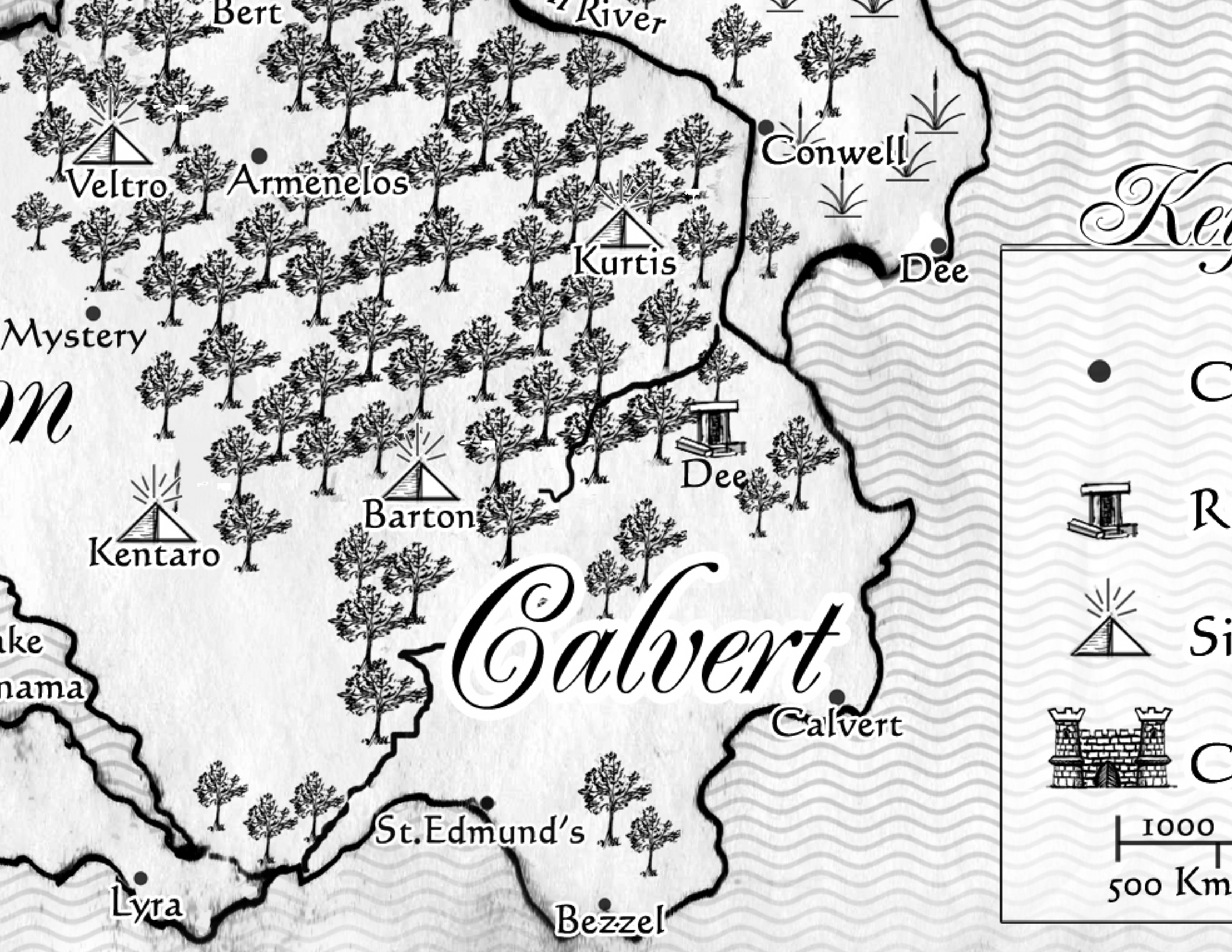
Map of the Calvert region of Kana
Coming of the Fiend
The murders began quietly enough, with various stumblebums and drunken sailors falling victim to the killer, sometimes out in the alleys and docks, sometimes in their modest rented rooms. The usual method of death: strangulation. The occasional death of a bum or sailor wasn’t unheard of in Calvert and not much attention was paid. But then more and more sailors and bums turned up dead, turned up missing. The Night of Unheard Cries in the city of St. Edmunds officially began the hysteria when ten sailors were found strangled to death in various sections of the city. The posts proclaimed: A Fiend Walks The Streets Of Calvert. The faceless killer now had a name.
There were plenty of clues to follow and it was assumed a simple genetic scan would bring the killer’s reign to a swift end. But, while the Fiend left a tantalizing abundance of clues: bits of cloth, shoe prints, partial fingerprints, his genetics were never found, not once in over a hundred murders. Another aspect of the Fiend’s work: he never harmed a single woman in thirty years, only men.
Lord Plaid, one of the Fiend’s more well-known victims
The Spirit of Calvert Dies
When the investigators from Calvert found the case too daunting, they brought in Gifted investigators from the west and the North, from Remnath and Vithland. Even they, however, could not stem the growing tide of death and mayhem and one of them, Lord Plaid, fell victim to the Fiend himself, found strangled to death in his room.
A result of all this was a pronounced change in Calvert. The locals began locking their doors at night, they began walking the streets with eyes down-cast and refusing a strangers’ needs. The greatest victim of the Fiend of Calvert was the spirit of the region itself.

The Mad Lord of Walther eventually put an end to the Fiend’s reign of terror
The City of the Dead
With the Mad Lord’s help, the rate of murders in Calvert plummeted. His presence appeared to hinder the Fiend and kept him in check in the final five years of his reign. The Mad Lord eventually made a key discovery. He located a vault near the Ruins of Woodward where a great many men from Calvert, assumed to be victims of the Fiend, were imprisoned. They seemed to be in a trance of some sort from which they could not be roused, and the posts called the vault the City of the Dead.
Harvesting a trove of clues from the Woodward vault, the Mad Lord successfully engaged the Fiend in St. Edmund’s and defeated him in battle. Wounded, the Fiend fled across the rooftops of St. Edmund’s with the Mad Lord in close pursuit, and he was not seen again.
And so passed the Fiend of Calvert.

Grand Dame Miranda of Rosel is a noted historian on the Fiend of Calvert
The Mad Lord, the man who stopped the Fiend, often wrote about him in his memoirs. The Mad Lord was always known to spin a good tale and his claims regarding the Fiend were particularly spectacular. He claimed that he saw the Fiend not as a man, but as a powerful woman dressed in gray.
None took the Mad Lord too seriously.
See the Fiend of Calvert in LoE Book VI: the Sands of the Solar Empire, coming July 2012
copyright 2012, Ren Garcia and Carol Phillips
SOTSE Characters: Lt. Gwendolyn
June 26, 2012

“Lt. Gwendolyn” by Eve Ventrue
Indeed, Gwen did have a bit of trouble with her temper. Her uncle of the Cone side of the family, Derlith, was fond of his niece and helped her channel her aggressions in constructive ways. He got her into contact sports: boxing, sambo, grappling–all things Zenon-girls was not expected to do. Gwen’s size and solidity helped to excel in those sports and Uncle Derlith took her to compete in tournaments every year on Onaris. She has a slight limp from a broken ankle suffered in one of those tournaments when she refused to submit from a sunk-in ankle-lock. Gwen also, unlike her sisters, mastered the FEDULA, the LosCapricos weapon of the Prentiss Household. She was quite deadly with it.

Lt. Gwendolyn wearing a Fleet Tremblar Uniform (note, the rapier-like FEDULA at her hip) –painting by Eve Ventrue
There was a darkness that seemed to hang over Gwen growing up. She had an aunt on her mother’s Cone side of the family who terrified her. Darkness seemed to walk with the woman, and when she came to Prentiss for a visit, Gwen often hid. Even the lurid sound of her voice scared Gwen. Through the vents in the manor, Gwen could hear her aunt frequently talking about some woman to the east whom she despised and cursed. She even hated her son, a boy named Stenstrom whom she hoped to torment.
And, eventually, her aunt would call for Gwen. “GWENDOLYN… COME HERE!!” rang out in her thoughts. Dreading each step, Gwen would come down the stairs and enter the parlor where her aunt and darkness waited.
copyright 2012, Ren Garcia and Eve Ventrue
SOTSE Characters: Lady Vendra of Cone
June 18, 2012
In what she thought would be the opening notes for the symphony of the rest of her life, the great Nether Day Ball in the city of Feren turned out to be one of the last.
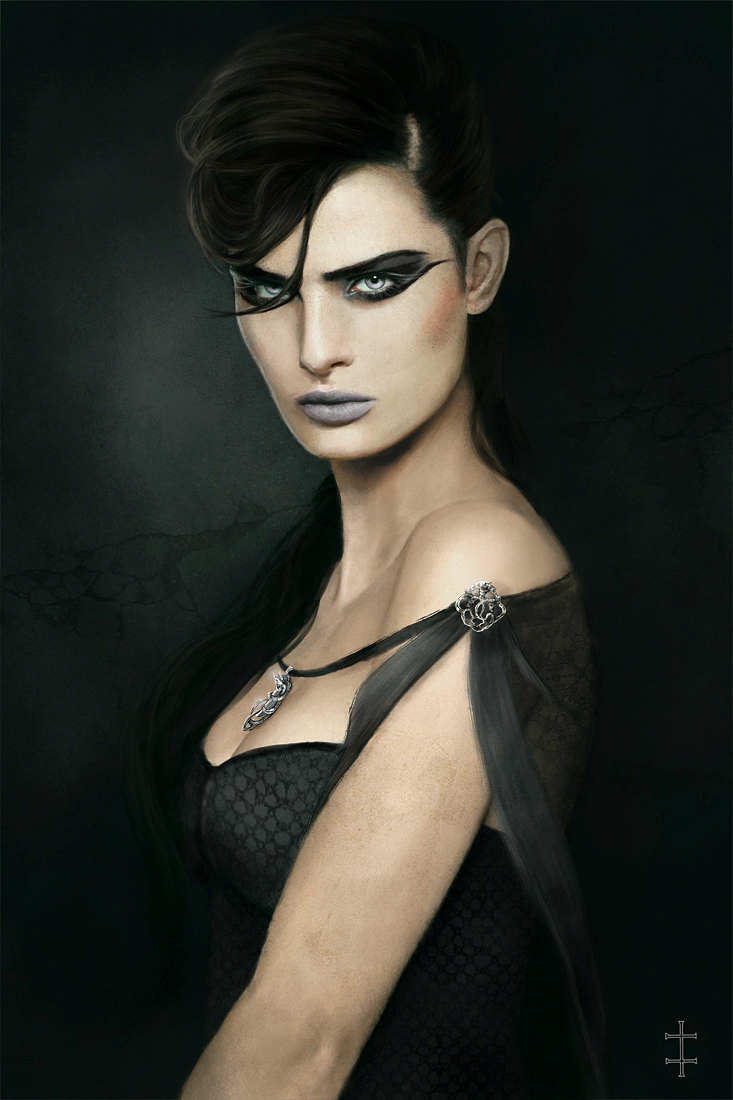
“Lady Vendra of Cone” by Eve Ventrue
When she came of age, her mother persuaded her to join the Posts. For a small initial fee, one could leave a letter in a general Fleet Posthole and any Fleet member who was looking to have a pen pal could respond and strike up a rapport. Vendra thoughtfully penned her letter and submitted it. She got many responses, though most she rejected. One, however, stood out. Lord Stenstrom of Belmont, a young Com officer aboard the Fleet Webber Amazing had answered her post. Vendra liked his simple wit and fine penmanship and decided to answer his reply. They soon, via correspondence, struck up a healthy friendship. With each exchange of letters, Vendra was more and more convinced that Lord Stenstrom was the man for her.
When all of the Cone daughters, except for Sephla who was on the BANNED list, were invited to the much-anticipated Nether Day Ball in Feren, Vendra immediately penned Lord Stenstrom a note and entreated him to accompany her.
She promised it would be an evening neither would ever forget.
Though she reserved final judgement until she met him in person, Vendra felt herself losing her heart to Lord Stenstrom, and when she saw him at last tall and handsome in his Fleet uniform, that was all–she was in love. They took an introductory swirl across the ballroom floor, every step a wonder. She tingled at his touch. They were such a fine pairing. After the dance, Vendra excused herself and Stenstrom went to get her a glass of punch. She gathered her friends and pulled them aside. She could barely speak she was so excited.
Lord Stenstrom.
Lord Stenstrom!
Everything she hoped he’d be.
Tall.
Handsome.
A fine Zenon House.
Perfect.
“In love. I’m in love,” she told her friends, breathless, and they clapped and congratulated her.
In later years, as she sat in a daze in her dreary convent room on the nightmarish world of Carina 7, she would reflect back on that fateful moment, standing amid her friends, speaking so freely of the new love growing in her heart. She would reflect back on the great mistake she made letting Stenstrom go, of parting with him. She should have stayed and gotten punch with him.
She should have never let him go.
In her excitement, she forgot about her sister, Lady Sephla, and all the enemies she had rolling about Kana. She forgot about the social game on Kana, the one-upmanship, the tawdry little ploys ladies played upon each other.
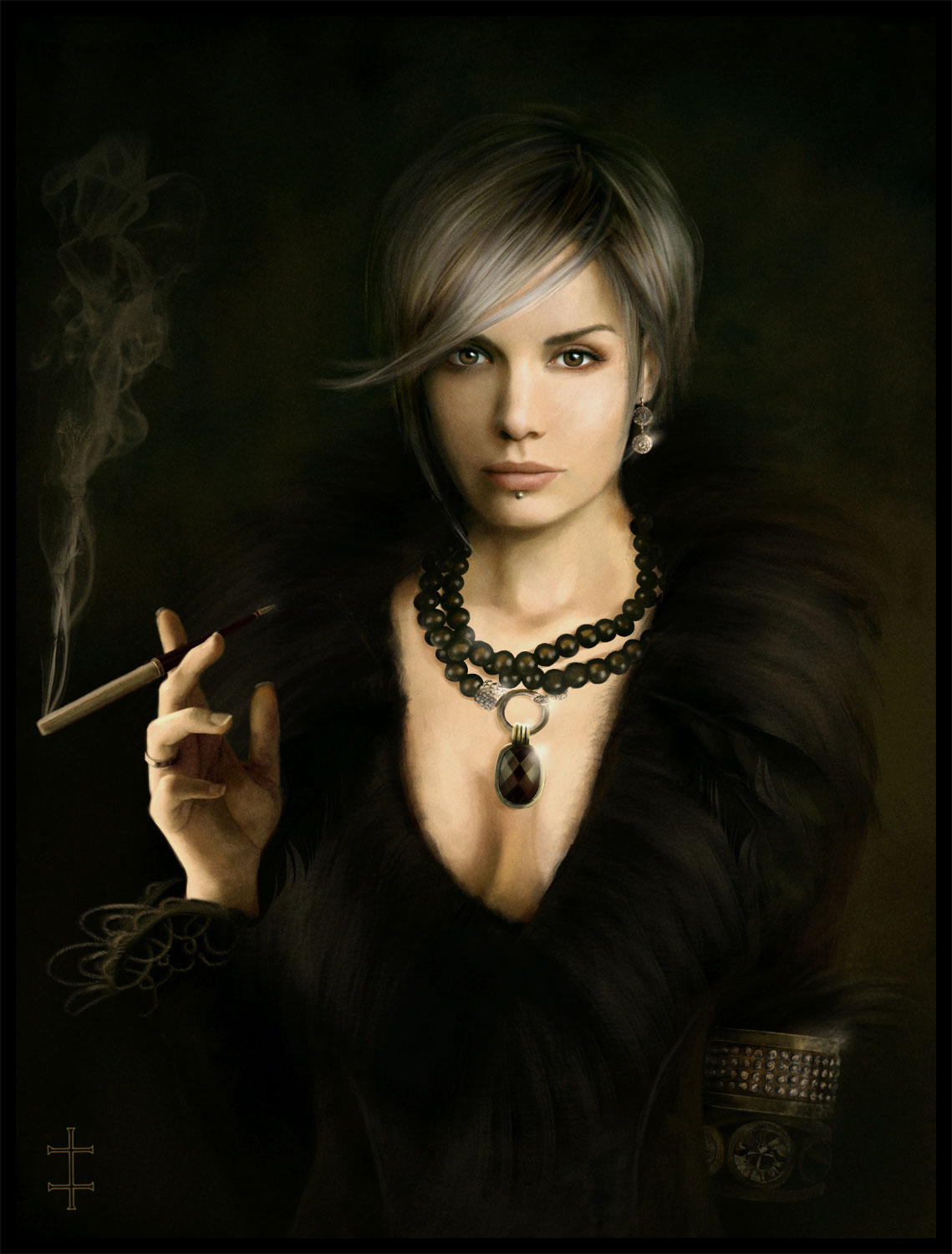
“Lady Jubilee” by Eve Ventrue
When she returned to the ballroom floor, she couldn’t find Lord Stenstrom anywhere. Where had he gone? She smiled as she checked the nooks and corners.
Where could he be?
And then she saw him, out on the dance floor with some silver-haired girl Vendra had never seen before. She tried to get his attention, to pull him away from the intruder, but she could not. That woman was nailed to him, eyes locked, feet in step. Eventually, arm-in-arm, they left the floor and vanished, probably retreating to some quiet alcove or terrace, the silver-haired girl taking what should have been hers.
She would later learn that silver-haired girl was Lady Jubilee of Tyrol, one of her sister’s most heated rivals.
The anger, the rage, the broken heart. It was too much. She threw all her colorful Cone gowns out her window, put on an ugly gray suit, and threw herself out as well. She survived her suicide attempt and went mad. Her family, not knowing what to do with her, committed Vendra to a convent on Carina 7 where they heard she would receive the best of care.
As her family departed in their transport, the dames of the convent converged on her room and slammed the door behind them.
“We have things to teach you, Lady Vendra,” they said, eager. “Wondrous things …”
–Lady Vendra of Cone appears in LoE Book VI: The Sands of the Solar Empire coming soon from Loconeal Publishing.
copyright 2012, Ren Garcia and Eve Ventrue
World’s Worst Blurbist III
May 31, 2012
 The time I live in fear of has come again: time to create the back cover marketing for Book VI The Sands of the Solar Empire.
I find the whole process bewildering, like trying to select a protein bar at GNC: so many choices, so many ways to put two feet wrong. Sometimes I wish I had a line of editors to do this stuff for me, but then I come to my senses and thank the Lord I don’t.
So, I stumble and flail about, trying how best to summarize a 115,000 word book in 200 or less.
All things considered, this book wasn’t as hard to summarize as, say, Book II, The Hazards of the One Ones which caused me no end of pain and suffering. Book VI is a little less complicated than Book II. I think it flows well enough, but what do I know??
copyright 2012, Ren Garcia
Book VI Cover Complete!
May 26, 2012
Whenever Carol Phillips finishes a new cover it’s like Christmas for me, eagerly huddled up next to my email waiting for that little electronic package to come skittering down the proverbial chimney.
And, here it is…
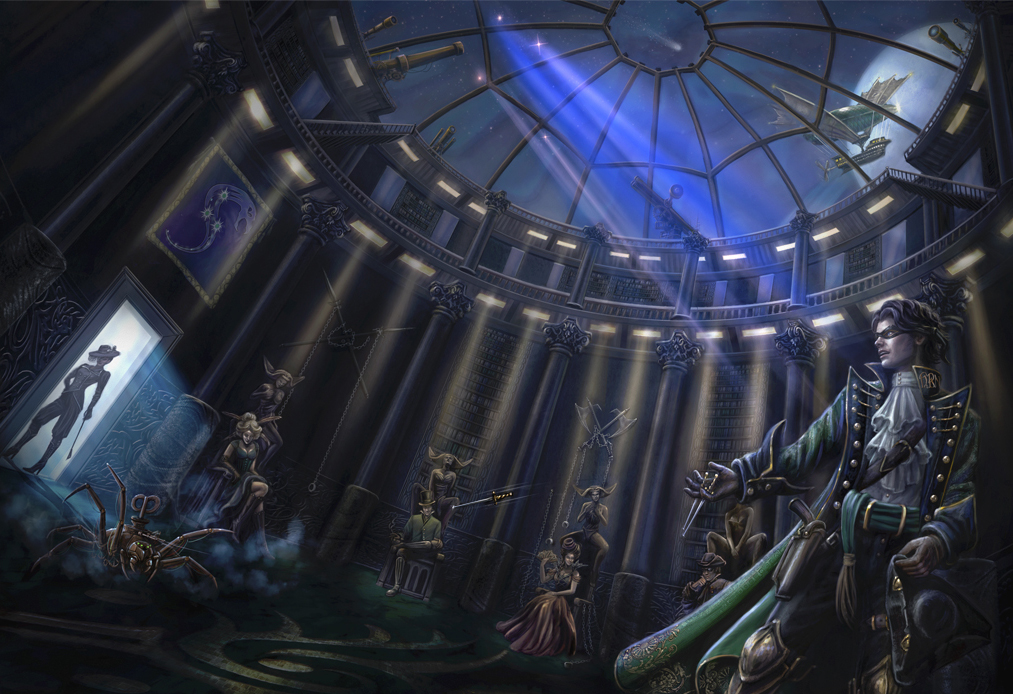
“The Sands of the Solar Empire” by Carol Phillips
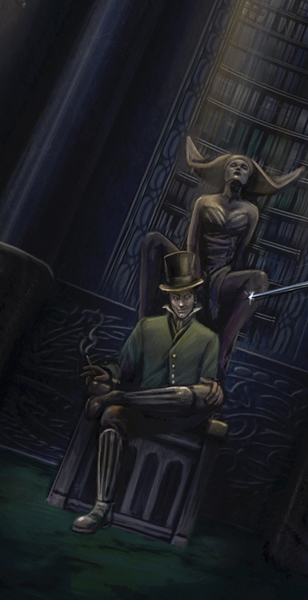
Lord Bannaster of the Bones Club, by Carol Phillips
It’s a much darker cover than the previous five, even more so than the Temple of the Exploding Head, which is pretty darn dark. It features a steam-driven geared spider with guns, a balloon/air ship and the constellation Camalopardus and the Sanctum Sanctorum of the Bones Club. The Sanctum comes from my recollections of a Masonic temple that I once wandered into, and here it is in full paint, fully steampunked and super-charged a little.
I can’t wait to finish collecting the interior artwork and get it out to the world.
Look for LoE Book VI: The Sands of the Solar Empire coming this August from Loconeal Publications
copyright 2012, Ren Garcia and Carol Phillips
SOTSE Characters: Lord A-Ram
April 23, 2012
JOSEPHUS, LORD OF A-RAM is a character in the upcoming LoE Book VI: Sands of the Solar Empire.
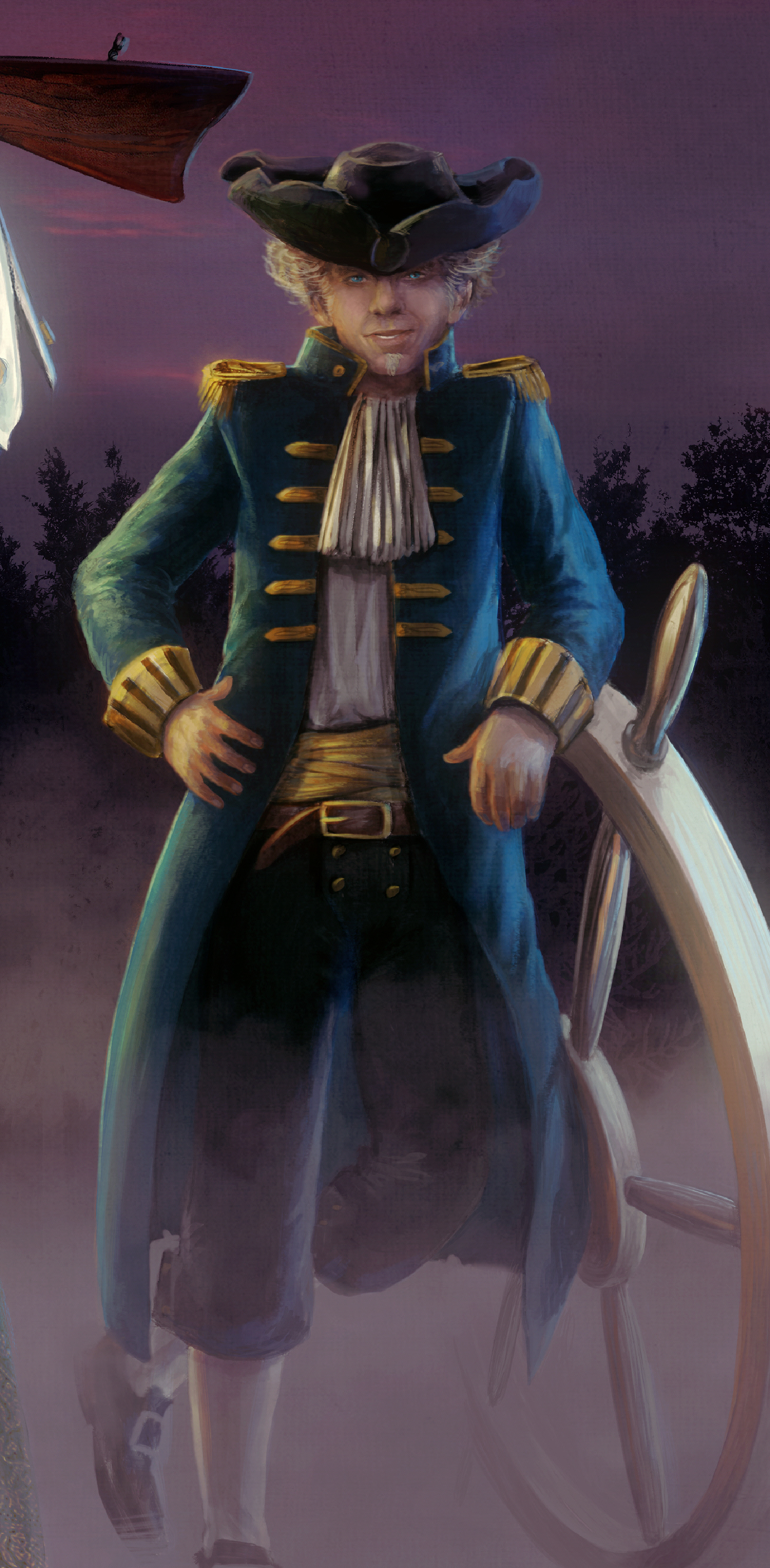
"A-Ram" by Fantasio
The House would have a rather sordid history with the Sisterhood of Light, always trying to please and impress them and always falling short. Clovis of A-Ram, who had become a noted chef in the region, once accidentally gave food poisoning to a Sister who had come to sample his dishes. Another A-Ram patriarch, Arlie, put a Sister into traction while attempting to pull off a bang-bang move playing brandtball. Silly things like that tend to stick in the Sisters’ minds, and they have a long memory. They eventually slapped the dreaded Programmability tag of Venta-Nomi on the House of A-Ram, meaning they are “Untouchable”.
Josephus was the youngest of seven children of the current A-Ram line. Tiny, slope-shouldered and badly near-sighted, Josephus (or simply A-Ram as he liked to be called) was a frail and sea-sick young lad, unable to go out with his father on the boats. He stayed ashore with his mother and sisters. His older brother, Ephelrood, gave him no peace for it and often bullied him. Despite his various shortcomings, A-Ram had a good mind and a quiet sort of tenacity about him. He was usually near the top of his class.

The Sisterhood of Light never gave the House of A-Ram much thought. (Eve Ventrue)
He got out of the mailroom by taking a position nobody else wanted, becoming the personal adjutant to Admiral Derlith of Cone, a notorious crabhead and yeller. Though often berated in public by the Admiral, A-Ram thrived. He never forgot his love of flying and often snuck into the simulators to fly as many types of ships as he could.
A-Ram had an intense fear/fascination with a serial murderer who terrorized the Calvert region known as the Fiend of Calvert, and was convinced he’d once heard the bump, bump, bump of the Fiend’s footsteps as he ran across their townhouse roof.
A-Ram could not know that the tall man in the mask and HRN coat would soon change his life, forever.
copyright 2012, Ren Garcia and Fantasio
SOTSE Characters: Lady Jubilee
April 15, 2012
LADY JUBILEE OF BELMONT-SOUTH TYROL is the mother of Lord Stenstrom the Younger, the hero of LoE Book VI: The Sands of the Solar Empire. She was a key influence in his early life.
"Lady Jubilee" by Eve Ventrue
At a Nether Day ball, Jubilee overheard the younger sister of Lady Sephla speaking to her friends about a gentleman she was very keen on. Jubilee decided to steal the man to humiliate her. She marched out onto the dance floor to do her dirty work.
The gentleman in question was Lord Stenstrom of Belmont, an officer in the Stellar Fleet from Zenon. Handsome and black-haired, of all things Jubilee lost her heart to him and, after a torrid romance, she became his lady and bore him thirty children–twenty-nine daughters and one son, Stenstrom the Younger.
The enemies she made that night at the Nether Day ball would follow Jubilee and her children throughout her life.
Lady Jubilee was reputed to be a practitioner of Tyrol Sorcery. She was said to be a master at creating potions, brewing poisons, summoning demons, walking in the shadows and opening locked doors. She was a domineering and very intrusive mother, often disrupting her children’s lives. Many of her children ran away from home, only to be summoned back at her whim via sorcery. Her daughter, Lady Calami, ran away from home a record 4,000 times. Another Belmont daughter, Lady Constance, went Carofab to escape Jubilee’s clutches.
Lady Jubilee appears in The Sands of the Solar Empire, from Loconeal Publishing in June 2012
copyright 2012, Ren Garcia and Eve Ventrue
LoE Characters: Admiral Pax
April 3, 2012
There are lots of characters rolling around in the LoE universe, some are active and part of the various storylines, while others are more passive helping to set the stage.
Admiral Pax is one of those characters.

"Admiral Pax" by Eve Ventrue
Admiral Pax is the Lord of Adrastus, a stately Zenon House perched along the dark blue banks of the Great Blue Pierce river. His family fortune comes from the making of fine cheeses and breads and the fermentation of various types of expensive vinegar. His vinegar production has a Xaphan connection as they are often used in the Xaphan delicacy Ooust. Admiral Pax is often known as “Lord Vinegar” around the Fleet mentioned in giggled whispers.
The Admiral is not an incompetent. He has a fine mind for organization, logistics and battle strategy. His expert placement of Fleet assets during the iconic Battle of Sorrander-Quo helped stem the Xaphan tide and win the day for the League. He is also a tireless fund-raiser and has the ear of the Sisterhood of Light.
The problem with Admiral Pax is his tart, boorish nature. He lords his status over all he considers inferior to himself, which is virtually everybody. He is needy, fussy and maintains an entourage of no less than a hundred people who follow him everywhere he goes. A gregarious man, he often visits various parts of the League and always demands a full War-Bird escort to accompany him at Fleet expense–a ruinously expensive thing. For his excesses Captain Davage has branded him a “criminal” and a “miscreant” and coined the phrase: “Fraud, Waste, Abuse and Admiral Pax”.
At the beginning of Book VI, The Sands of the Solar Empire, Private Taara is assigned to guard a bust of Admiral Pax that is hidden in a lonely alcove as a punishment.
copyright 2012, Ren Garcia and Eve Ventrue
 The Temple of the Exploding Head