ATD Characters: Morgan-Jeterix
November 9, 2012

“Morgan Jeterix” by Eve Ventrue
She is a lady of the House of Thompson, a family of Hala stock. Being a Hala, her family were well-known farmers owning vast tracts of fertile land in the central Hala-lands about three hundred miles east of the Killbane River. The Thompsons are publicly acknowledged and certified by the Sisterhood of Light as being Empathic. As such, all Thompsons are registered and painted with a 4-D tattoo marking them as empaths that only the Sisters can see. Among the House’s various empathic talents is the ability to see through complex illusions.
Morgan was the twelfth of fifteen Thompson children. She is typically of sturdy build with tanned, swarthy skin and burnished blonde hair that she most-often wears braided. When she was thirteen, a fire broke out in the Thompson manor which eventually burned the structure to the ground. Morgan was rescued and carried to safety by her father, though he suffered terrible burns in the process. Seeing her father suffering from his wounds, Morgan decided to join the Grand Order of Hospitalers and become a healer.
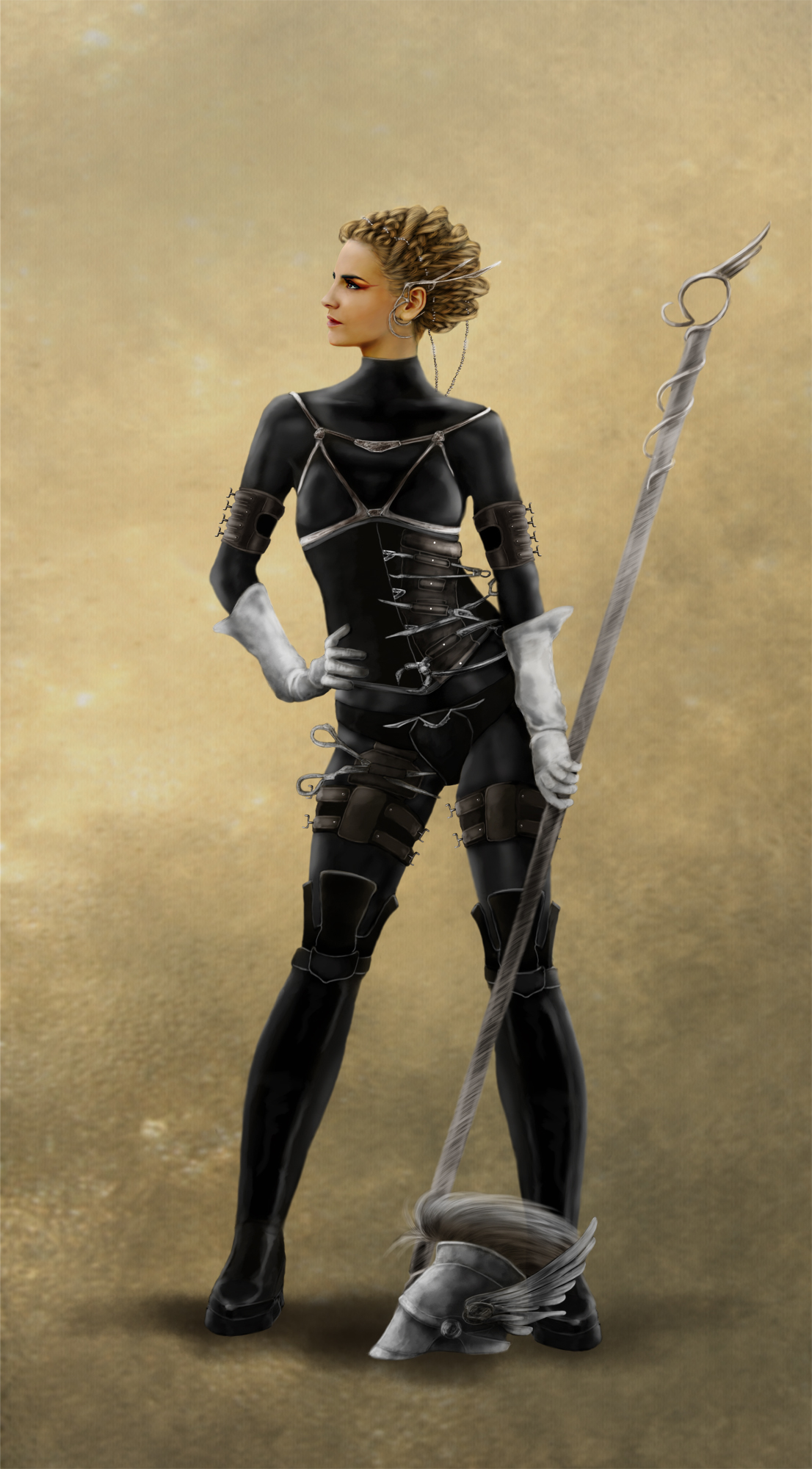
Morgan Jeterix in her Hospitaler uniform (painting by Eve Ventrue)
After nearly being killed in the fire as a girl, Morgan decided that life is precious and was determined to live it by following her heart no matter where it might lead. Her behavior afterwards was shocking by conservative Hala standards, earning her the epithet “Jeterix” which means Unmarried and Unprincipled in Hala. The “Jeterix” tag was normally a mark of shame for a woman in Hala society, but Morgan wore it with pride, officially adding it to her name. Morgan was well-known for her steamy and rather messy love affairs. She was constantly beginning a new relationship and ending an old one: her brief love affair with fellow Hospitaler and ex-Black Hat Bethrael of Moane was an A-List scandal in the city of Bern. Morgan did not confine herself to class, age, station or gender–any who caught her eye was a potential lover. Morgan was seductive and charming, and she had secretly learned the art of Xaphan Tropism (the art of inducing a sexual climax using minimal touches on non-erogenous parts of the body such as the wrists). Her touch was said to be “electric”.

Morgan would eventually teach Private Taara how to fight like a Hospitaler and the secrets of Xaphan Tropism (painting by Fantasio)
When Morgan met Paymaster Stenstrom and his friends Private Taara and Lord A-Ram, that’s when things really got interesting.
copyright 2012, Ren Garcia, Fantasio and Eve Ventrue
World’s Worst Blurbist, Part III
October 19, 2012
 Time to come up with the back cover Blurb for LoE Book VII: Against the Druries. Blurbing is without a doubt the thing I dislike most during the cover creation process–I’m not very good at being brief, I guess. Anyway, here it is. I added the text to the amazing painting of Lady Alesta by Kayla Woodside because I currently don’t have a paint wash of the Book VII cover yet. Carol Phillips is going to start painting it this weekend, she said.
Sorry if the text is a little small–just expand the pic and it reads just fine.
Copyright 2012, Ren Garcia and Kayla Woodside.
Carahil’s Daughter
October 4, 2012
As many people know full well, raising a child can be a trying and difficult undertaking. Children can be a veritable bundle of dynamite ready to explode at any moment despite one’s best efforts to diffuse them.

“Atha” by Fantasio
Take Carahil for example. Often considered a child himself, Carahil lost his heart to the Windwalker Mabsornath, the Cat Goddess of Zall 88 and they went off to the top of the Universal Tree and were wed. With marriage came children, seven of them in fact, four girls and three boys. Most of them were somber, thoughtful children, aware and weighed down with the burden and responsibility of being gods and the power the comes with it.
And then there was Atha. The youngest of the lot, Atha was an enigma to her parents in many ways. She most often chose to appear as a human instead of as an animal, as was the usual case: her brothers all appear as various types of seals, her sisters as wild cats. On occasion, Atha does appear as an animal, as a giant black snake, and, rarely, she appears as a cloud of smoke.
Most often, however, Atha chooses to appear as a human of changeable age, sometimes as a mischievous child and other times as a full-grown adult. In fact, she greatly resembles her grandmother, Lady Poe of Blanchefort, appearing tall and thin in a silvery gown and short platinum-blonde hair. Her one distinguishing feature–she always wears a pair of intricate, geared goggles as the ladies on Hoban often wear. The goggles are a constant feature whether Atha appears as a child or an adult, always perched on her nose covering a good portion of her face. Atha’s goggles are huge and protruding, rather like a pair of binoculars made of gold, silver and brass. It has been said that to see her eyes beneath the goggles is to go mad.
Atha shares much in common with her father. Atha keeps her word–if she promises something she follows through. She possesses his whimsy and unpredictable sense of fun and humor. She loves pranks and jokes, however, unlike her father whose pranks are always benign, Atha’s are anything but. She is selfish and self-absorbed, she is flighty as well, given to fits of rage and temper when things don’t go her way. According to various Hertog writings, she has a fascination with Vith heroes, both male and female, putting them through the wringer, literally torturing them (sometimes to death) with adventure and quest occasionally ruining their lives, and then, when she has had enough fun, she takes them into her bed and seduces them. Atha’s wanton promiscuity with the younger folk is well-known. In time, she became known in various pantheons as a goddess of mischief, of sex (and the misfortune of having sex) and questing.
Atha, also taking after her father, also has a habit as masquerading as other out-worldly entities, in particular, an entity known as the Shadow tech Goddess. Why she does such things is not known, though it is assumed such antics are for personal gain.
Carahil, though he loves his daughter, was beside himself and didn’t have a thought as to properly teach her not to do some of the things she often did. His solution to the problem was one many parents often make use of: he found Atha a “babysitter“, one whom he thought would teach Atha virtue and proper manners through deed and example. He therefore “dropped her off” at Castle Blanchefort to be taught by the people there and, with luck, her positive experiences would calm her down a little.
There she came under the tutelage of Maser of Blanchefort, his mentor and lover Laika of Stonebringer Tower, Sebastian of Tusck and Millicent of Blanchefort, a distant cousin of hers.
Would it do her any good–only time will tell.
copyright 2012, Ren Garcia and Fantasio
SOTSE Characters: Lady Alesta of Dare
September 28, 2012
Lady Alesta of Dare is a girl of Barrow stock hailing from the western city of the same name. The Dares are the largest extended family on Kana with over sixty percent of people of Barrow stock being Dares.
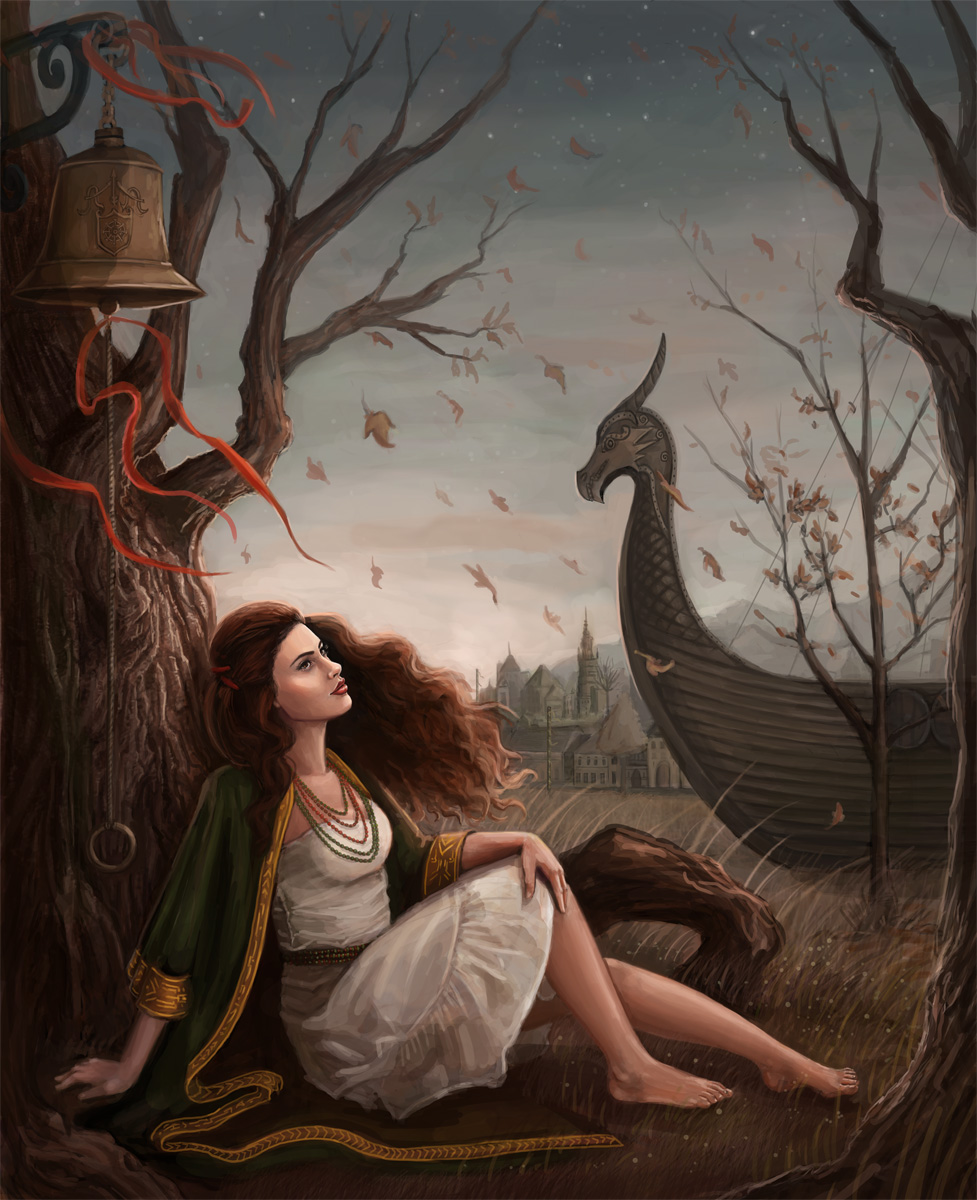
“Lady Alesta of Dare” by Kayla Woodside
When visiting the marketplace with her mother, she often saw a group of apparently impoverished beggars being harassed in the town square by gawkers. She asked her mother who the beggars were and her mother told her: “Pilgrims of Merian,” and she said nothing more, hurrying on.
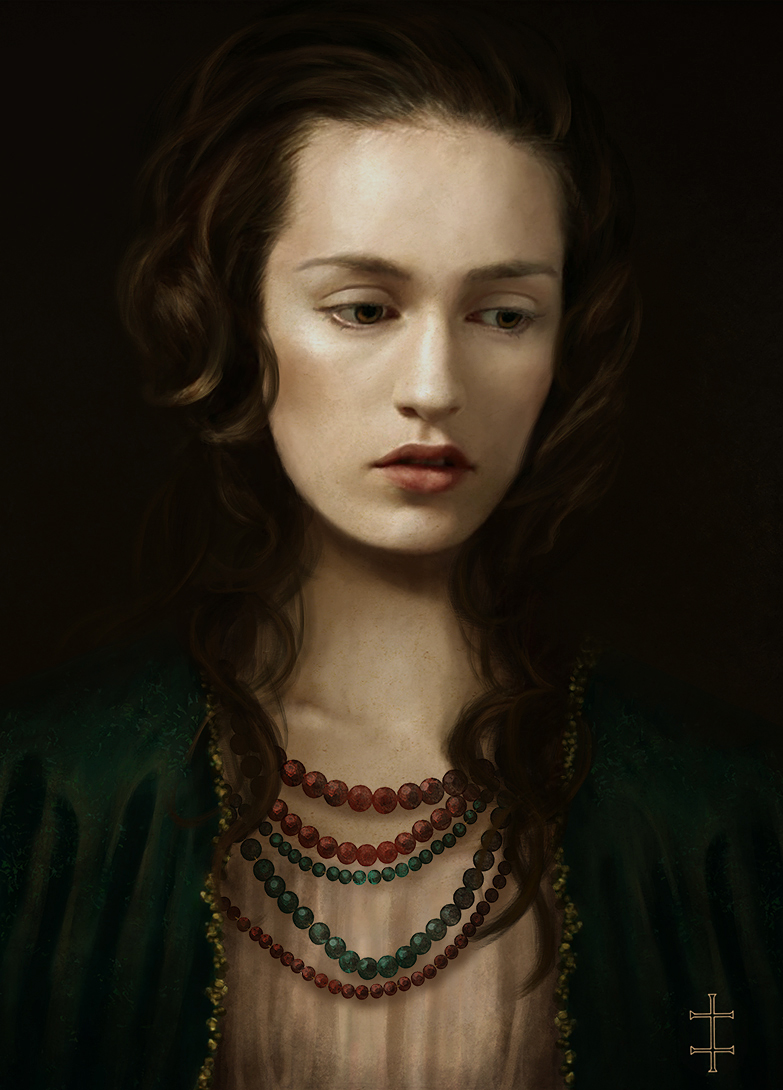
“Alesta” by Eve Ventrue
One day, she stopped to listen to what the Merians were saying. They said, amid the jeers, that the Elders were not gone, and to see them one need only open one’s eyes. The Merians mentioned their Star–a yellow star to the west. The people listening to them laughed. What star, they asked. There is nothing there.
“I see it!” Alesta cried. The Merians turned to her and she pointed right toward it.
Though her family protested, Alesta had found her calling. She left her family in Dare and set out, traveling in the meager wagons of the Pilgrims of Merian. She quickly discovered that there was much more to the Merians than they let on to the public. They took her to a sacred mountain to pray and discover her path. She knelt in the snow at the summit for hours waiting to hear the yellow star speak.
At last, she heard a kind voice whisper in her ear: “Save all those who fall astray.”
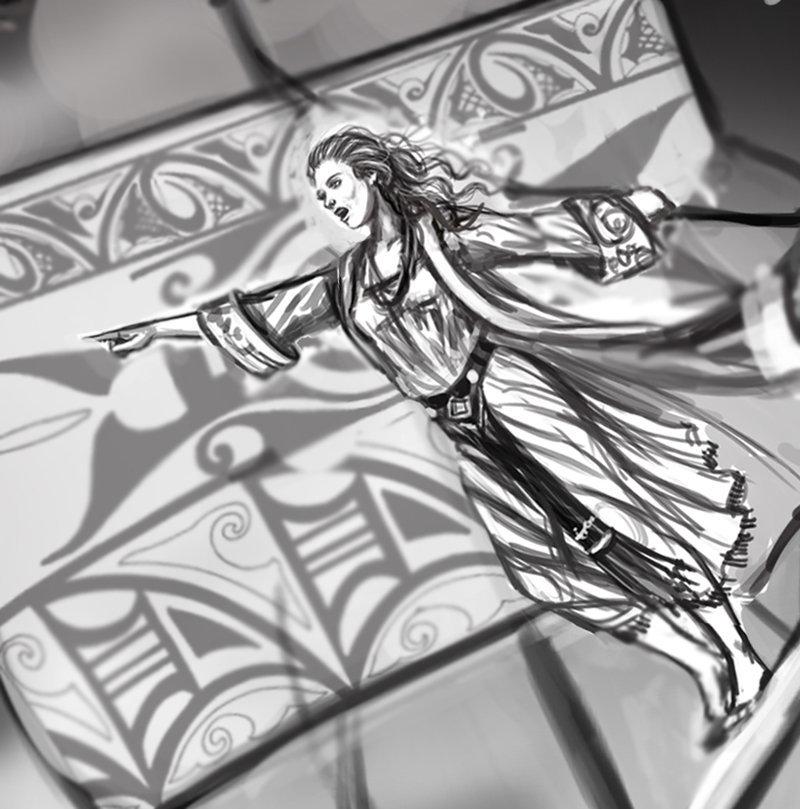
Alesta on the Merian Ship (From LoE Book VII cover, by Carol Phillips)
Though threadbare and impoverished, her star protected her. She wore a belt that allowed her to walk invisibly if she so wished and had beads that shielded her mind from attack.
She eventually ended up on a small outpost overlooking a watery world of evil unknown to the Sisters or the Fleet, hiding right under their noses where the unwary were lured in and killed. It was very dangerous, and should she and her Merian order be discovered by the caretakers of this world, there would be no mercy and no help for them. As always Alesta and the Merians were on their own in a dangerous world.
One day, she saw a star fall, and that was beginning of the end …
copyright 2012, Ren Garcia, Eve Ventrue, Carol Phillips and Kayla Woodside
From the Gates of Hell, the Heade-On-The-Hearth
September 13, 2012
Wherever people have sailed, be it across the seas, over the mountains, or through open space, there have always been tales of lost ships, the ghost ships: The Flying Dutchman, the Mary Celeste, the Edmund Fitzgerald, and on and on.
And so goes the Heade-On-The-Hearth, a warship in the League’s Fleet like many others, she has assumed a unique place in the lore of inter-stellar shipping, the demon ship that comes upon one in the emptiness where there is no help.

The “Heade-On-The-Hearth” by Fantasio
The Heade served for only a short period of time. Shortly after her maiden voyage, she was conscripted into battle with the Xaphan armada at Sorrander-Quo. There, she sustained major damage to her starboard fairing and had to be towed from the theatre. Eventually she was scuttled and left to drift in The Kills region of space. She was removed from the Fleet’s active books.
Several months later, mariners began issuing warning of a pirate ship sailing the deep sea between Kana and Onaris. Witnesses claimed a black Webber ship came at them from nowhere bent on theft and mayhem, a ship missing its starboard faring. Eventually the name of the offending ship reached the ears of the Fleet admiralty: the Heade-On-The-Hearth was doing the pirating. An investigation of The Kills revealed that her hulk was missing. It was later discovered that a band of pirates from Onaris, the Drury Brothers as they were known, had stolen the Heade from The Kills, strapped on a set of old Woburn rocket engines and brought the Heade back to life. The Druries used the Heade to great effect, able to fall on the weak and helpless and flee just before any dispatched to stop them could arrive.
Eventually the Fleet set a trap for the Druries off of Exeter’s Belt (a nebula eventually renamed Druries Belt). The Druries took the bait and, in the ship battle that followed, were sunk by the Fleet after hours of fierce fighting.
So much for the Drury Brothers …
However …

The Heade-On-The-Hearth modified with spotlights and tentacles (by Carol Phillips)
Eventually, the sightings died down, and the Druries and their black ghost ship faded into lore. On the new world of Bazz, they said the Devil had a new assignment for the Druries, to feed his children.
They still say if one dare to venture alone from Kana to Onaris and one wander off the shipping lanes, the Druries will get you.
copyright 2012, Ren Garcia, Fantasio and Carol Phillips
TOTSE: The Pilgrims of Merian
September 2, 2012

Sketch of the cover to LoE Book VII “Against the Druries” featuring a Merian ship attempting to rescue the wreck of the Demophalon John (Carol Phillips)
The chief tenet of their teachings is that the Elders of Old are not gone, only relocated. They believe in the Star of Merian, the astral presence of the Elder Merian thought to be long dead. They say those with clear sight can see the Star of Merian as a great yellow star, easily visible in broad daylight, and that it is wreathed in a twisting red cloud. A prerequisite to joining the order is to be able to see the star.
The Merians travel the countryside by way of floatwagons covered with tarpaulins. They have no known permanent headquarters and make a meager living selling hand-made trinkets and cloth and performing calligraphy (see below). When asked where they come from, the Merians always say “Westwood“, though such a place has never been located. Occasionally, the Merians will stop and settle in one place for a year or two. They often ask the local Lord or Lady permission to settle, and, when granted, build a temporary village called a Hermitage. The estate of Belmont-South Tyrol resides on the grounds of an old Merian Heritage. Though they are impoverished in the extreme, those who enter a Merian Hermitage are welcome to share in anything they have.

“Lady Alesta of Dare and Pilgrim of Merian” by Eve Ventrue
Though threadbare and impoverished, it is said in some quarters that the Merians are much more capable and advanced than they let on. Some say that their belts allow them to pass unseen if they wish, and their beaded necklaces shield the wearer’s mind from attacks and illusion. There is also the various tales that the Merians may travel virtually anywhere they wish at the blink on an eye via an arcane bridge called The Merian’s Road. Xaphan Traders often tell tales of selfless, green-robed people who walk into peril to rescue those in need and that they travel by way of a “Road” wreathed in fog.
Such tales have never been verified and the Merians themselves never speak of such things.
copyright 2012, Ren Garcia, Eve Ventrue and Carol Phillips.
Gencon vs Catholic Bake Sale
August 22, 2012
 Still trying to collect my thoughts from my furious weekend at Gencon in Indianapolis, Indiana.
First of all, what an amazing convention. It was huge, stocked full of cool stuff and interesting characters. I met amazing people, like artist Kayla Woodside, whom I plan on giving a lot of commissions to, and fellow Seventh-Star Saint Georgia L. Jones . I also sold more books there than I ever have at any one convention. Sounds great, right, but … before we get carried away and proclaim the Gencon experience the ultimate an author could ask for, let’s compare it to another fair I recently attended, the affable Stillwater Arts and Crafts Jamboree in Dayton, Ohio (basically, a Catholic bake sale).
Outperformed by 30%
First, the hard numbers. Over four days at Gencon, I sold a total of 64 books. I was able to sell all books in the LOE series, including the usually difficult to sell Book II and the Temple Trilogy which made me very happy. Meanwhile, at Stillwater, I sold 22 books in one afternoon. Comparing the two events, the Catholic bake sale actually out-performed Gencon by 30%–I didn’t sell as many books of course, but I was only there one day for four hours, while I averaged only 16 books a day over four days at Gencon. Just looking at the cold, hard numbers, the Bake Sale took Gencon down, it stands to reason–Gencon was a bewildering kaleidoscope of books, artwork, games, shirts, monsters, costumes and dice. Many people in a daze, walked past my table, smiled, and said “Just looking”. Some, who might have wanted to buy a few of my books, said they couldn’t find me again. There’s also the novelty factor. At Gencon, I was surrounded by artists and other authors while at the Bake Sale I was the only bookseller there amid a sea of oven mitts, aprons, cookies, cakes, doilies and other homemade treasures, the novelty of being an author of a book series was pronounced and a key selling point, while at Gencon it really wasn’t a big deal. One final note–my expenses for Stillwater were virtually nil, amounting to a $25 table fee and a tank of gas to get there, while Gencon carried significant expense.
The Portal to Hell
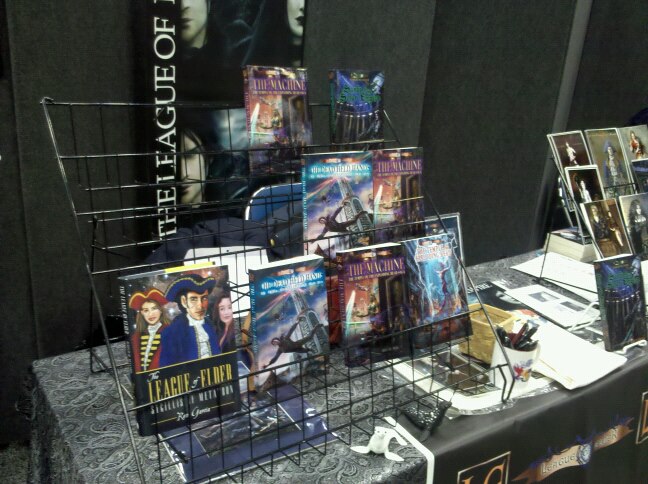
My depleted rack at Gencon as the show concluded
So, next year, I look forward to another outing at Gencon, and I also look forward to another go at Stillwater where vice and all that goes with it makes for great sales.
Bowl Naked
RG
copyright 2012, Ren Garcia
Book VI Around the Corner
July 25, 2012
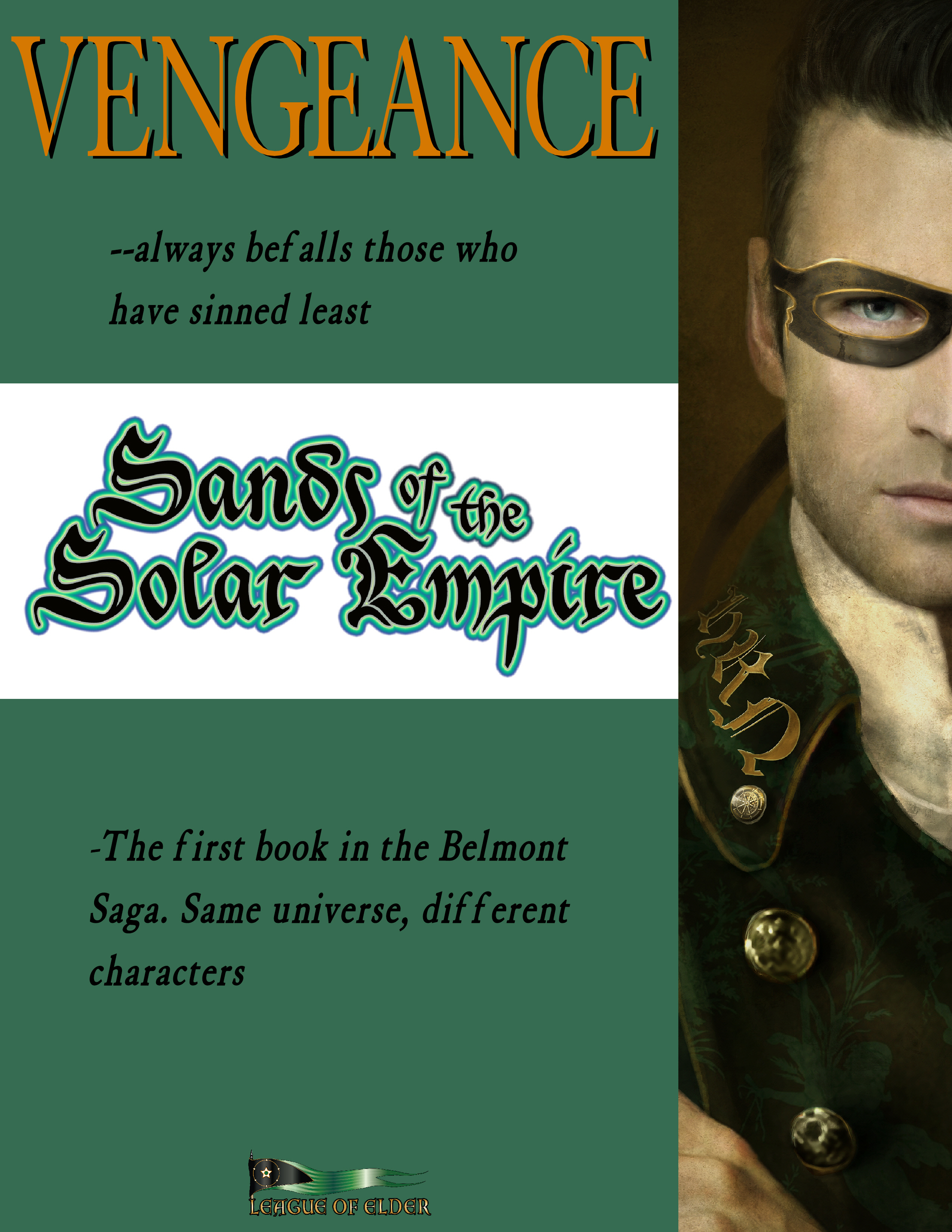 LoE Book VI, The Sands of the Solar Empire, is finally just around the corner in time for the summer convention season. I should have it in my hand in time for Gencon in August. We will also be doing a few free giveaways on Kindle Select, something I’ve not tried before.
Now that the Book is nearly ready, the hard part comes: Marketing. Writing a book is easy, marketing it is hard, and it never ends.We’re going to try a few new avenue this time to get the word out. Most of my past sales are direct POS–conventions, shows, flea markets and other such places where I can set my table up and place my fanny. Of course, we’re going to do the standard Facebook/twitter rounds, and I might even try diving into avenues such as Smashwords. One avenue, though a little expensive, is Publisher’s Weekly. We’re thinking about doing a mass ad from Loconeal advertising a number of upcoming titles.
Oh …. this is so complicated and tiring. I just wanna’ write the books, somebody else do this!!
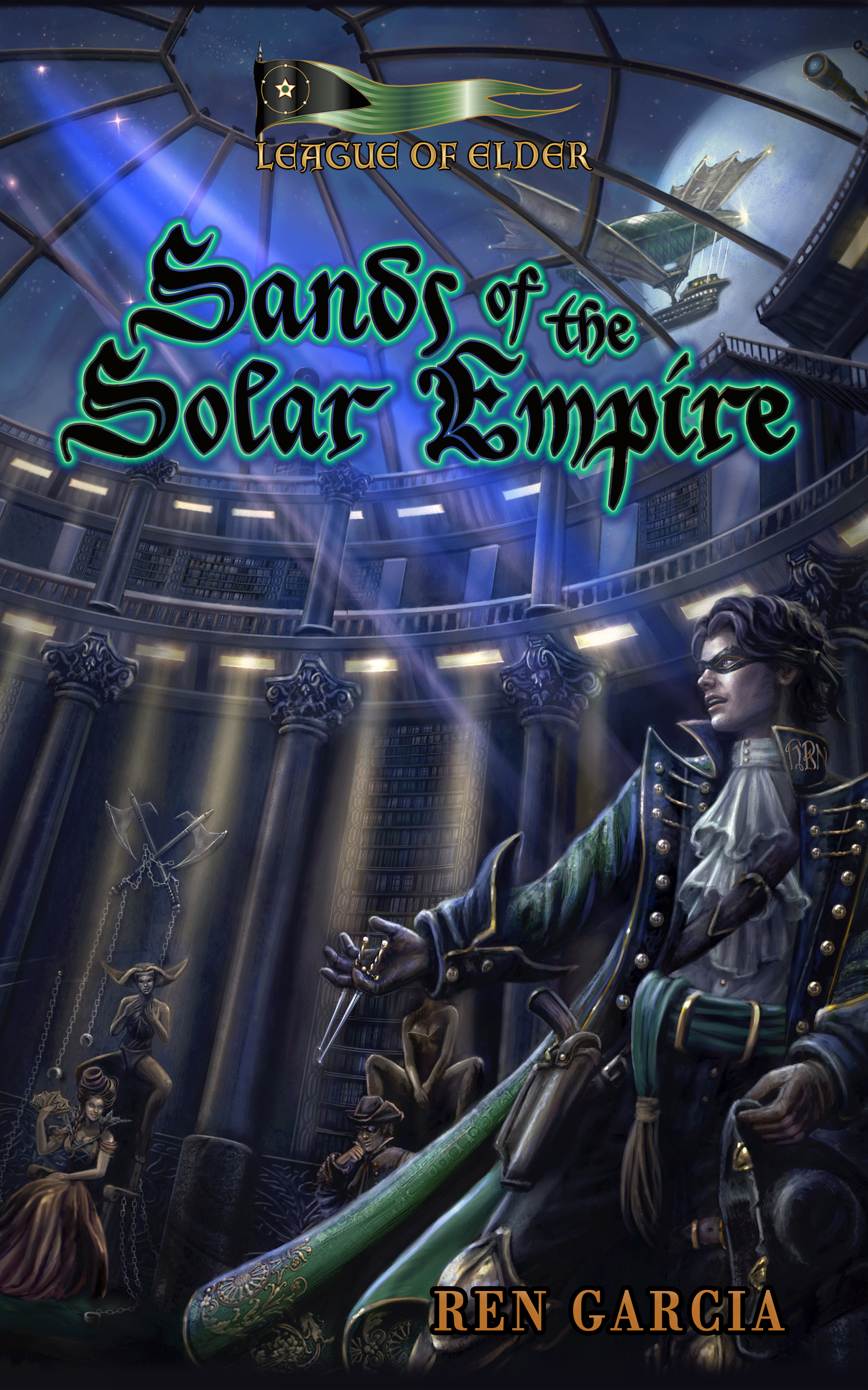 Sands of the Solar Empire from be out August 2012 from Loconeal Publishing.
Bowl Naked
RG
copyright 2012, Ren Garcia
The Fiend of Calvert
July 9, 2012
The mass murderer and psychopath who came to be known as the Fiend of Calvert terrorized the southern portion of Kana for well over thirty years. The Calvertlands of Kana have always been considered the lowest and meanest on the planet and the specter of a mad killer loose amid the crooked streets and seedy wharves wasn’t surprising to both the Sisterhood of Light and the League Ex-Commons–why they assumed such things were common in Calvert.
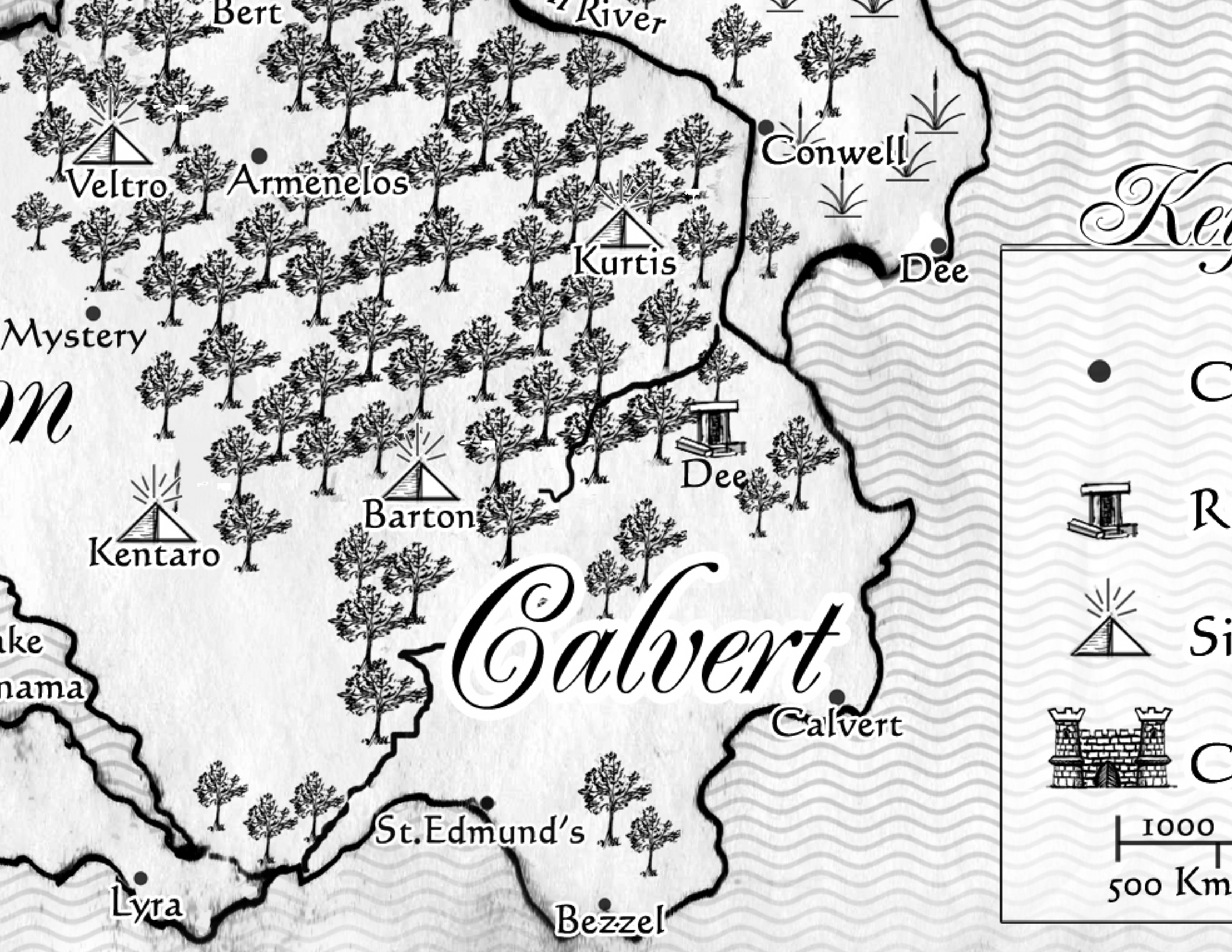
Map of the Calvert region of Kana
Coming of the Fiend
The murders began quietly enough, with various stumblebums and drunken sailors falling victim to the killer, sometimes out in the alleys and docks, sometimes in their modest rented rooms. The usual method of death: strangulation. The occasional death of a bum or sailor wasn’t unheard of in Calvert and not much attention was paid. But then more and more sailors and bums turned up dead, turned up missing. The Night of Unheard Cries in the city of St. Edmunds officially began the hysteria when ten sailors were found strangled to death in various sections of the city. The posts proclaimed: A Fiend Walks The Streets Of Calvert. The faceless killer now had a name.
There were plenty of clues to follow and it was assumed a simple genetic scan would bring the killer’s reign to a swift end. But, while the Fiend left a tantalizing abundance of clues: bits of cloth, shoe prints, partial fingerprints, his genetics were never found, not once in over a hundred murders. Another aspect of the Fiend’s work: he never harmed a single woman in thirty years, only men.
Lord Plaid, one of the Fiend’s more well-known victims
The Spirit of Calvert Dies
When the investigators from Calvert found the case too daunting, they brought in Gifted investigators from the west and the North, from Remnath and Vithland. Even they, however, could not stem the growing tide of death and mayhem and one of them, Lord Plaid, fell victim to the Fiend himself, found strangled to death in his room.
A result of all this was a pronounced change in Calvert. The locals began locking their doors at night, they began walking the streets with eyes down-cast and refusing a strangers’ needs. The greatest victim of the Fiend of Calvert was the spirit of the region itself.

The Mad Lord of Walther eventually put an end to the Fiend’s reign of terror
The City of the Dead
With the Mad Lord’s help, the rate of murders in Calvert plummeted. His presence appeared to hinder the Fiend and kept him in check in the final five years of his reign. The Mad Lord eventually made a key discovery. He located a vault near the Ruins of Woodward where a great many men from Calvert, assumed to be victims of the Fiend, were imprisoned. They seemed to be in a trance of some sort from which they could not be roused, and the posts called the vault the City of the Dead.
Harvesting a trove of clues from the Woodward vault, the Mad Lord successfully engaged the Fiend in St. Edmund’s and defeated him in battle. Wounded, the Fiend fled across the rooftops of St. Edmund’s with the Mad Lord in close pursuit, and he was not seen again.
And so passed the Fiend of Calvert.

Grand Dame Miranda of Rosel is a noted historian on the Fiend of Calvert
The Mad Lord, the man who stopped the Fiend, often wrote about him in his memoirs. The Mad Lord was always known to spin a good tale and his claims regarding the Fiend were particularly spectacular. He claimed that he saw the Fiend not as a man, but as a powerful woman dressed in gray.
None took the Mad Lord too seriously.
See the Fiend of Calvert in LoE Book VI: the Sands of the Solar Empire, coming July 2012
copyright 2012, Ren Garcia and Carol Phillips
SOTSE Characters: Lt. Gwendolyn
June 26, 2012

“Lt. Gwendolyn” by Eve Ventrue
Indeed, Gwen did have a bit of trouble with her temper. Her uncle of the Cone side of the family, Derlith, was fond of his niece and helped her channel her aggressions in constructive ways. He got her into contact sports: boxing, sambo, grappling–all things Zenon-girls was not expected to do. Gwen’s size and solidity helped to excel in those sports and Uncle Derlith took her to compete in tournaments every year on Onaris. She has a slight limp from a broken ankle suffered in one of those tournaments when she refused to submit from a sunk-in ankle-lock. Gwen also, unlike her sisters, mastered the FEDULA, the LosCapricos weapon of the Prentiss Household. She was quite deadly with it.

Lt. Gwendolyn wearing a Fleet Tremblar Uniform (note, the rapier-like FEDULA at her hip) –painting by Eve Ventrue
There was a darkness that seemed to hang over Gwen growing up. She had an aunt on her mother’s Cone side of the family who terrified her. Darkness seemed to walk with the woman, and when she came to Prentiss for a visit, Gwen often hid. Even the lurid sound of her voice scared Gwen. Through the vents in the manor, Gwen could hear her aunt frequently talking about some woman to the east whom she despised and cursed. She even hated her son, a boy named Stenstrom whom she hoped to torment.
And, eventually, her aunt would call for Gwen. “GWENDOLYN… COME HERE!!” rang out in her thoughts. Dreading each step, Gwen would come down the stairs and enter the parlor where her aunt and darkness waited.
copyright 2012, Ren Garcia and Eve Ventrue
 The Temple of the Exploding Head