LoE Characters: Admiral Pax
April 3, 2012
There are lots of characters rolling around in the LoE universe, some are active and part of the various storylines, while others are more passive helping to set the stage.
Admiral Pax is one of those characters.

"Admiral Pax" by Eve Ventrue
Admiral Pax is the Lord of Adrastus, a stately Zenon House perched along the dark blue banks of the Great Blue Pierce river. His family fortune comes from the making of fine cheeses and breads and the fermentation of various types of expensive vinegar. His vinegar production has a Xaphan connection as they are often used in the Xaphan delicacy Ooust. Admiral Pax is often known as “Lord Vinegar” around the Fleet mentioned in giggled whispers.
The Admiral is not an incompetent. He has a fine mind for organization, logistics and battle strategy. His expert placement of Fleet assets during the iconic Battle of Sorrander-Quo helped stem the Xaphan tide and win the day for the League. He is also a tireless fund-raiser and has the ear of the Sisterhood of Light.
The problem with Admiral Pax is his tart, boorish nature. He lords his status over all he considers inferior to himself, which is virtually everybody. He is needy, fussy and maintains an entourage of no less than a hundred people who follow him everywhere he goes. A gregarious man, he often visits various parts of the League and always demands a full War-Bird escort to accompany him at Fleet expense–a ruinously expensive thing. For his excesses Captain Davage has branded him a “criminal” and a “miscreant” and coined the phrase: “Fraud, Waste, Abuse and Admiral Pax”.
At the beginning of Book VI, The Sands of the Solar Empire, Private Taara is assigned to guard a bust of Admiral Pax that is hidden in a lonely alcove as a punishment.
copyright 2012, Ren Garcia and Eve Ventrue
Sands of the Solar Empire Cover
March 25, 2012
At long last, Book VI of the LoE series, The Sands of the Solar Empire is underway. Carol Phillips is beginning work painting the cover and, to me, the cover is the heart of the book and its completion is a huge ceremonial step toward publication.

Sketch for "The Sands of the Solar Empire" by Carol Phillips
The cover depicts a scene from the book where Lord Stenstrom, or “Bel” as he’s known is facing death at the Bones Club, a place where the members openly mock and disparage the Sisterhood of Light (If you look carefully at the chairs in the background, you’ll see several Sisters carved in demeaning positions).
The Sands is the first book in the League of Elder Second Series, where a new slew of characters are introduced.
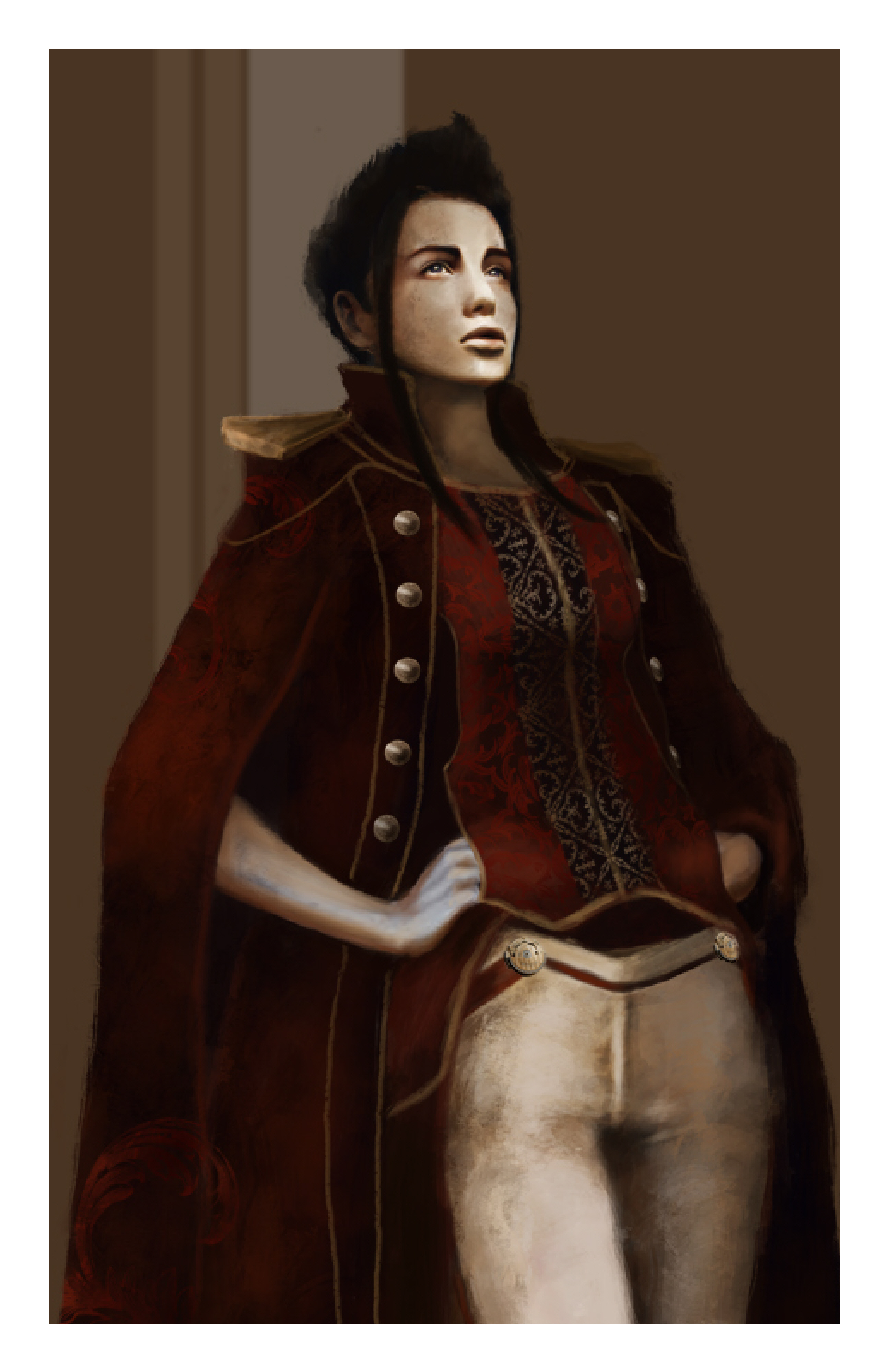
"Taara" by Eve Ventrue (unfinished)
It should take Carol about a month and a half to complete the cover. By then, with luck, most of the interior artwork will be completed. As with previous LoE books, the Sands will be well-appointed with artwork.
It should be a fun ride.
Bowl Naked
RG
copyright 2012, Ren Garcia, Carol Phillips, Eve Ventrue
SOTSE Characters: Lillian of Gamboa
March 14, 2012
Lord Stenstrom of Belmont grew up under the heavy hand of his rather domineering mother. Many times he yearned to be free of her. But, as many young men do (most without knowing it) he selected as his choice of bride a strong-willed and forceful lady very similar to his mother. Lord Stenstrom gave his heart to Lillian of Gamboa, in essence replacing one domineering woman in his life with another.

"Lilly" by Eve Ventrue
Stenstrom was introduced to Lilly by his mother, Lady Jubilee. Always in her son’s business, she searched high and low for a suitable match for him. She had to be of the proper stock, have the proper pedigree and, above all else, she had to be normal and mundane. Given Stenstrom’s training as a Tyrol Sorcerer, it was very important to his mother that he have a mundane, well-grounded wife to counter-balance his forays into the occult. Lilly fit the profile to a tee and Lady Jubilee was very keen on her son taking up with her.
She summoned Lilly to see Stenstrom in the Chalk House on the manor grounds three times. On the first two occasions, Stenstrom refused to see her as he resented his mother’s intrusions. On the third time, however, his mother summoned a demon who was promised his flesh if he didn’t see her. Choosing the Lady over the Demon, Stenstrom met with Lilly in the Chalk House and found, to his surprise, that he liked her.
After that, he was smitten and Lilly grew to control every aspect of his maturing adulthood. She suggested he go to school in Bern. When he was lonely at school, she would always arrive in her coach to cheer him up. She suggested his join the Bones Club. She picked his friends for him. She picked his choice of occupation. She even, eventually, selected his “uniform”, his HRN coat that would become his personal trademark.
And, years later as Stenstrom made his way through space in a powerless, scuttled Seeker thousands of stellar miles from Kana and crawling with demons, who emerged from the lightless bowels of the ship carrying an arcane lantern … Lilly.
Normal, mundane Lilly …
copyright 2012, Ren Garcia and Eve Ventrue
The Process of Cover Creation
February 16, 2012
Now that the Temple Trilogy is out in the world, we continue forward with LoE Book VI: The Sands of the Solar Empire. This is always my favorite time as we knock heads and come up with the design of the book. The manuscript is totally done–finished it about a year and a half ago. Of course as I go through the edited copy I’ll, do doubt, make a few changes here and there, but that’s all minor stuff.
It’s time to get the cover of the book going. The Cover creation goes in a very orderly progression, first from my head, then to Carol Phillips, then to sketch and then to paint.
I thought I’d illustrate the process using Book II, The Hazards of the Old Ones as a template.
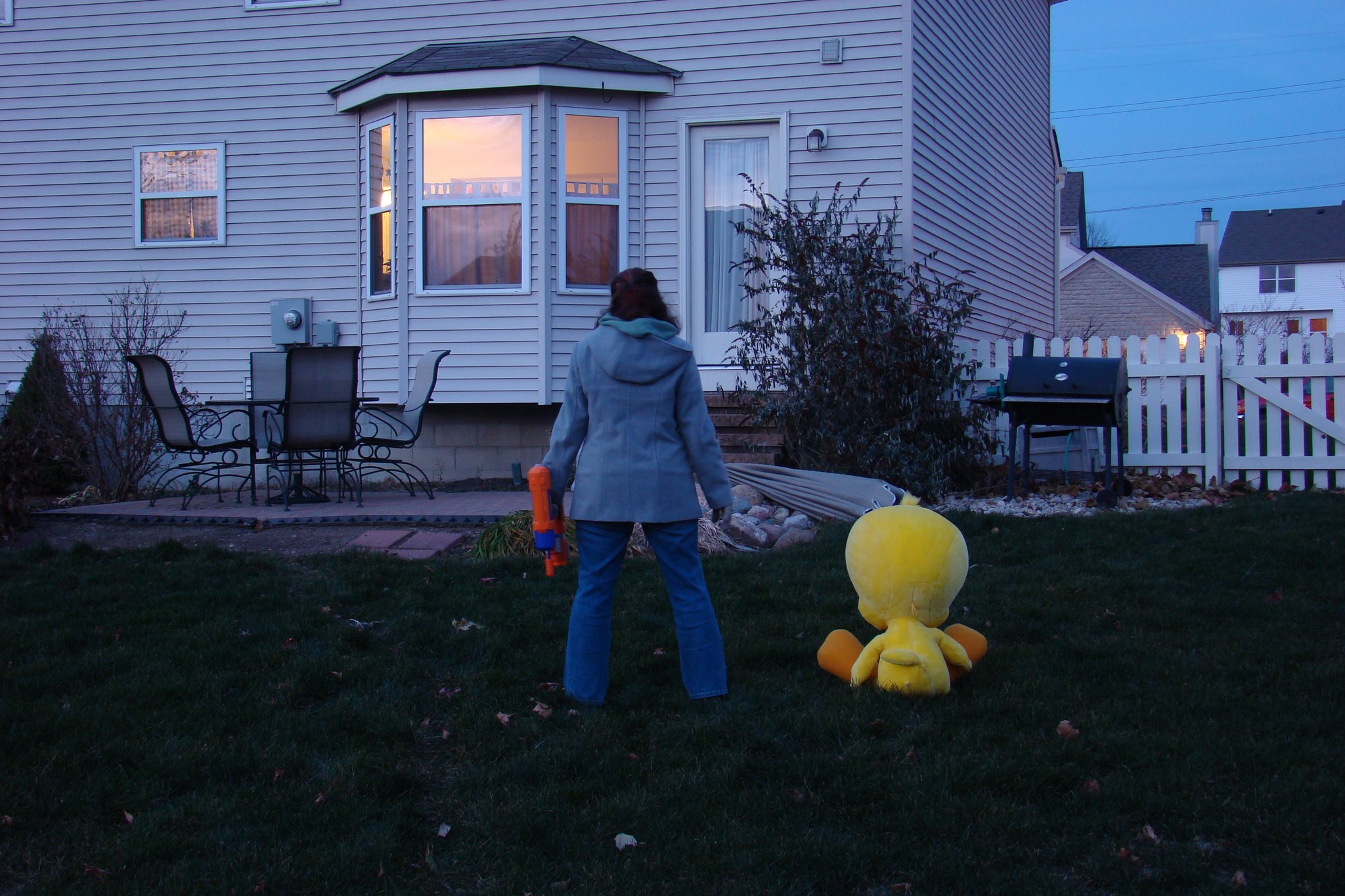 1)–Concept
First I come up with an idea. I usually have several floating around in my head. I then give them to Carol and I let her pick out the ones she’s most interested in painting (you’ve got to keep your artist empowered and excited). In the case of the Hazards, I took a photo of my favorite idea. My wife standing there represents Lt. Kilos, Tweety is Carahil and my house represents the mountains. Usually my ideas are pretty simple and uncluttered–I leave it to Carol to fill up the composition. Note how I imagined the painting from directly behind the characters.
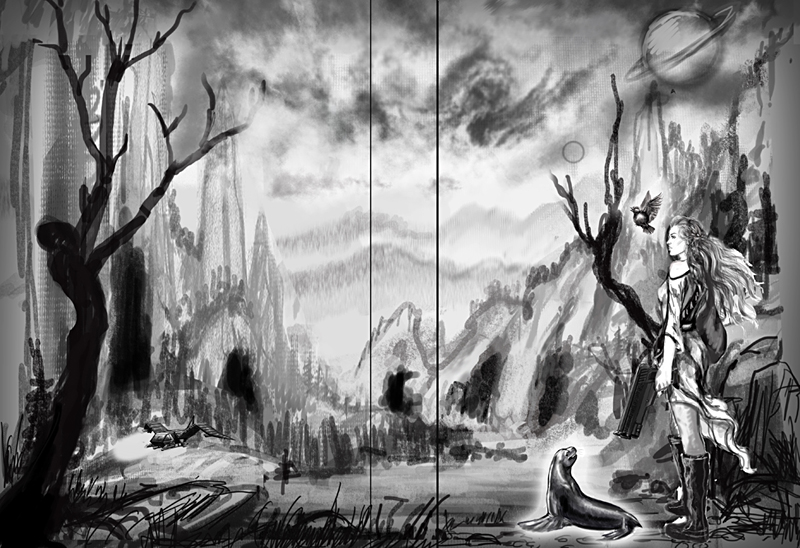 2)–Sketch
Carol then comes up with a series of simple sketches which get progressively more detailed until we come up with a final sketch. I give Carol a fair amount of freedom and her final product is almost always much more elaborate than what I had initially dreamed up. Note how Carol has tilted Lt. Kilos and Carahil so that you can see their faces, she also sketched the Mountains much differently than I had envisioned them. That’s part of the creative process–things never quite turn out exactly as you originally thought they would.
At this stage of the process being small comes into its own. We don’t have a legal department or a Board of Executives or a line of editors waiting to throw their two-cents in–we do what feels right without having to get it past a committee. What you eventually see, for good or ill, is exactly how we intended it to be.
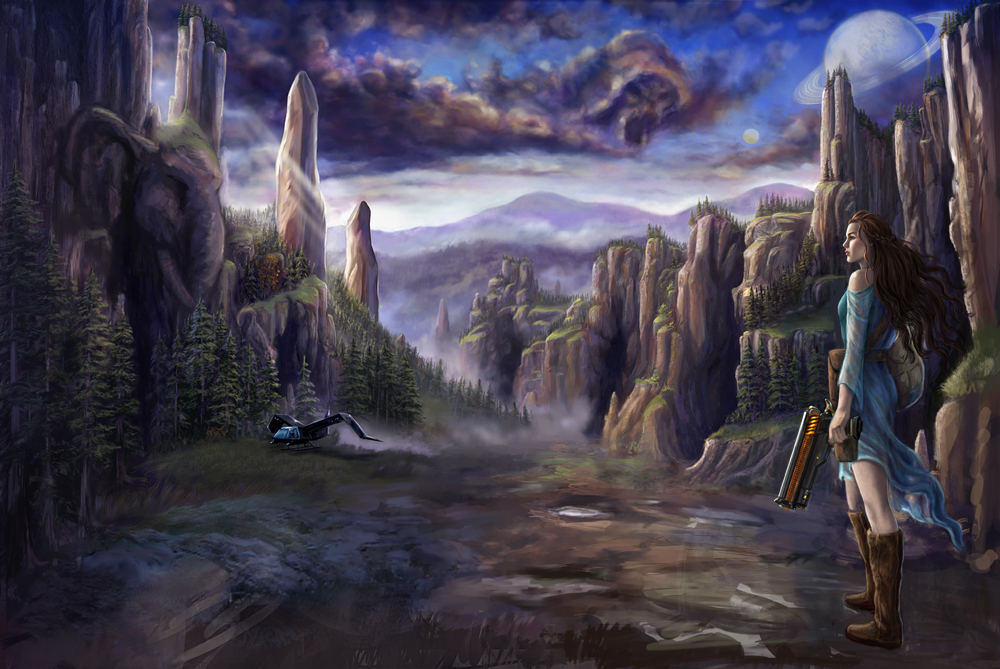 3)–Painting.
This is by far the longest part of the process. Carol Phillips usually takes about two and a half months to complete a cover from end to end. I try to leave her alone during this grueling part of the game, but it’s unbearable sometimes–like waiting for Christmas to roll around. Fortunately, Carol has a lot of patience with me. Note: we always choose to make use of a Wrap Cover, one that goes all the we around from the front, across the spine to the back.
 4–Nixies
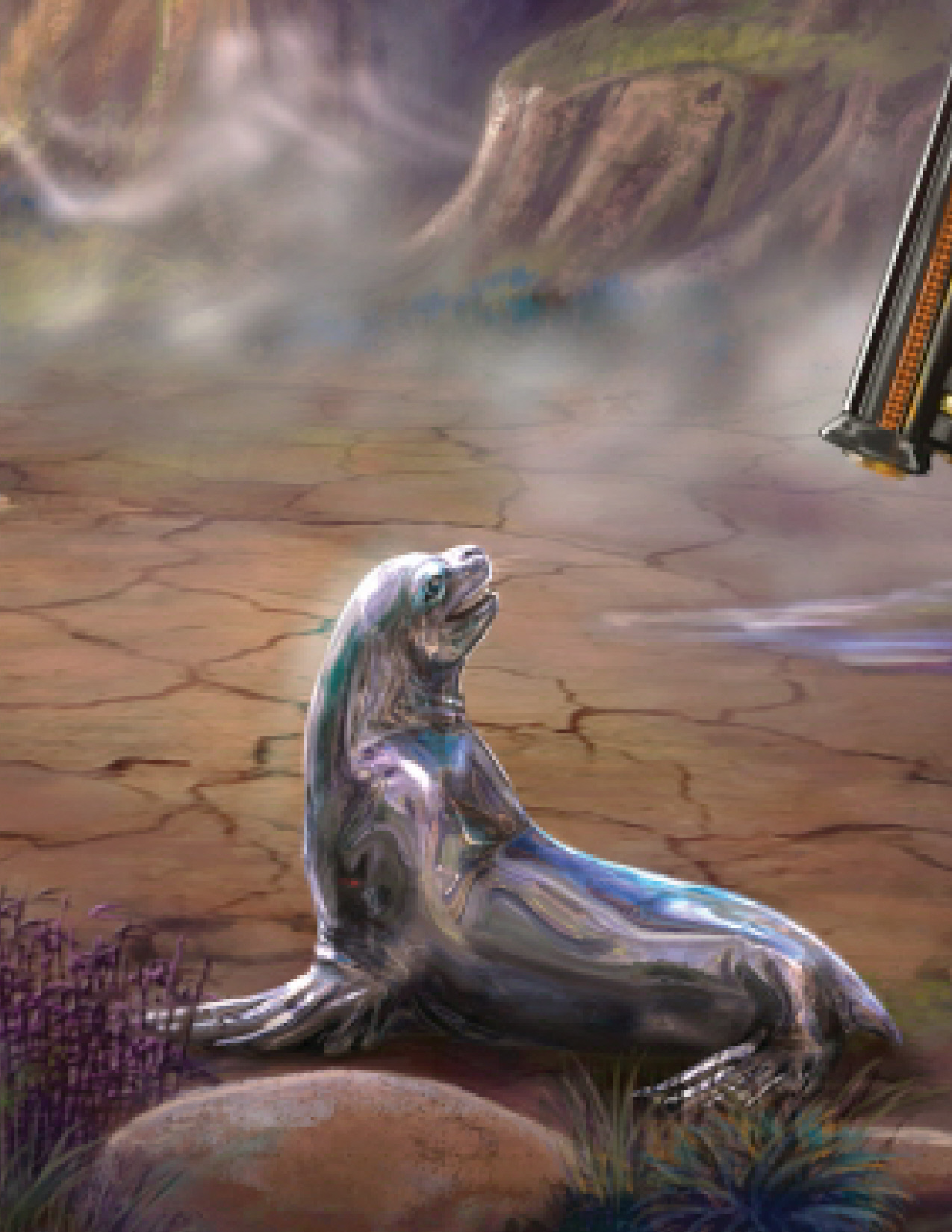
We almost always come up with a few extras that we hadn’t thought of at the outset. I sit there and dream something up, pitch it to Carol and then she adds it in. Often times these Nixies don’t jive with the continuity of the story, but we toss them in anyway because we think they look cool. In this example you can see the reflection of Mabs the Cat Goddess in Carahil’s shiny body. That was a late add-in.
Building the cover is always a labor of love, but the end result is always worth it.
Bowl Naked
RG
copyright 2012, Ren Garcia and Carol Phillips
Nixies and Book 1 Giveaway
January 11, 2012
As production for Book V, the conclusion of the Temple of the Exploding Head trilogy comes to an end and we move on to the League of Elder Second Series, I’m in the mood for giving.
I love giving.
Carol Phillips has the cover lettered, James Barnes, the driving force at Loconeal, just about has the PDF ready (“Stop using TAB, Ren! Everywhere I look, TAB, TAB, TAB!) So, the curtain is about to fall on the Temple Trilogy. The LoE Second Series is just around the Corner.
With that in mind, it’s time for a giveway.
NIXIES:
A “Nixie” is an artistic change that appears on a cover of a book or magazine that is inconsistent with the continuity of the story. Other people might use different names for them, but I use Nixie. You see them a lot on comic book covers–you know, where the villian looks different on the cover than he or she does in the body of the story–usually much more bulked-up, possibly wearing a different costume. They’re there to make the composition of the cover more interesting to the eye regardless if they’re accurate to the story itself or not.
And, we’re no different. We do Nixies when needed. Do `em all the time.

Book I Cover with Nixies
So, to the first two people who can correctly guess one or both Nixies on the cover to Book I, I’ll mail them out a signed hardback copy of Book I along with a few cool extras.
Good Luck
Bowl Naked
RG
copyright 2012, Ren Garcia
TOTEH Artists: Eve Ventrue
January 6, 2012

Eve Ventrue
“She’s great!” the person said.
The name of the young artist in question is Eve Ventrue.
It seems like a long time ago that I first went into her website and marvelled at the gallery of amazing portraits on display. I sent her an email, and I wondered if she would reply–artists often-times don’t. But the next day I had an email sitting in my box written in halting English from Eve.
Since then Eve has been a steady force in the LoE universe, contributing many pics and has been instrumental in defining the look of several characters I’ve dreamed up. I still remember her as a shy young lady lacking only in confidence. Being a German, her English also wasn’t the best and I sometimes had to guess at what she was saying, but, since then Eve has become not only a trusted artist that I can rely on for creating stunning pieces of art, but a dear friend. I’ve watched her grow not only as an artist, but as a person as well (and her English has improved too).
I recently asked Eve a few questions about art and the artistic process.
What is your greatest influence? What artist(s) do you admire most??:
Eve: I admire lots of artists and I like modern digital art as well as the good old Classicism and traditional painters – therfore I would mention William Adolphe Bouguerau, Zdzisław Beksiński, Luis Royo and Kekai Kotaki.

Eve helped define the look of Kay, the Main Character in TOTEH
How many hours a week do you devote to creating digital art?
Eve: Phew, this is difficult. As much as I can, which means about 40 hrs!
What obstacles do you frequently encounter and how do you overcome them?
Eve: The greatest obstacle is me and my self doubts and being short of time. Solving these problems is difficult, but I’ve learned to proceed no matter what, there is no other option, I guess.

This painting of Hannah-Ben Shurlamp is one of my favorite Eve works
In your daily life, where do you see inspiration??
Eve: Everywhere. It can be a tree, a rainy day, faces, a film, computer games or photos. Also music is a great inspiration for me!
Eve is a person on the move. She has written a fantasy book entitled The Venatore Legend that I hope she’ll let me translate into English for her some day.
Her amazing artwork was recently given top billing at Fantasy Inspiration.com:
http://www.facebook.com/l.php?u=http%3A%2F%2Ffantasyinspiration.com%2Fartists%2Frealism-in-fantasy-art-eve-ventrue%2F&h=TAQH5uKNH

Behind all the smoke and paint is a beautiful young woman of boundless talent
A Danish design studio has contracted Eve to do their artwork. Awesome, Eve–that’s my girl!!
To see more of Eve’s amazing artwork visit her website at: http://eve-ventrue.weebly.com
And finally, the most important question of all:
If you were to describe Ren Garcia in one word, what would it be???
Eve: Lovely.
copyright 2012, Ren Garcia and Eve Ventrue
Where is the Temple of the Exploding Head??
December 23, 2011
A fair portion of Book V: “The Temple of the Exploding Head” deals with locating the legendary Temple itself. The place could be literally anywhere on Kana, and, throughout history it has remained rather anonymous. It has defied the few attempts made over the years to uncover it.

Map of Kana
The first mention in Elder lore of the Temple of the Exploding head was in the writings of the berserker Remnath hero Atrajak of Want. Atrajak had fallen in love with an Anuian Monama princess, Tiverlan of Nebulon. Through his dealings with the Monamas, Atrajak discovered Kana was under the eye of a mysterious group of beings who could come and go at will and were hidden sight and sound. The Monamas knew all about them, and when they accepted him as their Sar-Gra-Ma, they told him all they knew. These beings whom Atrajak called The Kestral Oligarchy appeared to be quite hostile and he went on a long series of campaigns called the Hidden Wars where the Kestrals were driven away for a time. However, given their ability to step out of thin air, the Kestrals always returned. Tiverlan of Nebulon told Atrajak about a temple hidden deep in the ground where the Kestrals worshipped a terrible Horned God, and that it was the temple where they gained much of their power over Kana. After the death of his wife, Atrajak sought this temple but was unable to locate it. Eventually, broken and raving mad, he himself was killed when he stormed the Sisterhood stronghold of Twilight 4.
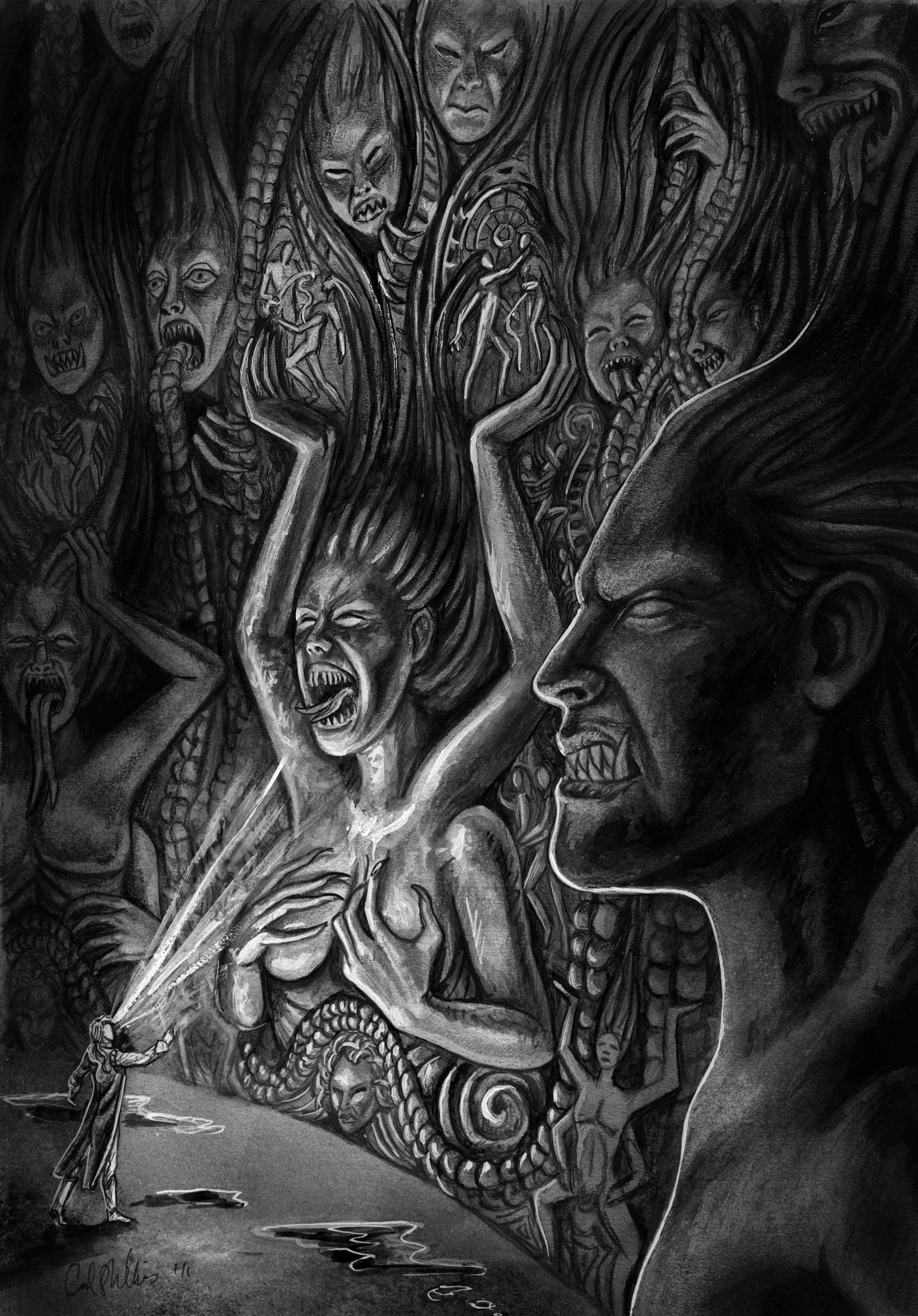
The Cylinder of Ugly Faces--the Entrance to the Temple of the Exploding Head (Carol Phillips)
They had warning, though. All the signs were there and the symptoms were a matter of public record. The occasional scribe wrote of “Bad Dreams” and a pervasive “Taint”, but nobody ever made the connection that the cause of this taint was an actual place hidden from sight.
(Ren Speaks–Though I make a big deal about the “Hidden Location” of the Temple, I pretty much say exactly where it is in one of the previous League of Elder books. There’s really nothing hidden or left to chance about it, it’s there in plain text. If you can tell me what part of what book “spills the beans” I’ll send you the entire LoE series, signed and remarked by the artist Carol Phillips. Done Deal, totally free.)
Bowl Naked
RG
copyright 2011, Ren Garcia and Carol Phillips
The Horned God
December 12, 2011
The Main bad Guy of the Temple of the Exploding Head trilogy is the diabolical Horned God. Although his role in the story has changed much since the first draft, his appearance has always been firm in my mind: A gigantic half man/half deer monster full of lust and fury.

"Kay Faces the Horned God" by Carol Phillips
And then, came 1977 (I think). There was this book at the Hallmark store of all places, sitting on the spinner that I wanted desperately but my folks wouldn’t buy me. I washed cars, mowed lawns, did dishes until I had enough to buy it. The book was the first edition AD&D Monster Manual. I swear I read it cover to cover a dozen times (it’s still sitting in my bookcase to this day).
The scariest monster in the book for me, was the Peryton, a harpy-like monster sporting a stag’s head with a particular taste for human flesh. An amazing thing: though it was a winged, deer-headed monster, it cast the shadow of a man. I thought that was really cool and creepy.
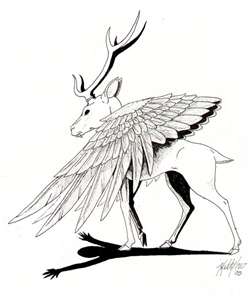
Peryton
When I began the process of envisioning the Horned God, he came together in my mind in two basic forms, one a stag with a towering set of antlers and as a Pan-like hoofed man with an angry deer’s head.
I’m not sure which one give me more shivers.
copyright 2011, Ren Garcia and Carol Phillips
TOTEH Characters: Wilhella Cormand-Grande
August 6, 2011
OF ALL THE DOUR AND RATHER DANGEROUS RANKS OF BLACK HATS, WILHELLA CORMAND-GRANDE OF WAAM IS TRULY UNIQUE.
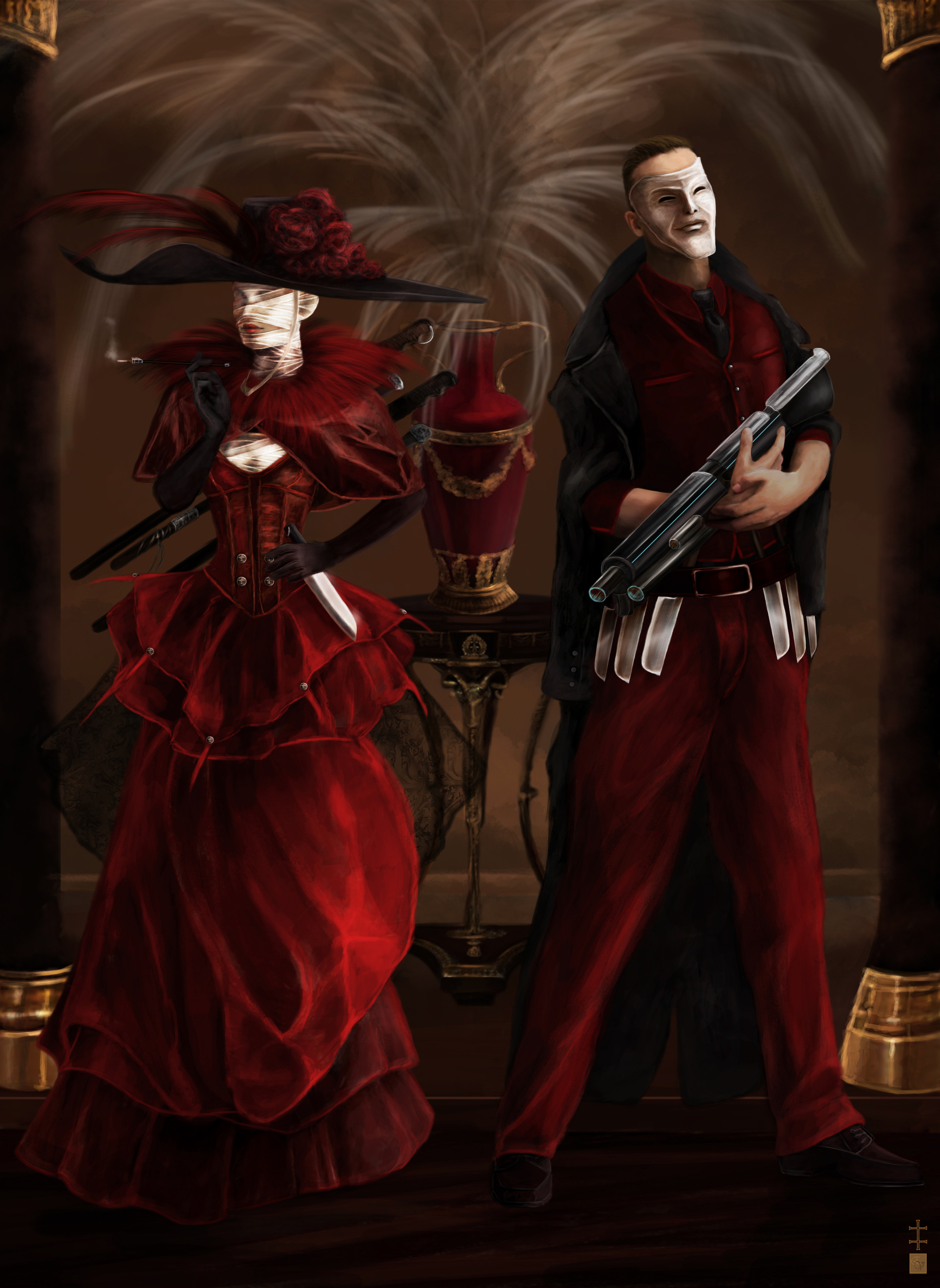
"Wilhella Cormand-Grande and her first husband Scrib Tiffin" by Eve Ventrue
A lover of the bright lights and social scenes of Waam, Wilhella forces her way into the light of day and demands the people there pay her heed. She contributes frequent editorials and other writings to the local media. When she chooses to exit her temple and walk the streets with her Shadow tech entourage she often leaves a trail of dead chefs and mutilated tailors in her wake. She loves good food and fine clothes … and she loves killing people too.
She inhabits a high-rise temple in Waam-Core. Her temple sits squarely in the center of a busy highway, forcing traffic to go around. She often throws lavish parties at her temple and invites guests from all over to attend. It is not wise to refuse an invitation from the Mad Black Hat of Waam.
Wilhella invented a new type of Shadow tech known as a Whamic. A Whamic is a type of Shadow tech that may be transmitted along the skywaves. It is most often associated with junk e-mail messages that come to life, jump out of the holo screen and attack the opener. She eventually refined Whamic to the point where she could send them via hand-written letters as well, where the ink on the page could come to life and kill.
copyright 2011, Ren Garcia and Eve Ventrue
BOOK V Cover Update: Mood and Lighting
July 30, 2011
CAROL PHILLIPS is working away on the horrific cover to Book V, The Temple of the Exploding Head. It’s coming along quite well with the enhanced lighting adding mood and drama to the scene.
As Carol puts it:
Light and shadow is a really important part of creating mood in a painting. It can take a boring painting and make it look really awesome, or if done incorrectly, can make it look flat and dull. I learned early on it was important to pay attention to your various light sources and always keep them in mind while creating your piece. It is a key point in creating a believable environment, character or creature and can make or break your artwork.

"The Temple of the Exploding Head" by Carol Phillips
It’s also important to keep in mind if your light is warm light ( fire/ candle) or cool light (could be found out doors). It is especially challenging when working with both cool and warm light sources on a piece like the Temple, but using warm and cool lights can add a lot of drama and interesting colors to a piece.
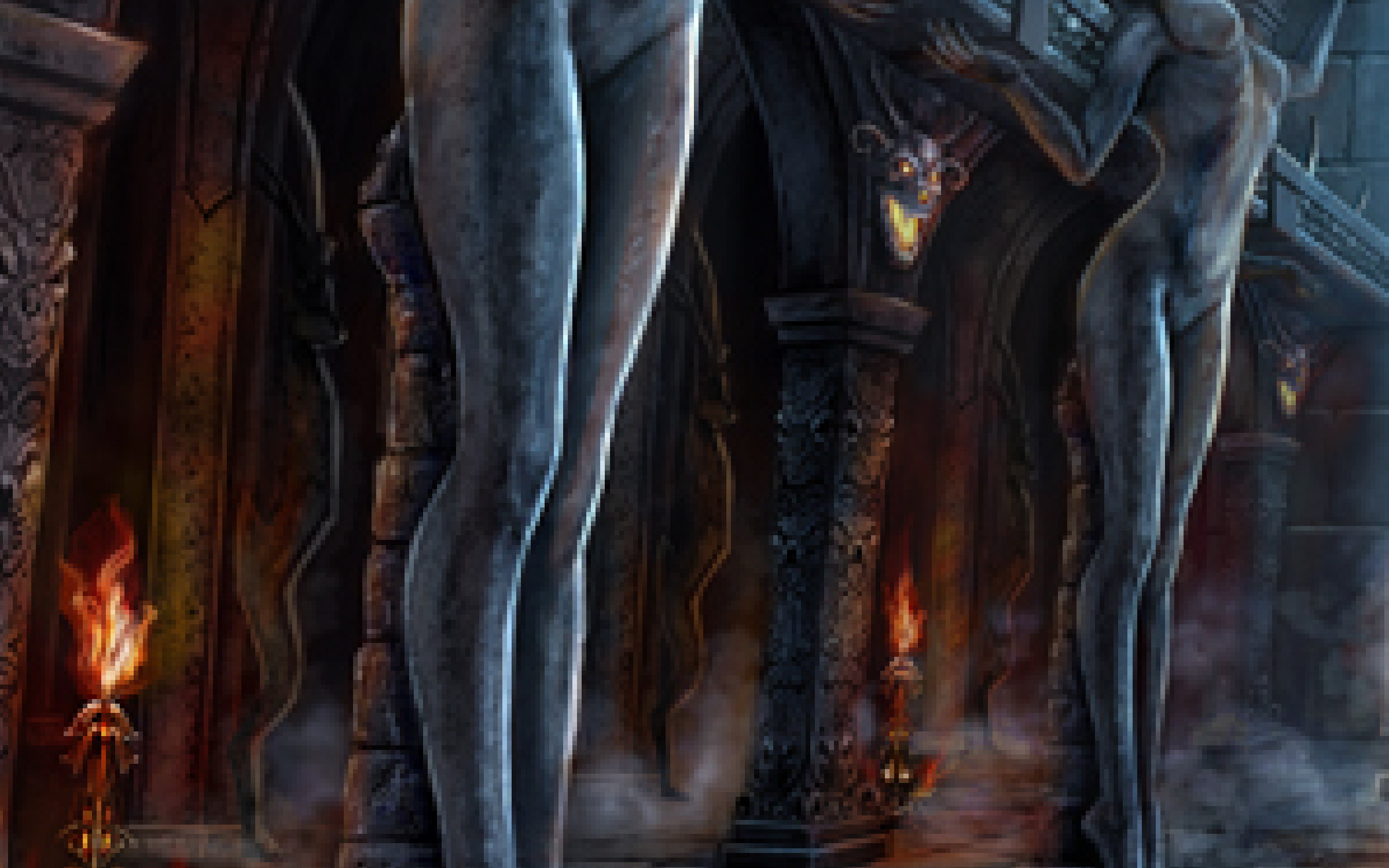 Look how the warm fire light brings out the depth of the Temple, lighting up the back tiers giving the viewer a hint how wide the Temple is, while the cooler lighting provides a sense of loftiness and imposing height. With the lighting in place, you can see what was previously hidden behind the more prominent tiers of statue and pillars. With the orange light, the Temple looks more unsettled, more wild and dangerous, which is the impression the viewer should be getting. I can only imagine what the scene will look like when the character layers are turned on.
 See the difference when only the cool lighting elements are displayed. The Temple looks calm, peaceful even, like a football stadium before the football game starts. Even though the place is festooned with horrific images, the lighting makes it seem at peace. It also loses all of its depth, with the deeper parts of the temple lost in shadow. The Temple seems much taller rather than wide in the cool lighting.
Book V, The Temple of the Exploding Head will be available for purchase November 2011.
copyright 2011, Ren Garcia and Carol Phillips
 The Temple of the Exploding Head